Egon Bahr, Change through Rapprochement and the Indirect Approach
In 1963 the Berlin Wall has stood for almost two years, and West Germany is relying on isolating East Germany. In Tutzing, Egon Bahr proposes the opposite: change not through pressure but through contact. This becomes the foundation of the new Ostpolitik.
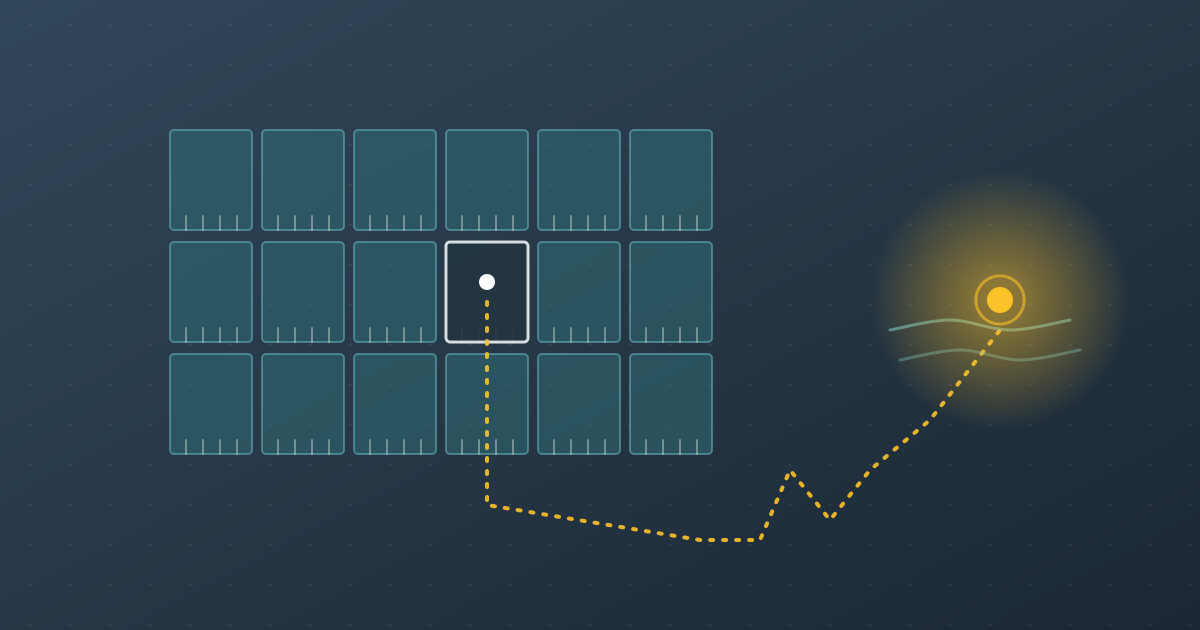
A teal dot bounces three times off a mist-blue line, and the line grows thicker with each thrust. The picture widens, the line reveals an open end, and the dot travels around it as a golden arc to the target circle, which lights up in gold.
Principle #31
Indirect Approach: Instead of charging against the other side’s strength, you go around it and choose the path they least expect.
4 min read5 sectionsSituationLink to the principle
Contents
In the early 1960s, the situation in Germany is deadlocked. West Germany does not recognize East Germany (the GDR), and under the Hallstein Doctrine it breaks off relations with states that do. The Wall separates families in Berlin. The direct route, pressure and isolation, has not loosened the division but hardened it. In this situation, Egon Bahr looks for another way – an example of the Indirect Approach.
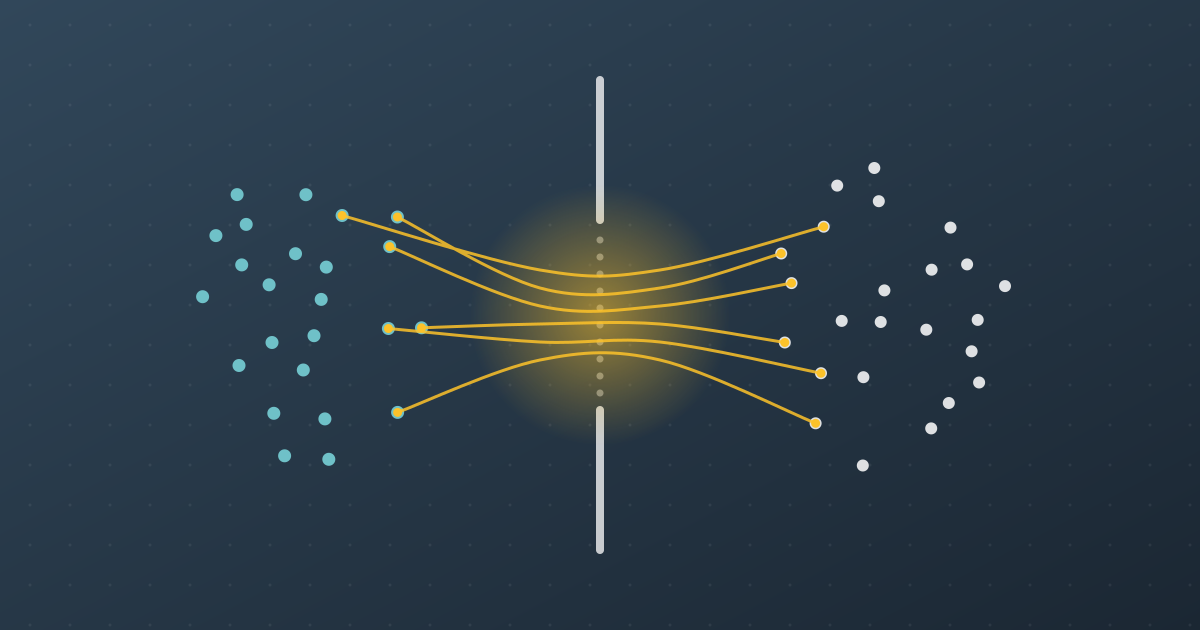
A hard dividing line becomes permeable in the middle, and fine golden threads connect the two groups – as with Egon Bahr’s “change through rapprochement.”
01
A deadlocked front
Situation
On August 13, 1961, construction of the Berlin Wall begins. The Western powers protest but do not intervene. Willy Brandt is Governing Mayor of West Berlin; Egon Bahr heads the Berlin press and information office and speaks for the city’s government, the Senate. On June 10, 1963, U.S. President John F. Kennedy gives a speech on a strategy of peace aimed at détente with the Soviet Union.
Link to the principle
East Germany and the Soviet Union are strongest exactly where the West is pushing: they hold the border by force. A frontal attack on this position is out of the question. If you want to change something, you have to find a different way in.
02
The speech in Tutzing
Situation
On July 15, 1963, Willy Brandt and Egon Bahr speak at the Protestant Academy in Tutzing. Bahr interprets the Wall as an expression of the communist regime’s fear for its own survival. If this fear were reduced, he reasons, a loosening of the border would also become possible. He sums this up in a formula: Wandel durch Annäherung, change through rapprochement. In doing so, he invokes the strategy of peace that Kennedy had presented a few weeks earlier.
Link to the principle
Bahr does not attack the opponent’s position. He starts with its motive, the fear for its own security. He wants to accept the status quo for now in order to change it in the long run. This is the indirect approach in politics: not through the wall but around it.
03
Resistance in his own camp
Situation
The concept contradicts official policy. The governing Christian Democrats (CDU) criticize it as a softening, and it also meets criticism in parts of the Social Democrats (SPD). At first the federal government does not change course. But that same year, 1963, the Berlin Senate negotiates with East Germany and reaches a border pass agreement: West Berliners may visit relatives in the eastern part of the city over Christmas and New Year.
Link to the principle
The indirect route first works on a small scale. A border pass does not solve the German question. But it shows that contact is possible, and it brings people together. Small steps build trust where big demands only trigger defensiveness.
04
From formula to policy
Situation
In 1969, Willy Brandt becomes chancellor, and Bahr becomes his most important negotiator. Then come the Treaty of Moscow (August 12, 1970) and the Treaty of Warsaw (December 7, 1970), in which West Germany recognizes the existing borders. The Four Power Agreement on Berlin (September 3, 1971) secures access to West Berlin. With Michael Kohl of East Germany, Bahr negotiates the Transit Agreement (December 17, 1971) and the Basic Treaty (December 21, 1972). In 1971, Brandt receives the Nobel Peace Prize.
Link to the principle
The detour through recognition and treaties leads to more contact between East and West than two decades of isolation had achieved. Even so, West Germany does not recognize East Germany under international law. It keeps German unity open as an objective and simply chooses a different route to it.
05
Disputed to this day
Situation
The Eastern treaties are fiercely contested when they are ratified. The CDU/CSU fears that they will cement the division. After reunification in 1990, many see the policy of détente as having paved the way. Others stress the pressure from the opposition in Eastern Europe and the arms race. Since Russia’s attack on Ukraine in 2022, there has also been debate over whether the hope for change through contact with Russia was held on to for too long.
Link to the principle
The indirect approach is no cure-all. It works when the opponent can actually be changed through contact. Where that does not happen, the detour becomes a dead end. You have to check whether the assumption behind your detour still holds.
Key takeaways
Key lessons
01
When the front is deadlocked, ask about the other side’s motive, not just its position.
02
Sometimes you have to accept what is in order to be able to change it.
03
Start with small steps that build trust.
04
Be prepared for resistance to the detour in your own camp.
05
Keep checking whether the assumption behind your approach still holds.
Summary
After the Wall was built, the German question was deadlocked. In 1963 in Tutzing, Egon Bahr proposed changing the division not through pressure but through rapprochement. What began as a controversial formula became, under Willy Brandt, the new Ostpolitik, with border passes, the Eastern treaties and the Basic Treaty. The example shows the power of the Indirect Approach in politics, and the debate after 2022 shows its limit.