In 1998, the U.S. government sues Microsoft. The court finds that Windows is protected by a wall of tens of thousands of programs. Users stay because the programs exist, and developers write programs because the users exist.
A single dot, then a second, connected by a line; with every new dot many lines are added, a gold arc rises more and more steeply, and a smaller mist-blue network empties toward the large one. A frame of teal lines encloses the large network, then a gap opens in it, and groups of connected dots move into a new network.
Principle #77
Network Effects: An offering that becomes more valuable with every user attracts more users, and the more it costs to switch, the more firmly they stay; but the same force can also empty a network in the opposite direction.
3 min read5 sectionsSituationLink to the principle
Contents
Network effects are not just a topic for textbooks. In the antitrust case United States v. Microsoft, a court described them step by step at the end of the 1990s. Its findings of fact read like a manual on how a monopoly arises from Network Effects and switching costs, and how it is defended.
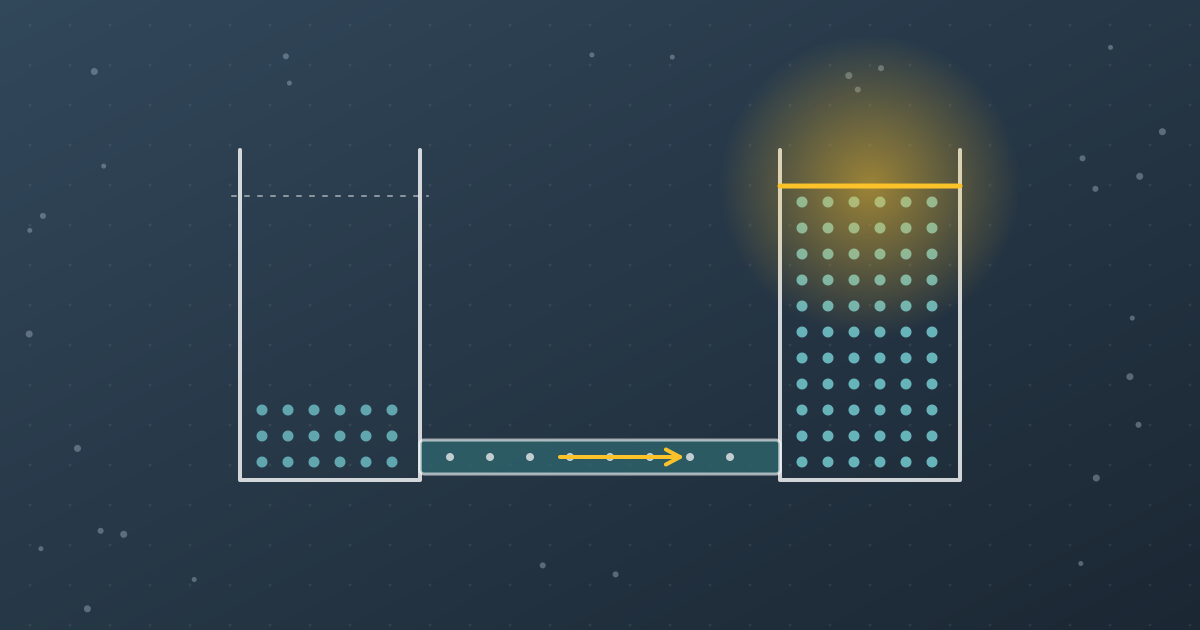
A gold frame full of users, in front of it a high wall of programs, outside a single dot – as in the Microsoft case.
01
The lawsuit
Situation
On May 18, 1998, the U.S. Department of Justice and 20 states sue Microsoft for abusing its market power. Microsoft denies the allegations. The trial runs from October 19, 1998, to June 24, 1999. On November 5, 1999, Judge Thomas Penfield Jackson publishes his Findings of Fact.
Link to the principle
An antitrust court has to explain why a company holds a monopoly position and why others cannot simply attack it. In the Microsoft case, the answer is network effects.
02
The chicken-and-egg problem
Situation
The court finds that Microsoft’s share of the worldwide market for operating systems on Intel-compatible PCs has been above 90% for a decade, and at least 95% in recent years. It describes a chicken-and-egg problem: users do not choose an operating system for which there are few good programs. Developers do not write programs for an operating system with few users.
Link to the principle
This is an indirect network effect. Windows does not become more valuable to users because other users have it, but because many users attract many developers, and many programs in turn attract more users. The loop reinforces itself.
03
The wall of applications
Situation
The court calls this the “applications barrier to entry.” According to its findings, Windows supports more than 70,000 applications. A competitor would have to offer a comparable selection to win over customers. That, the court says, would be prohibitively expensive. On top of that, every developer waits until others have committed.
Link to the principle
This is where the network effect turns into lock-in. For the individual user, switching would be expensive: buying programs again, converting files, learning anew. For the market as a whole, the wall is even higher, because no challenger can attract enough programs.
04
IBM’s attempt
Situation
The court cites an example. IBM spends tens of millions of dollars to win developers for its OS/2 Warp operating system. At its peak, about 2,500 applications run on it, and its market share is around 10%. In 1996, IBM gives up the fight against Windows and retreats to a niche of business customers.
Link to the principle
Even a global corporation with money and technology can hardly prevail against an established network effect. If you come too late, you don’t just have to build a good product; you have to create an entire ecosystem out of nothing.
05
The threat and the defense
Situation
Two developments were dangerous for Microsoft: the Netscape Navigator web browser and Sun’s Java programming language. Both would have made it possible to write programs independently of the operating system. The court finds that Microsoft deliberately acted against both. In June 2000, Judge Jackson orders Microsoft to be broken up. An appeals court overturns this in June 2001 but upholds the finding that Microsoft unlawfully maintained its monopoly. In November 2001, the government and Microsoft reach a settlement.
Link to the principle
Network effects are only as strong as the barrier that protects them. If a new platform decouples programs from the operating system, the lock-in falls. Microsoft knew this and defended the wall. The appeals court confirmed that it had acted unlawfully in doing so.
Key takeaways
Key lessons
01
Ask whether your offering attracts people who in turn attract others.
02
Lock-in arises where your customers have invested time, data and habits.
03
Don’t underestimate how expensive it is to take on an existing network.
04
Watch for anything that could loosen people’s ties to you.
05
Defend your position with performance, not with means that land you in court.
Summary
In the antitrust case against Microsoft, Judge Thomas Penfield Jackson found in 1999 that Windows was protected by an “applications barrier to entry”: more than 70,000 programs that tied users to it, and many users who tied developers to it. Even IBM failed against it with OS/2. Microsoft defended this wall against Netscape and Java, and in 2001 the appeals court confirmed that it had unlawfully maintained its monopoly. The case shows network effects and lock-in in their purest form.