Otto von Bismarck, the Reinsurance Treaty and the Six Measures
In 1887, the German Empire is allied with Austria-Hungary. Nevertheless, Chancellor Otto von Bismarck secretly concludes a treaty with Russia, Austria’s rival. The double game is meant to prevent Russia from allying itself with France. After Bismarck’s fall in 1890, the treaty is not renewed, and the situation turns.
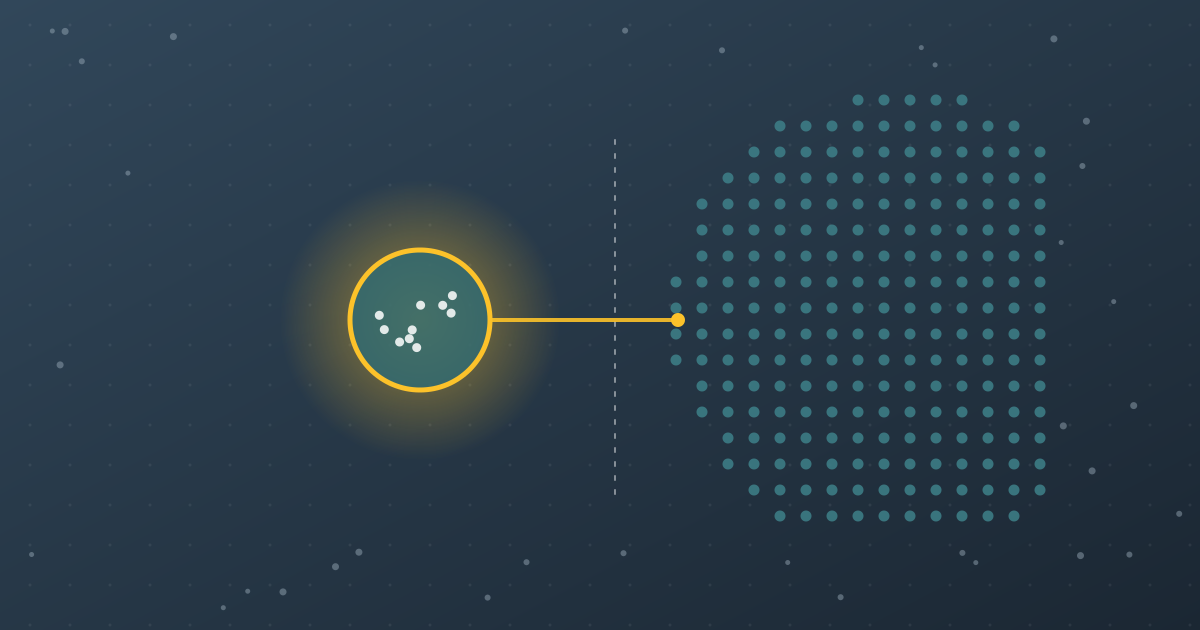
A balance made of fine lines holds a golden circle on the left and a teal one on the right; beneath it lies a disk with six fields of simple signs made of dots, lines, arcs and frames. When the balance tips, the disk turns and clicks into place at the matching field, which lights up in gold while the other fields stay teal and mist-blue.
Principle #59
Six Measures: Whether peace, war, staying put, marching, seeking shelter or a double policy is right depends on the balance of strength, not on your wishes.
4 min read5 sectionsSituationLink to the principle
Contents
Among the Six Measures of the Arthashastra, the double policy is the most delicate. It means keeping the peace with one party and waging war against another. Kautilya recommends it when you need help to achieve a goal. In the 19th century, Otto von Bismarck pursued a diplomatic variant of it: he waged no war, but he played on two sides at once.
A dot keeps five balls in the air in an arc, and a hidden golden line connects two of them – like Bismarck with the Reinsurance Treaty.
01
The fear of two fronts
Situation
Founded in 1871, the German Empire lay in the middle of Europe. To the west stood France, which had not gotten over the loss of Alsace-Lorraine. To the east lay Russia. Bismarck feared nothing so much as an alliance between these two that would force Germany into a two-front war. In 1879, he concluded the Dual Alliance with Austria-Hungary, a defensive alliance aimed above all at Russia. With the League of the Three Emperors of 1881, renewed in 1884, he also bound Russia to his side.
Link to the principle
Bismarck’s situation did not call for a simple measure. War against France or Russia would have been a risk. Seeking shelter with just one side would have driven the other into the arms of France. He needed several partners at once, including some who mistrusted each other.
02
A rift between the partners
Situation
In the Bulgarian crisis that began in 1885, Austria-Hungary and Russia clashed over influence in the Balkans. The League of the Three Emperors expired in 1887, and renewing it among all three was no longer possible.
Link to the principle
Now the very thing Bismarck had wanted to prevent loomed: Russia would look around for a new partner, and the most obvious one was France. The measure had to adapt to the new situation.
03
The secret treaty
Situation
On June 18, 1887, Herbert von Bismarck, state secretary at the Foreign Office, and the Russian ambassador, Count Pavel Shuvalov, signed the Reinsurance Treaty in Berlin. Each side promised the other benevolent neutrality if one of them found itself at war with a third great power. This did not apply to a war against Austria-Hungary or France that one of the two contracting parties itself started by attacking. Germany recognized Russia’s predominant influence in Bulgaria. In a secret additional protocol, Germany promised Russia benevolent neutrality as well as moral and diplomatic support if Russia had to defend access to the Black Sea. The treaty ran for three years and was strictly secret.
Link to the principle
This is the double policy. Germany remains allied with Austria but promises Russia not to take part in an Austrian attack. Each partner gets security against an attack by the other. At the same time, Russia stays bound and does not turn to France.
04
The tension in the system
Situation
The additional protocol in particular was hard to reconcile with Germany’s other alliances: the Dual Alliance with Austria-Hungary and the Triple Alliance, which also included Italy. The source sees this as a sign of how desperately Bismarck wanted to hold his alliance system together.
Link to the principle
The double game works only as long as one person holds all the threads and keeps track of everything. It is demanding, and it is vulnerable. If it becomes known or the player changes, the partners lose trust.
05
The end of the reinsurance
Situation
In March 1890, Bismarck was dismissed. The new government under Leo von Caprivi rejected the Russian offer to renew the treaty. It expired at the end of June 1890. In the years that followed, Russia and France drew closer and concluded an alliance between 1892 and 1894.
Link to the principle
Bismarck’s successors considered the double game too complicated and incompatible with the other alliances. But they did not replace it with any other suitable measure. Whether the treaty would have prevented the alliance between Russia and France in the long run is disputed among historians. What is certain is that Germany now had potential opponents in the west and the east who were allied with each other.
Key takeaways
Key lessons
01
Choose your measure according to the danger you need to prevent.
02
A double game can bind rivals at the same time, but it is fragile.
03
If you play on two sides, you need to keep track of everything and stay discreet.
04
Don’t abandon a difficult measure without having a better one.
05
Check whether your system depends on a single person.
Summary
Otto von Bismarck wanted to prevent a two-front war. When the League of the Three Emperors broke apart, he secretly reinsured himself with Russia in 1887, even though Germany was allied with Austria-Hungary. The double game kept Russia away from France. After Bismarck’s fall, his successors let the treaty expire, and Russia and France came together. The example shows what the double game can achieve and how fragile it is.