Reed Hastings, Netflix and the Principle of Exploration and Exploitation
In January 2007, Netflix launches streaming while its DVD-by-mail business is still growing. The company explores the new with the money from the old and builds both side by side for a while.
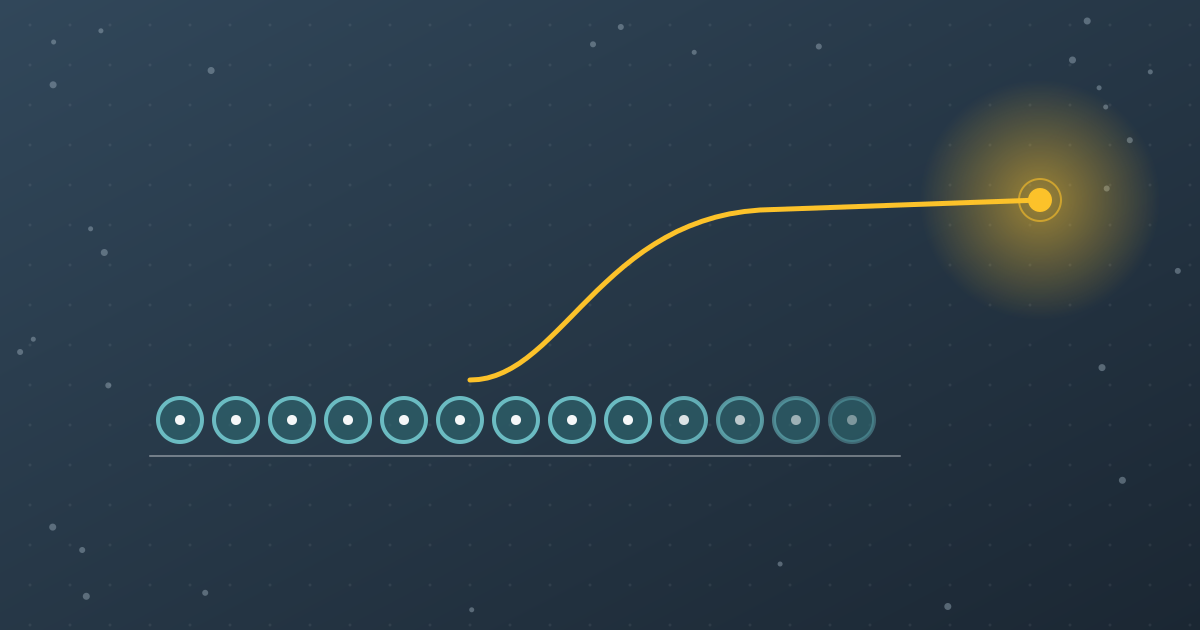
A scale made of lines: on the left a circle of many teal dots, on the right a small gold cone of light pointing into a mist-blue space. Almost all the new dots fall into the circle until its dots fade; then some deliberately move to the cone of light, a line opens into the dark toward a new circle, and the scale settles.
Principle #79
Exploration and Exploitation: If you only exploit what you have, you lose the future, and if you only search for the new, you lose the present; good strategy deliberately keeps both in balance.
4 min read5 sectionsSituationLink to the principle
Contents
Many companies see their future coming and wait until the old business no longer carries them. By then, the money for the switch is gone. Netflix did it the other way around. The company started on the new while the old was still doing well. The road was not smooth, and it is precisely the stumbling blocks that show how hard it is to run both at once – an example of the Principle of Exploration and Exploitation.
A row of discs keeps running and slowly fades; from its middle, a gold line rises and pulls away – as at Netflix.
01
A name that sets the course
Situation
Starting in 1999, Netflix rents out DVDs by mail on a subscription basis. By 2007, the catalog has grown to more than 70,000 titles, and the company calls itself the world’s largest online movie rental service. When announcing streaming in 2007, co-founder Reed Hastings explains that the name was chosen in 1998 because they believed the future of movie rental lay on the internet: first as a better service, then as a way to deliver the movies themselves.
Link to the principle
The DVD business was exploitation: logistics, recommendations, subscriptions, improved year after year. Streaming had been part of the plan from the start. The balance between the two was therefore no accident but part of the intention.
02
January 2007: streaming as an extra
Situation
On January 16, 2007, Netflix announces that subscribers can watch movies and TV shows instantly on their PCs. At launch, there are about 1,000 titles. Depending on the plan, 6 to 18 hours a month are included at no extra charge. The DVDs keep coming by mail. Hastings himself says that, because of content and technology, it will be years before watching online becomes the norm.
Link to the principle
This is what exploration looks like when it is set up wisely. The stakes are limited, customers pay nothing extra, and the core business is not put at risk. Netflix learns how customers stream, which titles they watch and what technology is needed. The old finances learning about the new.
03
Two businesses side by side
Situation
In the following years, the streaming service grows. Netflix brings its service to game consoles, TVs and other devices and in 2010 introduces a streaming-only plan in the United States. The DVD business continues in parallel.
Link to the principle
Running two businesses with different logics side by side is exhausting. One requires warehouses and postage; the other, servers and licenses. The researchers Charles A. O’Reilly III and Michael L. Tushman call the ability to do this ambidexterity. It means taking both seriously without one smothering the other.
04
The 2011 misstep
Situation
In July 2011, Netflix announces that it will separate the prices for DVDs and streaming. Customers who use both pay up to 60% more. In September, Hastings publicly apologizes for the way the change was handled and at the same time announces that the DVD business will be spun off under the new name Qwikster. Customers push back. In the third quarter of 2011, Netflix loses about 800,000 subscribers in the United States. In October, the company reverses the spin-off.
Link to the principle
This shows how fine the line is. If you give up the old too slowly, you miss the future. If you shed it too quickly, you alienate the customers who are carrying you today. The transition itself is a leadership task, not just the decision for the new.
05
The end of exploitation
Situation
Starting in 2013, with original series such as “House of Cards,” Netflix takes another step into new territory: from distributor to producer. The DVD business shrinks and is shut down at the end of September 2023, more than 16 years after streaming was launched.
Link to the principle
For a long time, the DVD was a source of money, then a bridge and finally a business being phased out. That Netflix kept it for so long was not hesitation but part of the balance. It also shows that exploration never stops. Hardly had streaming become the new core business when the next round of exploration began.
Key takeaways
Key lessons
01
Start the new while the old is still making money.
02
Keep the stakes small at first and learn fast.
03
Run the old and the new business according to their own logic.
04
Plan the transition for your customers, not just for your numbers.
05
Be prepared for every new core business to require exploration in turn.
Summary
Netflix started streaming in 2007, while its DVD-by-mail business was still growing. The old business financed learning about the new one, and the two ran side by side for years. The Qwikster misstep in 2011 shows how delicate the transition is. In the end came a new core business and the insight that the balance between exploration and exploitation is never finished.