Andrew Grove, Intel and the Concentration of Force
In the mid-1980s, Intel loses the battle for memory chips, the very business that made the company big. Andrew Grove and Gordon Moore get out and concentrate all their forces on microprocessors. This sets off the company’s rise to become the world’s leading chipmaker.
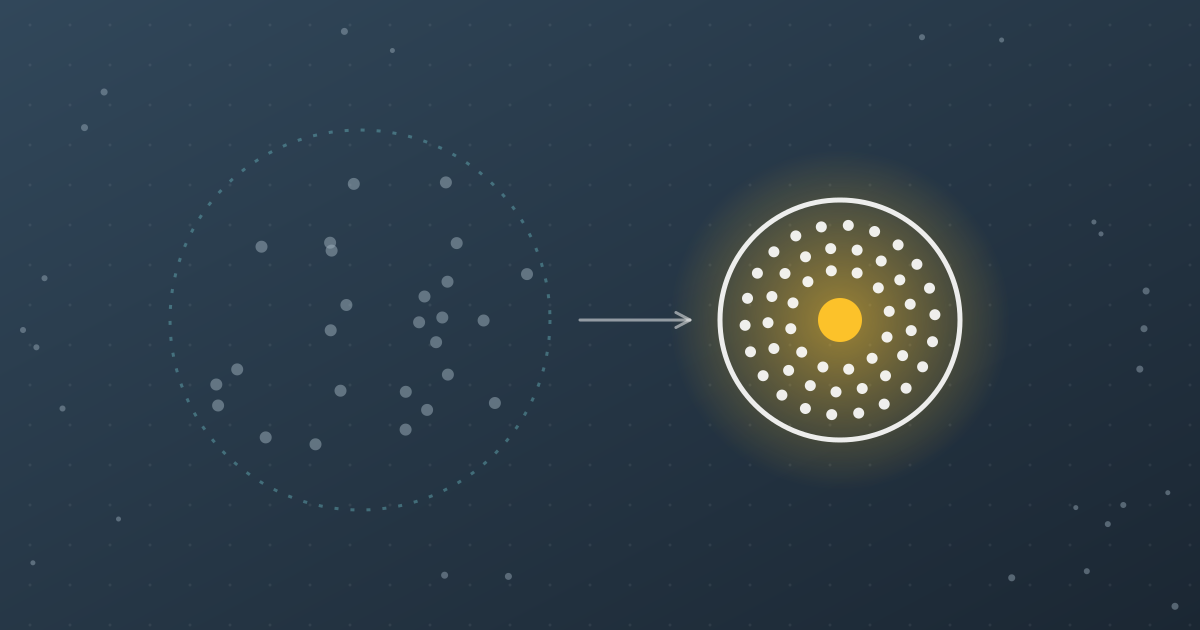
Twenty faint mist-blue dots lie scattered in front of a teal line that none of them reaches. The dots glide together until they form a single golden beam; it makes the line glow at one point and open into a gate through which the dots flow onward.
Principle #7
Concentration of Force: Concentrate your forces where the outcome is decided instead of spreading them across many fronts.
4 min read5 sectionsSituationLink to the principle
Contents
Carl von Clausewitz considered keeping one’s forces together the simplest and highest law of strategy. That sounds easy. It becomes hard when your forces are tied up in a business that defines who you are and in which you can no longer win anyway. That is exactly the situation Intel faced in 1985. The story shows why the Concentration of Force almost always begins with letting go.
On a chip, the memory grid fades and all the lines converge on a golden processor core – like Andrew Grove and Intel in the mid-1980s.
01
The business that defined Intel
Situation
Robert Noyce and Gordon Moore founded Intel in 1968. Its first big successes were memory chips (DRAM). Intel was seen as a memory company, with the microprocessor running alongside as a second line of business. In the early 1980s, Japanese manufacturers with large factories and low prices pushed into the memory market. In 1983 Japanese competition put heavy pressure on Intel’s profits. Intel lost market share and soon money as well.
Link to the principle
Intel’s forces were spread over two big fronts. Research, factories and management were working for memory and for processors at the same time. In memory, Intel was outmatched. In processors, the company had held a strong position since the IBM PC of 1981. If you try to hold both fronts in such a situation, you weaken the promising one to defend the lost one.
02
The question at the revolving door
Situation
In his book “Only the Paranoid Survive” (1996), Andrew Grove, then Intel’s president, recounts a conversation with CEO Gordon Moore in mid-1985. Grove asked what a new CEO would do if the board threw them both out. Moore answered without hesitation that a new CEO would get out of the memory business. Grove then suggested that they walk out the door in their minds, come back in and do it themselves.
Link to the principle
Concentration rarely fails because of the analysis. It fails because of attachments, habits and pride. The imaginary revolving door breaks that attachment. It separates the question “What have we built?” from the question “Where is the outcome being decided now?”
03
The organization was already a step ahead
Situation
The Stanford researcher Robert A. Burgelman later studied the exit in detail. He found that Intel’s plants had long been allocating their capacity according to the profit margin per wafer. As a result, production shifted step by step from memory to processors before management officially decided to exit.
Link to the principle
Concentration can begin from the bottom up when a simple rule directs resources to where they have the greatest effect. The leaders’ task is then to recognize this movement and see it through, instead of slowing it down out of loyalty to the old business.
04
Everything on one chip
Situation
The exit was painful and dragged on for several years. Intel closed plants and laid off thousands of employees. In October 1985 Intel introduced the 80386 processor; volume production began in 1986. Grove decided not to license it to other manufacturers as second sources, as had been done with earlier chips. Intel made the 386 on its own.
Link to the principle
Concentration doesn’t just mean leaving things out. The forces that have been freed up must be committed in full at one place. Intel could have shared the new chip with second sources and so spread the risk. Grove wanted the full effect at the point where everything was now being decided.
05
What came of it
Situation
When Compaq launched the Deskpro 386 in September 1986, the chip became the standard of the PC industry. Until 1991 Intel remained its only manufacturer, and the profits financed the next generations. Grove became CEO in 1987. In the 1990s, revenue grew to more than $20 billion.
Link to the principle
The success shows both the power of concentration and its price. Intel now depended on one business. Grove called such moments strategic inflection points. He knew that one day the new, concentrated position would also come under attack, and the question at the revolving door would have to be asked again.
Key takeaways
Key lessons
01
Ask yourself what a successor without your history would do.
02
Don’t hold on to a field just because it made you big.
03
Pay attention to where your people are already directing resources on their own.
04
Commit freed-up forces in full at one place, not spread out.
05
Remember that concentration also creates dependence.
Summary
In the mid-1980s, Intel was fighting on two fronts: memory, where the company was losing to Japanese manufacturers, and microprocessors, where it was strong. Andrew Grove and Gordon Moore gave up the business the company had grown up with, pulled their forces together and committed them in full to the 386. The concentration cost plants and jobs and brought losses, but it made Intel the dominant processor manufacturer.
Andrew S. Grove: Only the Paranoid Survive. New York: Currency Doubleday 1996.
Robert A. Burgelman: Fading Memories: A Process Theory of Strategic Business Exit in Dynamic Environments. In: Administrative Science Quarterly 39 (1994), no. 1, pp. 24–56.
Back to the basics
Read what lies behind the Concentration of Force: with explanation, animation, video and research.