Around 723, the missionary Boniface fells a mighty oak dedicated to the god Donar at Geismar in northern Hesse. Instead of engaging in many small debates, he strikes at the point on which belief in the old gods depends.
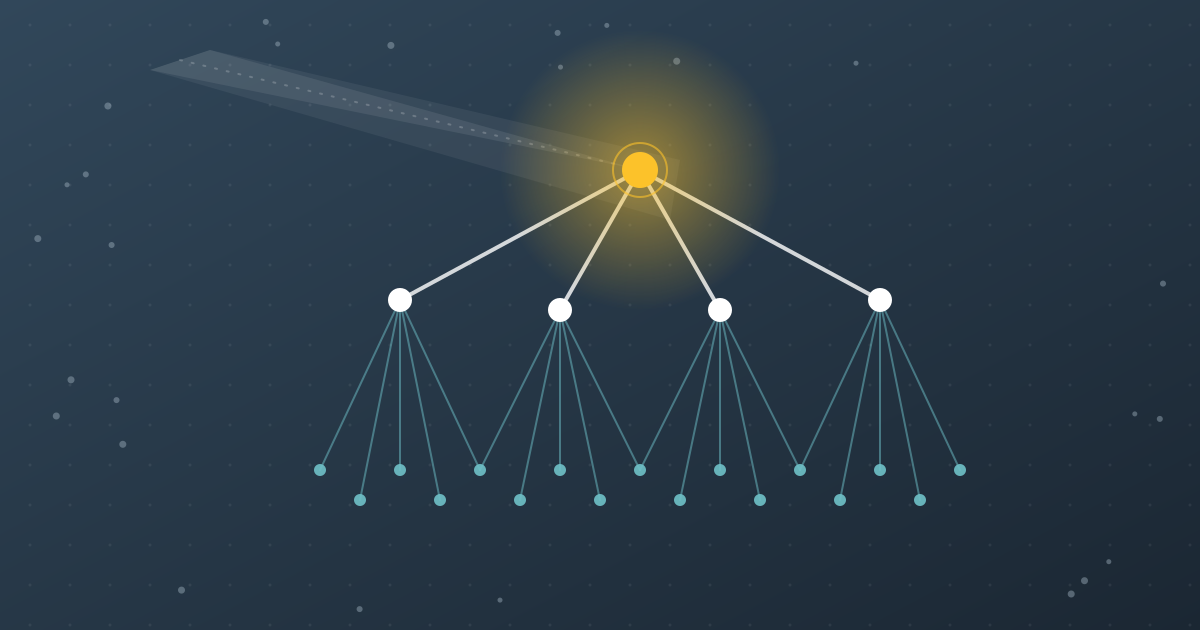
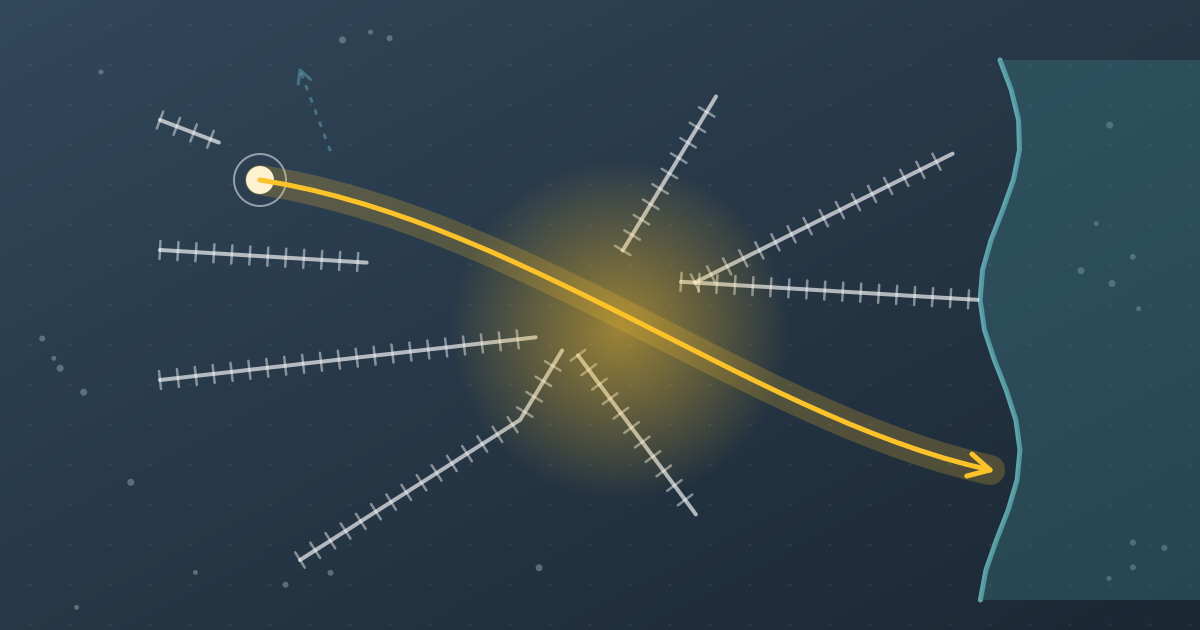
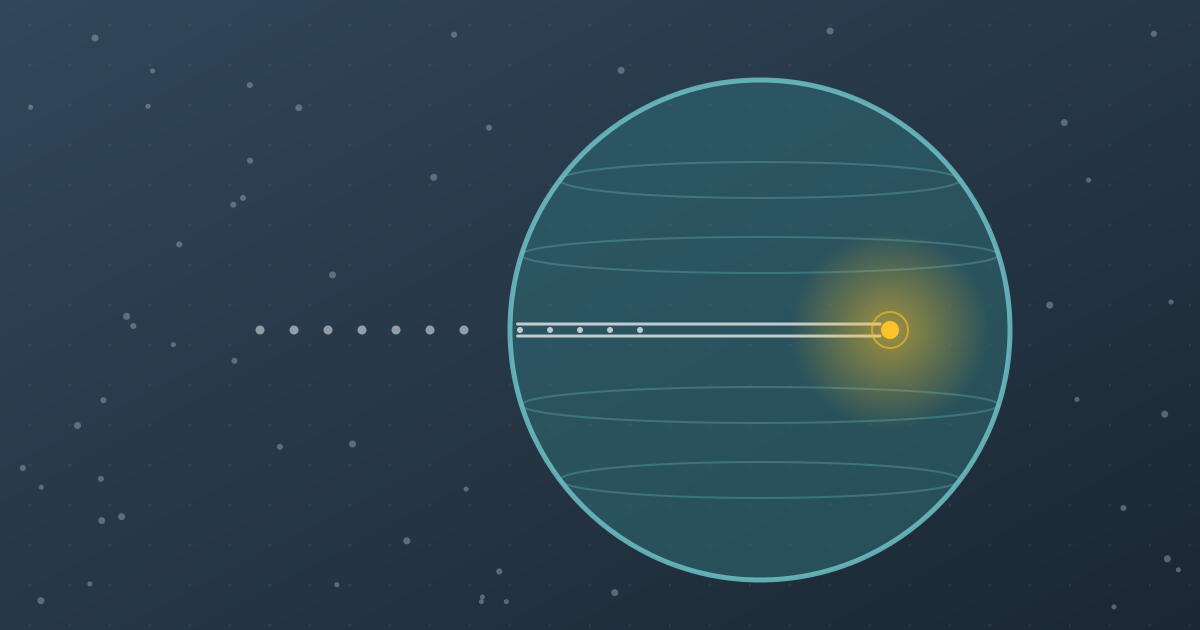
A large structure of teal dots, joined by fine lines, is nudged at every point by mist-blue dots and barely wobbles. A circle of light scans the structure and makes a small node glow golden, the one on which all the lines hang; the dots converge on it, the node comes loose, the structure falls apart, and in the final image a frame settles protectively around your own golden node.
Principle #6
Center of Gravity: Find the one point on which the other side’s strength and cohesion depend, and direct your forces there instead of spreading them everywhere.
4 min read5 sectionsSituationLink to the principle
Contents
In “On War,” Carl von Clausewitz writes that in a war a center of gravity develops out of the circumstances of both sides, “the hub of all power and movement, on which everything depends” (Book VIII, Chapter 4). If you hit it, everything else begins to waver. Clausewitz was thinking of armies and states. The story of Boniface shows that the Center of Gravity also applies where convictions are at stake.
Threads from all the dots around it hang from a mighty oak; a golden cut runs through its trunk – like Boniface at Geismar.
01
A missionary with backing
Situation
Boniface, originally named Wynfreth, is an Anglo-Saxon monk from Wessex. In 719 Pope Gregory II gives him the name Boniface and a mandate to do missionary work. In 722 he consecrates him as a bishop in Rome. Boniface works among the Chatti in Hesse. Many of them have been baptized, but some continue to make offerings at trees and springs, in secret or openly.
Link to the principle
Boniface faces a common problem: the new faith has been accepted but has not taken root. He could go after every single place of sacrifice and every single custom. That would be a fight on a hundred fronts without end.
02
The diagnosis: What does the old faith hinge on?
Situation
At Geismar, today part of the town of Fritzlar, stands an enormous oak dedicated to the god Donar. Following Roman usage, Willibald calls it the Oak of Jupiter. It is regarded as one of the most important sanctuaries in the region. The old faith rests on the conviction that the gods are mighty and punish anyone who violates their sanctuary.
Link to the principle
This is where the center of gravity lies. Not in the many small customs but in the one belief that the old gods will defend themselves. If this belief is visibly refuted in one place, the small places of sacrifice lose their power as well.
03
The blow
Situation
According to the account of his biographer Willibald, Boniface has the oak felled on the advice of Hessians who have already been baptized, before the eyes of many pagans who curse him as an enemy of their gods. He has hardly begun, Willibald reports, when the tree crashes down and breaks into four equal parts. The onlookers stop cursing and profess their faith in the God of the Christians.
Link to the principle
Boniface stakes everything on one point and one moment, in front of as many witnesses as possible. The expected punishment from the gods does not come. That has a stronger effect than any sermon, because it strikes exactly the conviction that carries everything else.
04
From timber to church
Situation
From the oak’s timber, Boniface has an oratory built and dedicated to the apostle Peter. In the following years, a church and a monastery, also dedicated to Saint Peter, are built in Fritzlar. Fritzlar Cathedral stands today on the site of that church.
Link to the principle
If you strike a center of gravity, you also have to shape what comes after. Boniface puts a new center in place of the old one. In this way, a single blow becomes a lasting change.
05
What the story must not leave out
Situation
Willibald writes his biography around 760, decades after the events and with the aim of presenting Boniface as a saint. Boniface acts with a letter of protection from the Frankish mayor of the palace, Charles Martel, at his back. Since 2012, a Boniface statue with a memorial plaque, erected in Fritzlar in 1999, has repeatedly been the target of protests. Representatives of nature religions see it as glorifying the violent forced Christianization of the region.
Link to the principle
A blow against the center of gravity is powerful, and precisely for that reason, the question of whether you have the right to strike it matters. The principle explains why the act worked. Whether it was right is another question.
Key takeaways
Key lessons
01
Don’t ask where the many problems are; ask what they all hinge on.
02
A visible step at the center of gravity has a stronger effect than many small steps at the margins.
03
Put a new center in place of the old one; otherwise a gap remains.
04
Check whether you have the right to attack someone else’s center of gravity.
05
Read success stories with an eye to who wrote them down.
Summary
In Hesse, Boniface could have gone after countless customs. He recognized that the old faith hinged on the conviction that the gods would protect their sanctuary. By felling Donar’s Oak, he struck this center of gravity and used its timber to create a new center. The story shows the power of the principle and at the same time raises the question of its limits.
Willibald: Vita Bonifatii. In: Reinhold Rau (ed.): Briefe des Bonifatius. Willibalds Leben des Bonifatius. Darmstadt: Wissenschaftliche Buchgesellschaft 1968 (in Latin and German).
Carl von Clausewitz: Vom Kriege. 3 vols. Berlin: Ferdinand Dümmler 1832–1834 (in German).
Back to the basics
Read what lies behind the Center of Gravity: with explanation, animation, video and research.