The principle in detail
Three steps through the principle: grasp it, place it, put it to work. Open each topic on its own.
The core messageCore statement and 3 clarifications
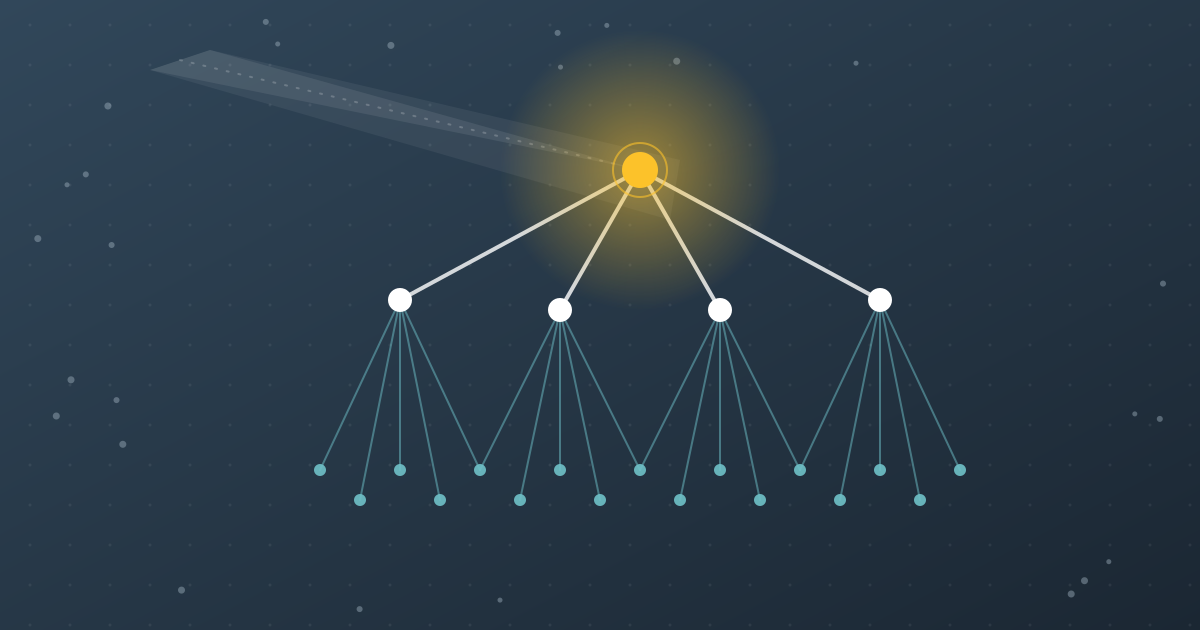
Not every part of a force is equally important. If you find the point on which cohesion, will or supply depend, you don’t need superior numbers.
- It does not say
- That the center of gravity is the strongest or most visible part. Sometimes it is a person, a connection, a belief or a secret.
- It does not say
- That every opponent has exactly one center of gravity. Networks without a head may have several or none at all.
- It also says
- You have a center of gravity yourself. If you don’t know it, you can’t protect it.
The explanationThe center of gravity is rarely what looks strongest.
The center of gravity is rarely what looks strongest.
The principle has two sides.
- It calls on you to look for the other side’s center of gravity, and it warns you to know and protect your own.
- Many superior organizations have failed at a point they themselves had not kept in view.
What does the whole thing hinge on, and what do you hinge on?
The signs3 signs when you heed it · 3 when you overlook it
- Before every major undertaking, you ask what the problem actually hinges on.
- You pull only a few levers and take the time to understand the other side.
- You know which person, which knowledge or which relationship holds your own team together.
- You launch many measures at once, and none of them takes hold.
- You wear yourself out on the most visible opponent while the pattern behind it stays in place.
- A failure nobody saw coming paralyzes your area.
The backgroundFrom Carl von Clausewitz’s “On War” (1832–1834). · T1 Classical Theory of War
- 1832–1834OriginCarl von Clausewitz
On War
- 1996SupplementedJoseph L. Strange
An analytical framework for practice
- 2002SupplementedAntulio J. Echevarria II
A critique of U.S. doctrine
- Tradition T1TraditionClassical Theory of War
Carl von Clausewitz, Antoine-Henri Jomini, Helmuth von Moltke the Elder, Frederick William Lanchester
See the tradition on the Origin page
Read more: the full background
From Carl von Clausewitz’s “On War” (1832–1834). Supplemented by Joseph L. Strange’s analysis (1996) and Antulio J. Echevarria II’s interpretation (2002).
The research3 sources: 2 theories, 1 classic · 1832–2002 · with limitations of the research
- weak
- moderate
- strong
An influential theory with case examples whose meaning is disputed even in the specialist literature and which has not been measured.
- 1996Joseph L. Strange
An analytical framework for practice: centers of gravity, critical capabilities, critical requirements and critical vulnerabilities.
- 2002Antulio J. Echevarria II
A critique of U.S. doctrine: the center of gravity is not a source of strength but a focal point that holds the whole together. Without a close connection between the parts, there is none.
- Not every opponent has a single center of gravity.
- Decentralized networks, leaderless movements or broadly diversified companies may have several or none; the search for the one point then leads to false simplifications.
- Whether a center of gravity may be attacked at all – especially when it lies with people who are not fighting – is something the principle does not say.
- Applying it to organizations, families and churches is an analogy.
Read more: what research shows
The principle is a classic theory of military thought, not a measured law. In Book VIII of “On War,” Carl von Clausewitz describes the center of gravity as a hub of power and movement on which the whole depends. The concentrated blow of all forces should be directed against this point. Depending on the situation, he locates it in the army, in the capital, with a powerful ally, in the unity of an alliance or in leaders and public opinion. Joseph L. Strange turned this into an analytical framework of critical capabilities, requirements and vulnerabilities. Antulio J. Echevarria II counters that Carl von Clausewitz meant a point that holds a system together, not a strength. Such a point exists only where the parts are connected closely enough. The interpretation remains disputed to this day.
The related principles04 Kernel of Good Strategy · 07 Concentration of Force · 11 Bottleneck Focus · 31 Indirect Approach
To go deeper, see 04 Kernel of Good Strategy (a good diagnosis often finds the center of gravity) and 31 Indirect Approach (the way there rarely runs head-on)
07 Concentration of Force says what happens once you know the center of gravity
11 Bottleneck Focus carries the idea over to organizations
Read more: the full text
To go deeper, see 04 Kernel of Good Strategy (a good diagnosis often finds the center of gravity) and 31 Indirect Approach (the way there rarely runs head-on); 07 Concentration of Force says what happens once you know the center of gravity, and 11 Bottleneck Focus carries the idea over to organizations.
The action steps5 things you can actually do
- For a deadlocked problem, write down which habit, person, rule or relationship holds it together. For each item, ask yourself: What would happen if exactly this were gone?
- Distrust the first candidate that comes to mind. What is most visible is often not what carries the weight.
- Gather knowledge of the other side before you act: conversations, figures, observations. Only then choose the point.
Direct your strength at this point and cut measures that only work at the margins.
- Examine your own center of gravity: Where are you vulnerable if a single person, customer or system fails? Secure this point, and before every intervention, think about what should take its place afterward.
The reflection questions3 questions: What does the problem that is costing you the most strength right now hinge on?
- What does the problem that is costing you the most strength right now hinge on?
- Which measure do you pursue mainly because it is visible, not because it hits the core?
- Which failure would paralyze your area, and who is protecting that point?
Take your time with one question. Write down your answer – or talk it over with someone you trust.
The picture to rememberThe animation once more, with an explanation
- A large structure of teal dots, joined by fine lines, is nudged at every point by mist-blue dots and barely wobbles
- A circle of light scans the structure and makes a small node glow golden, the one on which all the lines hang
- The dots converge on it, the node comes loose, the structure falls apart, and in the final image a frame settles protectively around your own golden node
How the principle shows up in practice
Boniface 723
He fells Donar’s Oak at Geismar, the region’s central sanctuary, and thereby strikes at the belief that the old gods will defend themselves.
Boston Globe 2002
The Spotlight team targets not individual priests but the knowledge and the cover-up in the leadership of the archdiocese under Cardinal Bernard Law.
March to the Sea 1864
William Tecumseh Sherman lets the opposing army go and targets the South’s railroads, supplies and will to fight, at a high cost to the civilian population.
What does the whole thing hinge on?
Get your profile across all 12 groups in about 10 to 15 minutes.
Start the Strategy CheckGroup 1: Purpose and Objective
Guiding question: What are you fighting for, and what should be left standing at the end?
Stage 1 of 5: Clarify
- TraditionClassical Theory of War
Carl von Clausewitz, Antoine-Henri Jomini, Helmuth von Moltke the Elder, Frederick William Lanchester
Where the 92 principles come from: eight traditions of strategy, from classical war theory to dealing with uncertainty.
More about the originBackground: WEGVISOR’s own selection from the strategy literature · More about the origin