Lehman Brothers and the Principle “First Make Yourself Invincible”
Lehman Brothers is a counterexample. The investment bank works with extreme leverage from borrowed money and bets heavily on real estate. When prices fall, a small loss is enough to wipe out its equity, and in September 2008 the bank goes bankrupt.
A golden circle stands exposed in the middle, and arrows of teal lines approach from all sides; the picture rewinds, and a ring of dots grows around the circle, its weakest points lighting up first. The arrows bounce off and grow shorter; one overextends and leaves a mist-blue gap behind it, and at that moment a gate opens in the ring and a narrow golden line thrusts straight into the gap.
Principle #39
First Make Yourself Invincible: First secure your own weak points, for whether you lose depends on you, while whether you win depends on the opportunity the other side gives you.
4 min read5 sectionsSituationLink to the principle
Contents
Sometimes a principle comes through most clearly where it is ignored. Lehman Brothers is such a case for the principle “First Make Yourself Invincible.” For decades, it was one of the great names on Wall Street. The bank earned well as long as markets were rising. But it had not made itself invincible. On the contrary, it had positioned itself so that a single development could bring it down.
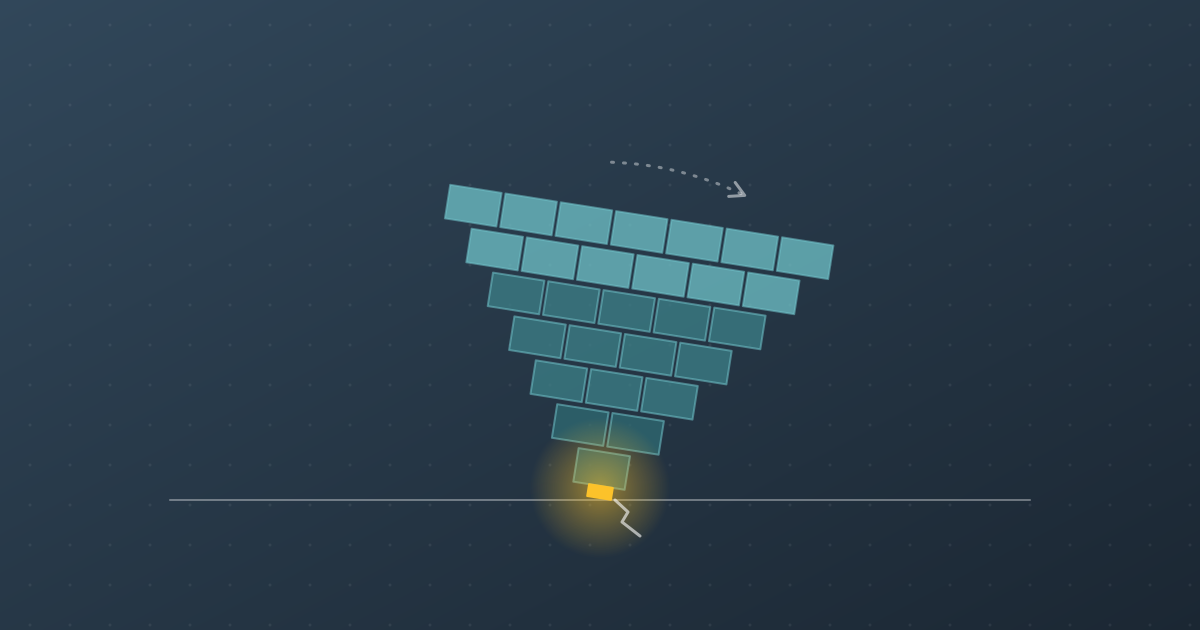
An upside-down pyramid of blocks stands on a tiny golden base and tilts to one side – like Lehman Brothers with its leverage.
01
The leverage
Situation
Banks work with borrowed capital. What matters is how much of their own money stands behind their business. At Lehman, the ratio of assets to equity rose from about 24 to 1 in 2003 to 31 to 1 in 2007. In 2008, some $680 billion in assets rested on only $22.5 billion in equity.
Link to the principle
With leverage of 31 to 1, a loss in value of just over 3% is enough to wipe out all the equity. The bank did not rely on being invincible but on nothing going wrong. Sun Tzu would say that it had not used what lay in its own hands to rule out defeat but had left that to the market.
02
The bet on real estate
Situation
Lehman was heavily involved in real estate. The bank held securitized mortgages and commercial property worth about 30 times its equity. In 2007, together with the real estate company Tishman Speyer, it also bought the residential company Archstone for about $22 billion, just as the U.S. housing market was beginning to turn.
Link to the principle
If you concentrate your forces on a single risk, you create a weak point that your opponent does not even have to look for. Here the opponent was not a competitor but the situation itself. Security would have meant limiting this dependence.
03
Weakness hidden instead of fixed
Situation
The March 2010 report by Anton Valukas, the examiner appointed by the bankruptcy court, describes what are known as Repo 105 transactions. With them, Lehman made its own balance sheet look better on the reporting dates than it really was. The New York attorney general later took action against the auditing firm Ernst & Young.
Link to the principle
If you hide a weak point instead of closing it, you do not make yourself any safer. You only postpone the moment when it becomes visible. To first make yourself invincible means taking an honest look at your own gaps.
04
The weekend in September
Situation
In the summer of 2008, Lehman searches desperately for capital. Talks with the state-owned Korea Development Bank stall, and on September 9 the stock falls by 45%. Over one weekend, Barclays and Bank of America negotiate a takeover. The British regulator refuses Barclays a necessary waiver, Bank of America buys Merrill Lynch instead, and the U.S. government refuses a rescue with public money. On September 15, 2008, Lehman files for bankruptcy protection with more than $600 billion in assets, the largest bankruptcy in U.S. history.
Link to the principle
If you have not secured yourself, you end up dependent on other people’s decisions. Lehman could only hope: for a buyer, for the government, for a miracle. That is exactly the situation the principle is meant to prevent.
05
What you can learn from it
Situation
The consequences hit far more than the bank. The collapse deepened the global financial crisis. A few days later, the bankruptcy court approved Barclays’ takeover of the core North American business for about $1.35 billion.
Link to the principle
Profits in good years do not prove that a position is secure. The question is whether it survives a bad day. Lehman went after the opportunity for profit before it had ruled out its own defeat. The order was wrong.
Key takeaways
Key lessons
01
Ask not only how much you can win but how much you can afford to lose.
02
Keep enough reserves of your own to survive a bad day.
03
Don’t bet everything on a single development.
04
Close weak points instead of hiding them.
05
Make sure your survival does not depend on the mercy of others.
Summary
Lehman Brothers worked with leverage of more than 30 to 1 and bet heavily on real estate. When prices fell, a small loss was enough to wipe out its equity. Weaknesses were hidden in the balance sheet instead of fixed, and in the end everything depended on buyers and authorities who did not help. As a counterexample, Lehman shows what the principle “First Make Yourself Invincible” demands: first rule out your own defeat, then seek gains.