Emperor Trajan leads the Roman Empire all the way to the Persian Gulf. His successor Hadrian gives up the new provinces in the east in 117, right after taking office, and makes the Euphrates the border once again. He makes the empire smaller so that he can hold it.
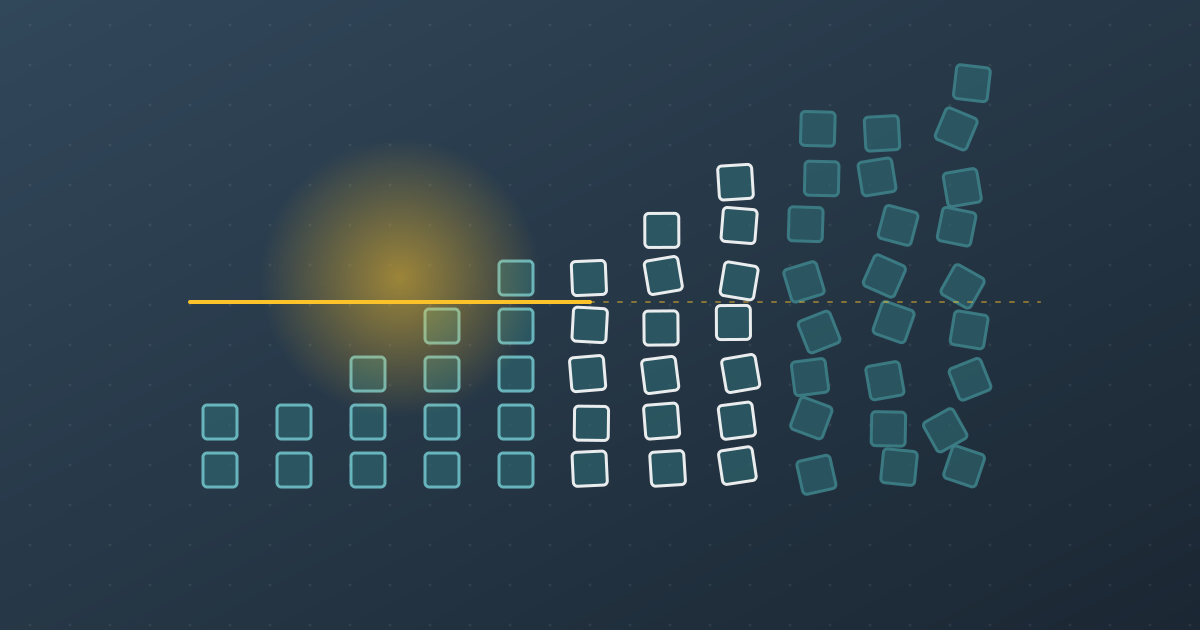
A golden circle is surrounded by a thick teal frame lined with small dots packed close together; with every expansion the frame grows larger and thinner, the dots move apart, and below them a steep line and a flat line diverge. A small mist-blue push makes the frame tear at its thinnest point; afterward it pulls back to a tighter line, grows thick again, and both lines run level.
Principle #14
Overstretch: If you let your commitments grow faster than the means to sustain them, you will end up losing even what you could have held safely.
3 min read5 sectionsSituationLink to the principle
Contents
In 1987 the British historian Paul Kennedy wrote a book about the rise and fall of great powers. His finding: powers often fail not because of their enemies but because their commitments grow faster than their economic strength. He calls this “imperial overstretch.” Some 1,900 years earlier, a Roman emperor recognized this danger and did the opposite of what people expect from a ruler.
Beyond a river a wide territory fades; on this side everything gathers behind a golden border – as with Emperor Hadrian at the Euphrates.
01
The largest empire
Situation
Starting in 114, Emperor Trajan wages war against the Parthian Empire. He makes Armenia a Roman province and conquers Mesopotamia. In 116 he takes Seleucia, the Parthian capital Ctesiphon and Babylon and sails down the Tigris to the Persian Gulf. The Roman Empire has reached its greatest extent.
Link to the principle
On the map, this is a triumph. But every new province is also a new commitment: it needs legions, administration, supplies and loyalty. Whether an empire gets bigger says nothing yet about whether it gets stronger.
02
An empire at its limit
Situation
The limits show even during the campaign. Seleucia rises up and has to be retaken. The city of Hatra withstands a siege. Trajan’s health declines, perhaps after heatstroke outside Hatra. He installs the Parthian prince Parthamaspates as a client king of the Parthians and withdraws to Syria. In 117 he dies.
Link to the principle
The conquered territories have been won, but not secured. To hold them, Rome would have to tie down troops in the east permanently, troops that would then be missing on other frontiers. That is exactly what overstretch is: the commitment has been made, but the means to sustain it are not there.
03
Hadrian’s first decision
Situation
Hadrian, Trajan’s adopted son, becomes emperor in 117. As governor of Syria, he has seen the campaign up close. Right at the start of his reign, he gives up the new conquests in the east. He withdraws the troops from Armenia, Mesopotamia and Assyria and makes the Euphrates the empire’s border again.
Link to the principle
The sources do not say for certain what exactly moved Hadrian. Modern accounts see above all a practical reason: in the long run, the conquests in the east would have tied down more troops than Rome could muster. According to Tacitus, Augustus had already advised keeping the empire within its borders. Hadrian gives up what he cannot hold in order to secure what he can.
04
Making borders visible
Situation
In the years that follow, Hadrian travels through the provinces and has the frontiers fortified. The best known is the wall built in Britain starting in 122, which still bears his name today.
Link to the principle
If you limit your commitments, you also have to mark the limit. Hadrian’s Wall is a statement set in stone: this far and no further. It ties forces to a fixed line instead of using them up in ever new campaigns.
05
What it cost
Situation
The decision was not popular. Later Roman historians such as Eutropius and Aurelius Victor attributed the withdrawal to envy of Trajan’s fame. Modern accounts tend to see it as a sober adjustment to what Rome could sustain in the long run.
Link to the principle
Reducing the scope of your own commitments almost always looks like weakness. That is precisely why so few people do it in time. Hadrian accepted the loss of prestige in order to preserve the substance.
Key takeaways
Key lessons
01
Every new task is also a lasting commitment. Factor it in.
02
Don’t ask whether you can win something; ask whether you can hold it.
03
Let go of what you cannot carry before it drags you down with it.
04
Draw clear boundaries and make them visible, for yourself and for others.
05
Be prepared for moderation to be seen as weakness at first.
Summary
Trajan led the Roman Empire all the way to the Persian Gulf, but the new provinces in the east were hard to hold even in his lifetime. Hadrian gave them up in 117, right after taking office, and made the Euphrates the border again. Later he fortified the empire’s frontiers, most famously with the wall in Britain. Hadrian’s actions show the flip side of what Paul Kennedy calls overstretch: the timely decision to bring commitments into line with means.