The principle in detail
Three steps through the principle: grasp it, place it, put it to work. Open each topic on its own.
The core messageCore statement and 3 clarifications
What matters is the ratio of load to strength. If commitments keep growing faster than the means, even what has proven itself is put at risk.
- It does not say
- That growth is wrong. Sometimes growth is necessary just to survive, and if you cut back too early, you lose opportunities.
- It does not say
- That overstretch becomes visible right away. It shows up first in quality, reserves and exhaustion.
- It also says
- Giving up a commitment can be a sign of strength. If you scale back in order to hold on, you are acting wisely.
The explanationWhat makes overstretch deceptive is that for a long time it looks like strength.
- What makes overstretch deceptive is that for a long time it looks like strength.
- Its costs show up late, and first in inconspicuous places.
- The remedy takes two forms: deliberately reduce your commitments, or strengthen the foundation so that it grows along with them.
Is your load growing faster than your strength?
The signs3 signs when you heed it · 3 when you overlook it
- Before every commitment, you factor in what it will tie up in time, money and strength year after year.
- You measure growth by whether it can be sustained, not by volume.
- You end tasks that overburden the foundation.
- You say yes to everything and in the end can no longer do anything properly.
- Quality drops, reserves melt away, the reliable people are exhausted.
- Ongoing tasks are never ended because that would look like weakness.
The backgroundFrom Paul Kennedy’s “The Rise and Fall of the Great Powers” (1987). · T4 Political Prudence
- 1987OriginPaul Kennedy
The Rise and Fall of the Great Powers
- Tradition T4TraditionPolitical Prudence
Thucydides, Niccolò Machiavelli, Baltasar Gracián
See the tradition on the Origin page
Read more: the full background
From Paul Kennedy’s “The Rise and Fall of the Great Powers” (1987). The idea is older: according to Publius Cornelius Tacitus, Augustus himself advised keeping the Roman Empire within its borders.
The research2 sources: 1 classic, 1 theory · 1987–1990 · with limitations of the research
- weak
- moderate
- strong
An influential historical interpretation with no measure of when commitments become too much; its forecast for the United States has not come true as stated.
- 1990Joseph S. Nye and Paul Kennedy
Exchange of letters in The New York Review of Books: Joseph S. Nye Jr. disputes that the United States is declining unusually fast; Paul Kennedy stresses that his thesis concerns the gap between means and commitments.
- Paul Kennedy’s forecast for the United States has not come true as stated.
- It is hard to measure when commitments become too much.
- Sometimes growth is necessary to survive, and if you cut back too early, you lose opportunities.
- The principle is therefore not a rule against growth but a rule about the ratio of load to strength.
- Paul Kennedy studies states; applying the idea to companies, families and churches is an inference.
Read more: what research shows
The historian Paul Kennedy coined the term “imperial overstretch” in 1987 in “The Rise and Fall of the Great Powers.” He examines the great powers from 1500 to his own day, including Habsburg Spain, France and Britain. His finding: military power rests on economic strength. When a state’s strategic commitments permanently outgrow its economic base, relative decline sets in. The thesis is disputed. In 1990 Joseph S. Nye Jr. challenged Paul Kennedy’s application of it to the United States: the U.S. share of the world economy, he argued, had remained stable for about 15 years. Paul Kennedy replied that his thesis was about the gap between means and commitments, not about military spending alone.
The related principles09 Economy of Force · 13 Culminating Point · 15 Logistics · 60 Balance of Power
A single advance beyond the 13 Culminating Point often leaves lasting overstretch behind
If you are overstretched, you can no longer focus your forces on what matters, as 09 Economy of Force demands, and, as 15 Logistics shows, supply is usually the first thing to break
For Paul Kennedy, overstretch shifts the 60 Balance of Power among the great powers
Read more: the full text
A single advance beyond the 13 Culminating Point often leaves lasting overstretch behind. If you are overstretched, you can no longer focus your forces on what matters, as 09 Economy of Force demands, and, as 15 Logistics shows, supply is usually the first thing to break. For Paul Kennedy, overstretch shifts the 60 Balance of Power among the great powers.
The action steps5 things you can actually do
Write down all the ongoing commitments in your area, and next to each one what it permanently ties up in time, money and people.
With every new commitment, include the running costs, not just the effort to get started.
- Watch for early signs: falling quality, small things left undone, exhaustion among the reliable people.
If your means are not growing, deliberately end one commitment before you take on a new one.
- Strengthen the foundation in a targeted way: train people, build up reserves, and only then grow further.
The reflection questions3 questions: Which commitment did you most recently take on without calculating the running costs?
- Which commitment did you most recently take on without calculating the running costs?
- Where in your area are falling quality or exhaustion already showing?
- Which task would you no longer take on today, and what is stopping you from ending it?
Take your time with one question. Write down your answer – or talk it over with someone you trust.
The picture to rememberThe animation once more, with an explanation
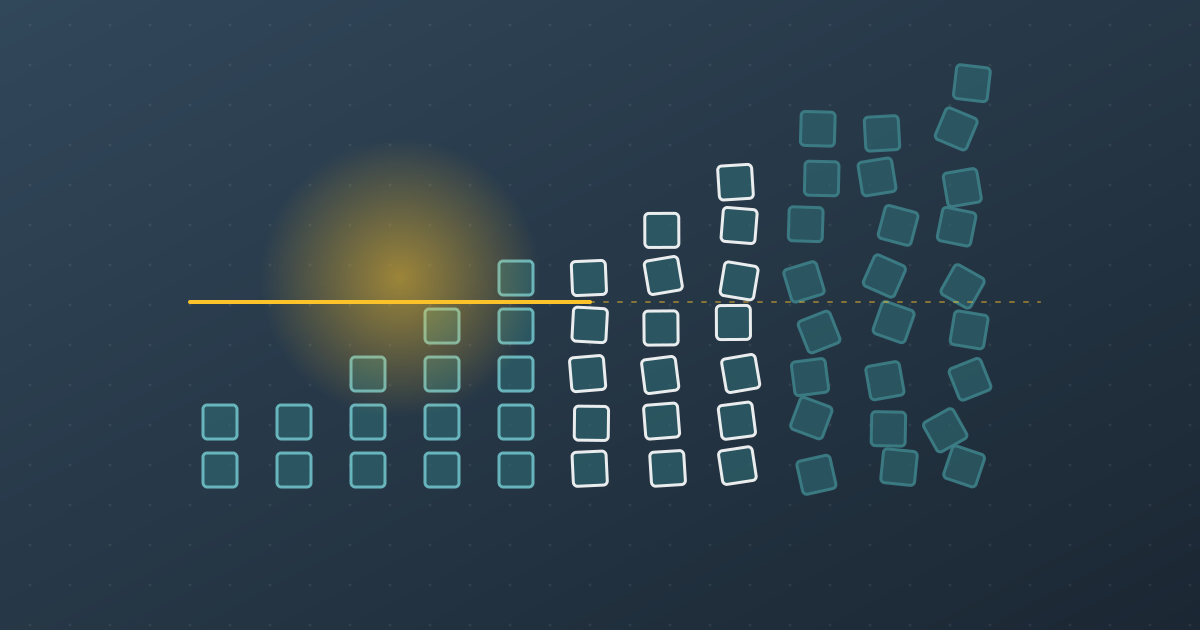
- A golden circle is surrounded by a thick teal frame lined with small dots packed close together
- With every expansion the frame grows larger and thinner, the dots move apart, and below them a steep line and a flat line diverge
- A small mist-blue push makes the frame tear at its thinnest point
- Afterward it pulls back to a tighter line, grows thick again, and both lines run level
How the principle shows up in practice
Emperor Hadrian, the Euphrates
In 117 Hadrian gives up Trajan’s conquests in the east and secures the empire by making it smaller.
Howard Schultz, Starbucks
After years of growing too fast, Starbucks closes about 600 U.S. stores in 2008, most of them only a few years old.
Akio Toyoda, Toyota
After recalls of about nine million vehicles, Toyoda tells the U.S. Congress in 2010 that growth had outpaced the development of people and organization.
What can you really carry?
Get your profile across all 12 groups in about 10 to 15 minutes.
Start the Strategy CheckGroup 2: Forces and Resources
Guiding question: Where do you commit your forces, and how long will they last?
Stage 3 of 5: Choose the path
- Related principles
Where the 92 principles come from: eight traditions of strategy, from classical war theory to dealing with uncertainty.
More about the originBackground: WEGVISOR’s own selection from the strategy literature · More about the origin