The principle in detail
Three steps through the principle: grasp it, place it, put it to work. Open each topic on its own.
The core messageCore statement and 3 clarifications
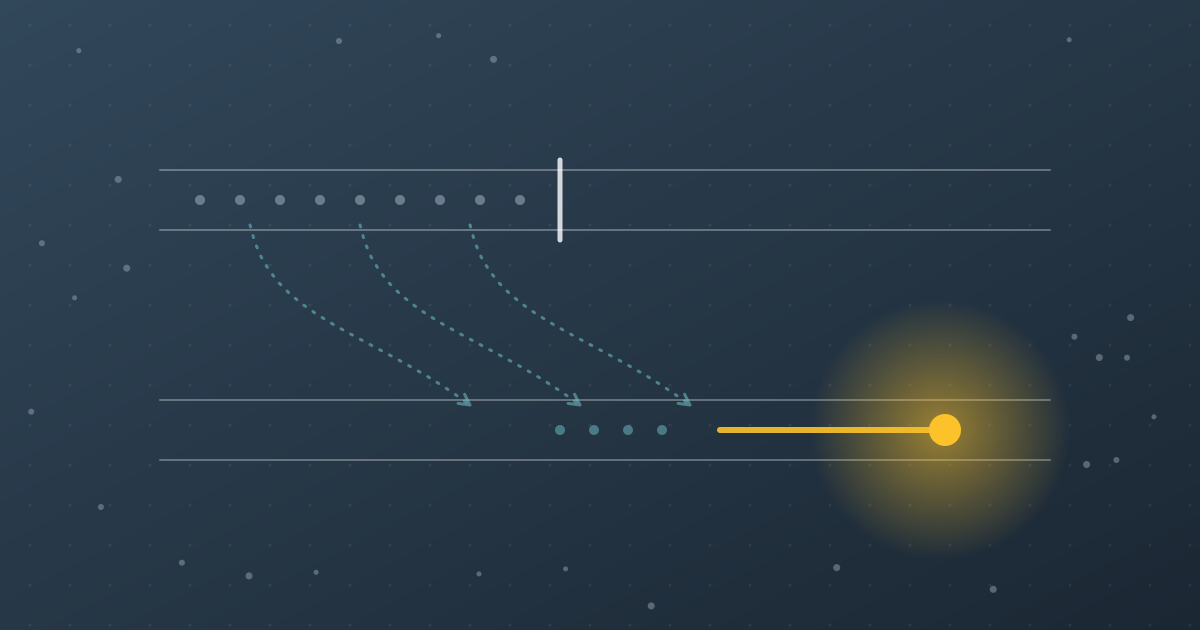
Secondary theaters get what they need, no more. Whatever is freed up there belongs to the main theater.
- It does not say
- That secondary theaters are unimportant. If you let them slide until they turn into a crisis, you lose the main effort as well.
- It does not say
- That secondary tasks go to the weakest people. They need the right people, people who can manage with little.
- It also says
- No part of your forces should sit idle. Economy does not just mean saving; it means using everything.
The explanationYou cannot use the same forces twice.
You cannot use the same forces twice.
Every hour tied up in a secondary theater beyond what it needs is missing from the main theater. Conversely, a neglected secondary theater can deteriorate so badly that it endangers the main effort.
The art lies in the measure: not nothing, not an equal share, but enough.
How much does this secondary theater really need in order to hold?
The signs3 signs when you heed it · 3 when you overlook it
- For every secondary task, you know what it needs to hold, and you give it exactly that.
- Your best time belongs to the task you are there for.
- When the situation changes, you redistribute.
- You spread everything evenly so as not to disappoint anyone, and you are not strong enough anywhere.
- A secondary task you let slide suddenly collapses.
- The allocation you made at the start of the year still stands, even though everything has changed.
The backgroundFrom Carl von Clausewitz’s “On War” (1832), Book III, Chapter 14. · T1 Classical Theory of War
- 1832OriginCarl von Clausewitz
On War
- 1926SupplementedJohn Frederick Charles Fuller
The Foundations of the Science of War
- Tradition T1TraditionClassical Theory of War
Carl von Clausewitz, Antoine-Henri Jomini, Helmuth von Moltke the Elder, Frederick William Lanchester
See the tradition on the Origin page
Read more: the full background
From Carl von Clausewitz’s “On War” (1832), Book III, Chapter 14. Supplemented by John Frederick Charles Fuller’s “The Foundations of the Science of War” (1926).
The research2 sources: 1 classic, 1 theory · 1832–1926 · with limitations of the research
- weak
- moderate
- strong
A basic rule of military theory that appears in many field manuals but has never been measured, and whose right measure remains open in each case.
- 1926John Frederick Charles Fuller
“The Foundations of the Science of War”: systematizes the principles of war; one chapter deals with the law of economy of force.
- The right minimum is rarely known.
- A secondary theater can suddenly become decisive, as the Pacific did after Pearl Harbor, and then too little is simply too little.
- The principle assumes that it is clear what the main effort is.
- Without that clarity, it turns into mere cost-cutting logic.
- The version based on the “minimum” does not appear in this form in Carl von Clausewitz’s work but in later field manuals.
Read more: what research shows
The principle is a classic rule of military theory, not a measured law. Carl von Clausewitz devotes the short Chapter 14 of Book III of “On War” to it. His emphasis is surprising: he demands that you always keep in view that no part of your forces is idle. If you keep troops where the enemy does not keep them busy enough, you are managing your forces badly. For him, then, economy means making full use of every resource. The version common today, in which secondary efforts receive the bare minimum they need, goes back to John Frederick Charles Fuller, who systematized the principles of war in 1926 and devoted a chapter to the law of economy of force. In management, the same idea appears as a portfolio decision.
The related principles06 Center of Gravity · 07 Concentration of Force · 12 Reserve · 14 Overstretch
To go deeper, see 06 Center of Gravity (only once it is clear can you say what counts as a secondary theater) and 07 Concentration of Force (economy is its flip side)
12 Reserve shows where the forces you save can go
14 Overstretch shows what happens when secondary theaters are not kept within bounds
Read more: the full text
To go deeper, see 06 Center of Gravity (only once it is clear can you say what counts as a secondary theater) and 07 Concentration of Force (economy is its flip side); 12 Reserve shows where the forces you save can go, and 14 Overstretch shows what happens when secondary theaters are not kept within bounds.
The action steps5 action steps: Write down your main task and all your secondary theaters.
- Write down your main task and all your secondary theaters. Without a clear main effort, there is no yardstick.
- For each secondary theater, determine the minimum it needs to hold: time, money, people, frequency.
Hand off secondary tasks to suitable people who can keep them running reliably with little effort, or to others who can run them better.
Set up a simple early-warning signal so you notice when a secondary theater starts to tip.
- Review the allocation at fixed intervals. What was a secondary theater yesterday may be decisive tomorrow.
The reflection questions3 questions: Where are you giving a routine your best time, even though it could manage with less?
- Where are you giving a routine your best time, even though it could manage with less?
- Which secondary theater have you neglected so badly that it could soon give way?
- Who in your world is stationed in a secondary theater, and does that person know why?
Take your time with one question. Write down your answer – or talk it over with someone you trust.
The picture to rememberThe animation once more, with an explanation
- A large circle in the center and two small circles at the edge receive equal numbers of mist-blue dots from a single source
- The large one stays pale while the small ones overflow
- Restart: the outer circles get a few targeted dots, just enough to stay teal, and the main stream goes into the center circle, which grows golden
- When one outer circle briefly fades, a single dot saves it
How the principle shows up in practice
“Europe First,” 1941 onward
The United States and Britain want to defeat Germany first and only hold in the Pacific. The guiding principle holds, but the actual allocation shows how hard it is to find the right measure.
Brawn GP 2008–09
Under Ross Brawn, the team stops work on its weak 2008 car early and bets everything on the 2009 rules. One weak year makes two world championships possible.
Lego 2005
Under Jørgen Vig Knudstorp, Lego sells the Legoland parks, keeps a stake and concentrates its resources on the bricks. A secondary theater is handed over without being lost.
How much is enough?
Get your profile across all 12 groups in about 10 to 15 minutes.
Start the Strategy CheckGroup 2: Forces and Resources
Guiding question: Where do you commit your forces, and how long will they last?
Stage 3 of 5: Choose the path
- TraditionClassical Theory of War
Carl von Clausewitz, Antoine-Henri Jomini, Helmuth von Moltke the Elder, Frederick William Lanchester
- Related principles
Where the 92 principles come from: eight traditions of strategy, from classical war theory to dealing with uncertainty.
More about the originBackground: WEGVISOR’s own selection from the strategy literature · More about the origin