The principle in detail
Three steps through the principle: grasp it, place it, put it to work. Open each topic on its own.
The core messageCore statement and 3 clarifications
The only strength that counts is the strength committed at the decisive point. There, the smaller side can be the stronger one.
- It does not say
- That size doesn’t matter. Carl von Clausewitz calls superiority of numbers the most general principle of victory; relative superiority is the way forward when absolute superiority is lacking.
- It does not say
- That local strength lasts. It disappears as soon as the opponent brings up reinforcements or gets around the conditions that created it.
- It also says
- Choose the place for its effect, not for your convenience.
The explanationHow the principle works and what matters
This superiority comes from the choice of place and timing and from skillful use of your forces. A local success often sets off a chain reaction, because disorder, doubt or defectors change the overall balance.
Where are you stronger, even though you are smaller overall?
The signs3 signs when you heed it · 3 when you overlook it
- You ask not only who is bigger but where you are stronger.
- You choose topics, markets or conversations in which your strength counts.
- You deliberately build on a local success.
- You compare overall figures and give up too early.
- You take on the bigger side exactly where it is strongest.
- You mistake a brief lead for a lasting one.
The backgroundFrom Carl von Clausewitz’s “On War” (1832), Book III, Chapter 8. · T1 Classical Theory of War
- 1832OriginCarl von Clausewitz
On War
- 1995SupplementedWilliam H. McRaven
Spec Ops
- Tradition T1TraditionClassical Theory of War
Carl von Clausewitz, Antoine-Henri Jomini, Helmuth von Moltke the Elder, Frederick William Lanchester
See the tradition on the Origin page
Read more: the full background
From Carl von Clausewitz’s “On War” (1832), Book III, Chapter 8. Supplemented by William H. McRaven’s case studies in “Spec Ops” (1995).
The research3 sources: 1 classic, 1 case study, 1 theory · 1832–1995 · with limitations of the research
- weak
- moderate
- strong
The distinction between absolute and relative superiority is grounded in classical theory and supported by case studies, but it has not been systematically measured.
- 1916Frederick William Lanchester
“Aircraft in Warfare,” Chapter V: under modern conditions, concentrating superior numbers immediately gives superiority in the fighting ranks.
- 1995William H. McRaven
“Spec Ops”: eight special operations; small units briefly achieve relative superiority through six principles.
- Relative superiority is limited in space and usually in time.
- It disappears as soon as the opponent brings up their forces or gets around the conditions, as at Thermopylae.
- In protracted conflicts, overall strength often prevails after all: Frederick the Great won at Leuthen and later in the war was once again brought to the brink of defeat.
- Local strength used against weaker parties raises ethical questions that the principle does not answer.
- William H. McRaven’s cases are military special operations; applying them to companies, families and churches is an analogy.
Read more: what research shows
The principle is a classic rule of military thought, supplemented by case studies. In Book III of “On War,” Carl von Clausewitz calls superiority of numbers the most general principle of victory. Where absolute superiority cannot be achieved, he argues, the only option left is to create relative superiority at the decisive point through skillful use of your forces. He explicitly calls victories over opponents twice as strong, such as those of Frederick the Great at Leuthen and Rossbach, rare. In 1995, William H. McRaven examined eight special operations and described how small units gain superiority over larger, well-defended opponents for a short time: through simplicity, security, repetition, surprise, speed and purpose. Frederick William Lanchester worked out mathematically why local numerical superiority is so effective (Principle 10).
The related principles07 Concentration of Force · 10 Square Law of Strength · 32 Surprise · 35 Terrain
To go deeper, see 07 Concentration of Force (relative superiority is its result at the decisive point) and 10 Square Law of Strength (it explains why local numerical superiority has a disproportionate effect)
Read more: the full text
To go deeper, see 07 Concentration of Force (relative superiority is its result at the decisive point) and 10 Square Law of Strength (it explains why local numerical superiority has a disproportionate effect); 32 Surprise (the moment) and 35 Terrain (the place) show how situations come about in which the bigger side cannot bring its numbers to bear.
The action steps5 things you can actually do
- Don’t compare yourself with the other side as a whole but point by point: Where are they thin, tied up or far away?
Choose a point at which your strength can tip the balance, and gather it there.
- Pay attention to timing: Superiority is often possible only for a short time. Prepare so that you can use it when it comes.
Be prepared for the bigger side to bring up reinforcements or to evade you, and think ahead about how you will build on your success.
Before you act, check whether you are using local strength against weaker parties, and ask yourself whether that is fair.
The reflection questions3 questions: Where are you comparing only overall figures and overlooking the point at which you are stronger?
- Where are you comparing only overall figures and overlooking the point at which you are stronger?
- Where are you currently taking on the other side exactly where it is strongest?
- Which small lead could you build on before the others catch up?
Take your time with one question. Write down your answer – or talk it over with someone you trust.
The picture to rememberThe animation once more, with an explanation
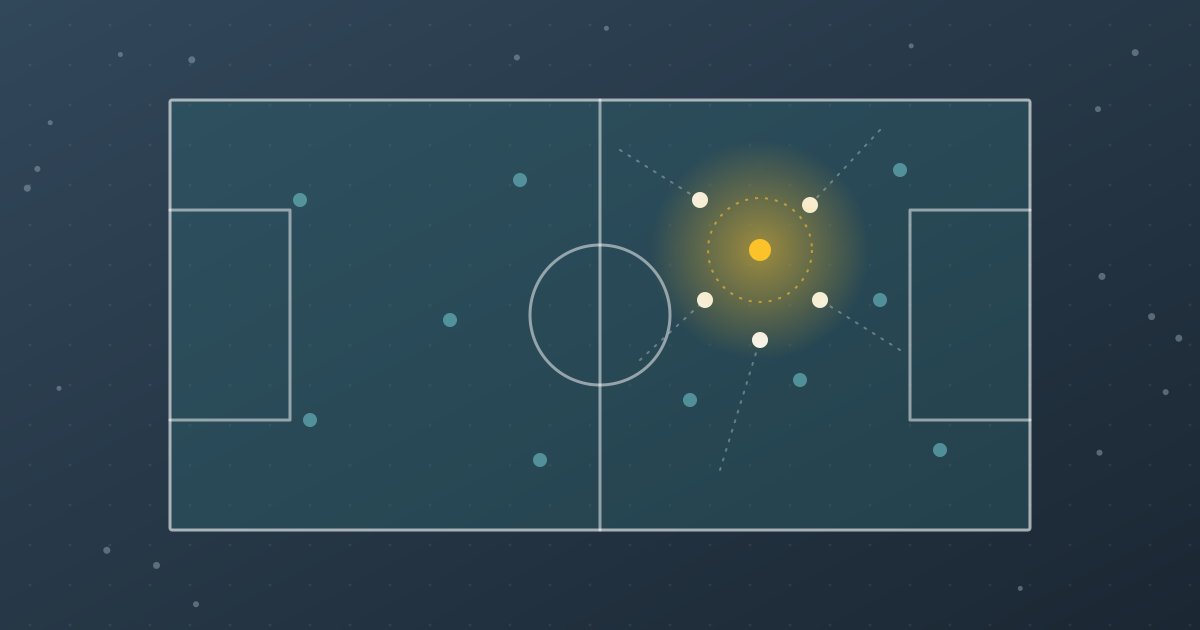
- In two rows, 10 teal dots face 20 mist-blue dots, and a balance beam above them tilts toward the larger row
- The 10 draw together at one end
- A golden circle of light shows 10 against 4 there, a small balance beam above the circle of light tips golden toward the other side, and the long row is rolled up from the flank
How the principle shows up in practice
Leuthen 1757
With about 35,000 men, Frederick the Great attacks an Austrian army almost twice as large and, after a feint, throws everything against its left flank. At the decisive point, the smaller side is stronger.
Walmart, 1962 onward
Sam Walton avoids the big chains’ cities, goes into small towns and clusters his stores around his own warehouses. He is superior locally long before he is big overall.
Borussia Dortmund 2011–12
Jürgen Klopp’s counter-pressing creates numerical superiority around the ball seconds after possession is lost. Dortmund wins the championship twice, ahead of the wealthier FC Bayern.
Where are you stronger?
Get your profile across all 12 groups in about 10 to 15 minutes.
Start the Strategy CheckGroup 2: Forces and Resources
Guiding question: Where do you commit your forces, and how long will they last?
Stage 3 of 5: Choose the path
- TraditionClassical Theory of War
Carl von Clausewitz, Antoine-Henri Jomini, Helmuth von Moltke the Elder, Frederick William Lanchester
- Related principles
Where the 92 principles come from: eight traditions of strategy, from classical war theory to dealing with uncertainty.
More about the originBackground: WEGVISOR’s own selection from the strategy literature · More about the origin