Frederick the Great, Leuthen and Relative Superiority
On December 5, 1757, at Leuthen in Silesia, Frederick the Great of Prussia attacks an Austrian army almost twice the size of his own. He feints an attack on the right flank, marches unseen behind a line of hills and throws his entire strength against the left. There he is superior, and that decides the battle.
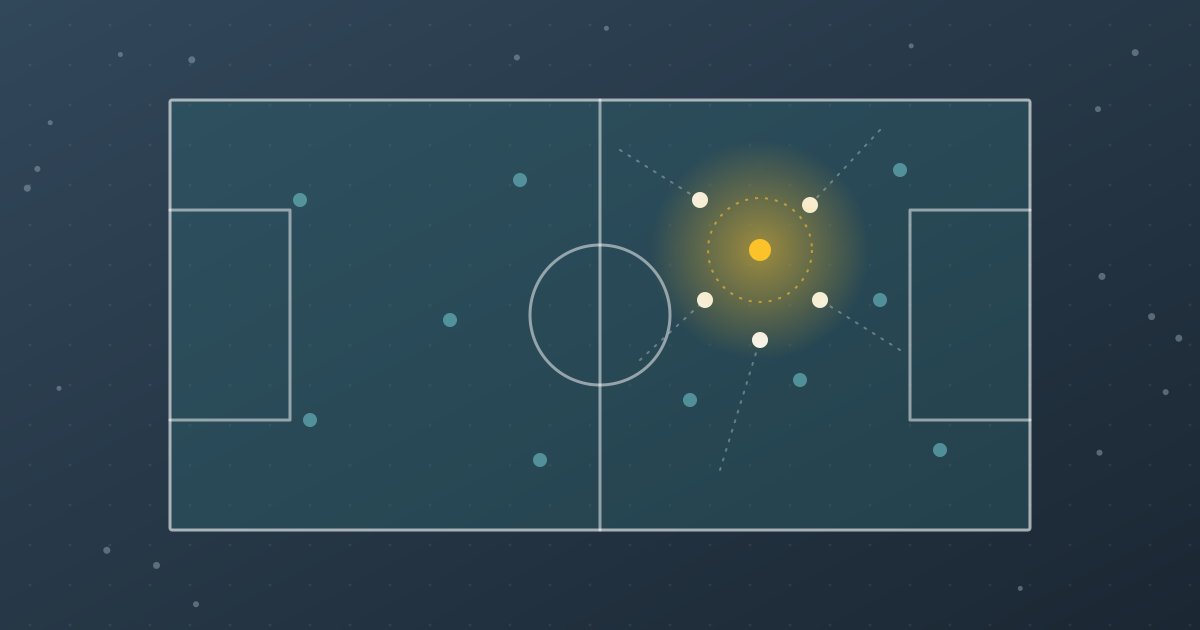
In two rows, 10 teal dots face 20 mist-blue dots, and a balance beam above them tilts toward the larger row. The 10 draw together at one end; a golden circle of light shows 10 against 4 there, a small balance beam above the circle of light tips golden toward the other side, and the long row is rolled up from the flank.
Principle #8
Relative Superiority: You don’t have to be bigger overall, just stronger at the decisive point.
4 min read5 sectionsSituationLink to the principle
Contents
Carl von Clausewitz called superiority of numbers the most general principle of victory. Where you don’t have it overall, he concluded, you have to create it at the decisive point through skillful use of your own forces. The Battle of Leuthen, which Clausewitz himself cites as an example, is a textbook case of Relative Superiority. It shows how an outnumbered army can defeat a larger one.
In front of a long line of dots, an arrow feints toward the northern end while, behind hills, a golden arrow moves toward its southern end – like Frederick the Great at Leuthen.
01
A hopeless situation
Situation
In the fall of 1757, in the second year of the Seven Years’ War, Frederick the Great (Frederick II of Prussia) had defeated a French army and an army of the Holy Roman Empire at Rossbach on November 5. Meanwhile, the Austrians under Prince Charles of Lorraine and Leopold Joseph von Daun captured the fortress of Schweidnitz in Silesia and pushed on toward Breslau. Frederick hurried to Silesia. At Leuthen, his roughly 33,000 to 36,000 men faced some 65,000 Austrians with considerably more artillery.
Link to the principle
In absolute numbers, the battle could not be won. So the question was not who was bigger but whether Frederick could be stronger at one point than the enemy at that same point.
02
The feint
Situation
On the morning of December 5, Frederick had cavalry and some infantry appear in front of the Austrian right flank near Frobelwitz. It looked as if the main attack would come from there. The Austrian command turned its attention to this flank.
Link to the principle
Relative superiority comes about not only through your own concentration but also through your opponent committing their forces in the wrong place. The feint tied up their attention where nothing was being decided.
03
The hidden march
Situation
Behind a line of low hills, the main Prussian force moved south unseen. Then it wheeled and formed up almost at right angles to the Austrian left flank. The cavalry under Hans Joachim von Zieten covered the flank. This form of attack is known as the oblique order: one wing strong and forward, the other held back.
Link to the principle
Frederick brought almost his entire army against one part of the enemy’s. The rest of the Austrian army stood far away and at first could not intervene. At the decisive point, the smaller side was suddenly the stronger one.
04
The thrust against the left flank
Situation
The Prussian infantry rolled up the left flank. The Württemberg troops in the first line held briefly and then broke, carrying with them the Bavarian troops that General Franz Leopold von Nádasdy had posted there. His requests for support went unheard. Charles and Daun recognized the main attack too late and moved their reserves too late. There was fierce fighting around the village of Leuthen and its church. After that, the Prussian cavalry struck the Austrian infantry as it withdrew toward Breslau.
Link to the principle
The Austrians had the majority but could never bring it to bear at the decisive point. Size counts only where it can take effect. If you bring up your reserves too late, you fight with whatever troops happen to be there.
05
The result and what made it possible
Situation
After about seven hours, the Austrian army was beaten. It lost some 22,000 men, about 12,000 of them taken prisoner, plus 116 guns. The Prussians lost about 6,300 men. Breslau surrendered a few days before Christmas. Napoleon later called the battle a masterpiece of movement, maneuver and resolution.
Link to the principle
The victory rested on one precondition: an army so well drilled that it could march unseen and wheel under time pressure. Relative superiority is not a trick of the moment. It requires capabilities that have been built up beforehand. Despite the victory, the war itself went on until 1763.
Key takeaways
Key lessons
01
Don’t ask who is bigger overall; ask who is stronger at the decisive point.
02
Tie up your opponent’s attention where you are not attacking.
03
Bring your entire strength to a point where they don’t expect it.
04
Make sure their superior numbers can’t come into play.
05
Practice in advance what you will need to do quickly at the decisive moment.
Summary
At Leuthen, Frederick the Great faced an army almost twice the size of his own. With a feint, a hidden march and the oblique order, he brought his entire strength against a single flank. There he was superior, while the bulk of the Austrian army intervened too late. The battle shows what Carl von Clausewitz calls relative superiority: what decides is not overall size but strength at the decisive point.