The principle in detail
Three steps through the principle: grasp it, place it, put it to work. Open each topic on its own.
The core messageCore statement and 3 clarifications
Where forces act at the same time and reinforce one another, concentration pays off disproportionately, and fragmentation costs disproportionately.
- It does not say
- That the formula makes precise predictions. It is a model; training, leadership, morale and terrain do not appear in it.
- It does not say
- That many people automatically add up to a concentrated force. If they do not act together, they are fragmented, however numerous they are.
- It also says
- Concentration has costs. On the way there, you are vulnerable, and other places are left open.
The explanationNever take on a superior force all at once; defeat its parts one after another with local superiority.
Two rules follow from this.
- Never take on a superior force all at once; defeat its parts one after another with local superiority.
- And never split your own forces.
A third consequence is uncomfortable: in the model, quality counts only linearly, while numbers count squared. If you had only half as many forces, you would have to be four times as good.
Where are you scattering forces that would achieve far more together?
The signs3 signs when you heed it · 3 when you overlook it
- You would rather put a whole team on a few projects than one person each on many.
- You take on a big task in parts instead of tackling everything at once.
- You present a decision to the outside world together with the others who share responsibility for it.
- Every project has exactly one person carrying it alone.
- Budgets are spread across many fields and show up nowhere.
- You and your colleagues appear separately and are won over one by one.
The backgroundFrom Frederick William Lanchester’s book “Aircraft in Warfare: The Dawn of the Fourth Arm” (1916). · T1 Classical Theory of War
- 1916OriginFrederick William Lanchester
Aircraft in Warfare: The Dawn of the Fourth Arm
- Tradition T1TraditionClassical Theory of War
Carl von Clausewitz, Antoine-Henri Jomini, Helmuth von Moltke the Elder, Frederick William Lanchester
See the tradition on the Origin page
Read more: the full background
From Frederick William Lanchester’s book “Aircraft in Warfare: The Dawn of the Fourth Arm” (1916). Independently of him, M. Osipov arrived at similar equations in Russia in 1915.
The research5 sources: 2 experiments, 1 classic, 1 review, 1 primary study · 1916–2023 · with limitations of the research
- weak
- moderate
- strong
The model is mathematically clear, and a disproportionate effect of numbers can be seen in battle data, but it is markedly weaker than the square, and animal experiments partly contradict it.
- 2004Thomas W. Lucas and Turker Turkes
Fits Lanchester equations to the battles of Kursk and the Ardennes.
- 2005Nicola J. R. Plowes and Eldridge S. Adams
Fights between fire ants do not confirm the square law.
- 2016Philip Chan
Explains the model and its assumptions; historical battles are better fitted by an exponent between 1 and 1.5. The law works as a rule of thumb, not as a precise prediction.
- 2023Samuel J. Lymbery, Bruce L. Webber and Raphael K. Didham
Australian meat ants against Argentine ants: the advantage of numbers is weaker than the square law predicts; in complex terrain, individual strength counts for more.
- The law applies only when all units fight at the same time and can reach every opponent.
- It does not apply to one-on-one fights, to armies only part of which is engaged, or to area fire.
- Morale, leadership and terrain do not appear in the formula.
- In real battles, numbers have a disproportionate effect, but less than the square.
- Applications to markets, elections or organizations are analogies, not laws of nature.
Read more: what research shows
In 1916, Frederick William Lanchester distinguished between two kinds of combat. If each fighter engages only one opponent, strength grows with the numbers. If everyone can hit every opponent, it grows with the square of the numbers. As evidence, he interpreted Horatio Nelson’s plan for Trafalgar. The equations were taken up widely in operations research. Comparisons with real battles, however, point more to an exponent between 1 and 1.5, as Philip Chan summarizes; Thomas W. Lucas and Turker Turkes studied Kursk and the Ardennes in this light. Experiments with animals do not paint a uniform picture either: in fire ants, Nicola J. R. Plowes and Eldridge S. Adams found no square law, and in fights between Australian meat ants and Argentine ants, the advantage of numbers was weaker than predicted.
The related principles07 Concentration of Force · 08 Relative Superiority · 09 Economy of Force · 77 Network Effects
To go deeper, see 07 Concentration of Force (the square law explains why concentration pays off so strongly) and 08 Relative Superiority (even local superiority in numbers leads to a clear victory)
09 Economy of Force shows the costs of concentration elsewhere
77 Network Effects shows the same self-reinforcement through size in the marketplace
Read more: the full text
To go deeper, see 07 Concentration of Force (the square law explains why concentration pays off so strongly) and 08 Relative Superiority (even local superiority in numbers leads to a clear victory); 09 Economy of Force shows the costs of concentration elsewhere, and 77 Network Effects shows the same self-reinforcement through size in the marketplace.
The action steps5 things you can actually do
Count how many projects in your area are each carried by a single person, and merge some of them.
Concentrate budget and attention on a few fields where you can become visible.
Break an overwhelming task into parts and take them on one after another with full strength.
On important decisions, present a united front instead of making separate attempts.
- Use the formula as a thinking aid, not as a calculation: check whether your forces really act at the same time and reinforce one another.
The reflection questions3 questions for you or for a conversation
- Which projects in your area are each carried by one person alone, and which could you carry together?
- Where are you facing a big task all at once instead of tackling it in parts?
- On which decision would a united front be stronger than two separate attempts?
Take your time with one question. Write down your answer – or talk it over with someone you trust.
The picture to rememberThe animation once more, with an explanation
- Ten teal dots face five mist-blue dots
- Above both, the numbers grow into their squares, 100 and 25, and fine lines show how the five fall while only one or two of the 10 fade
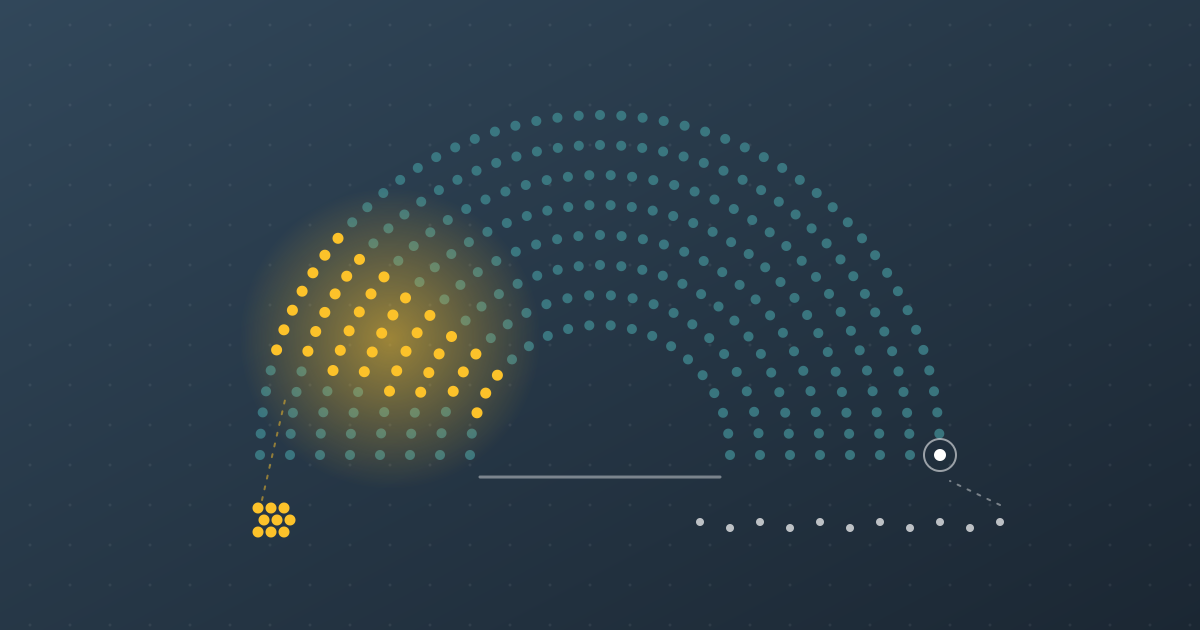
- Then a long mist-blue row faces a smaller teal group
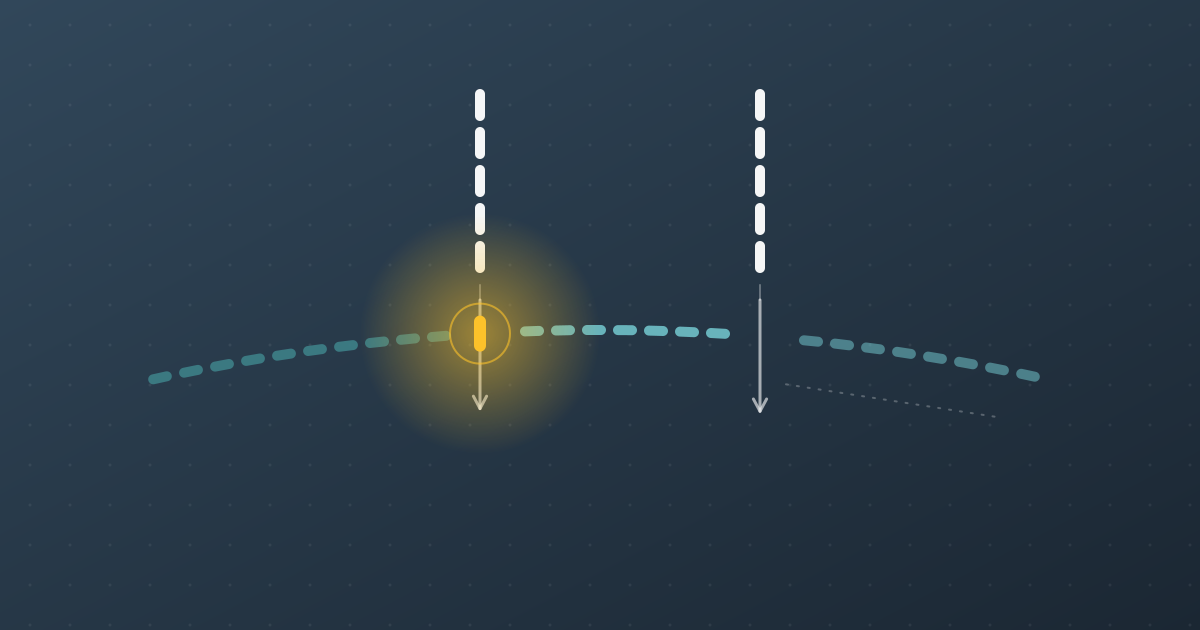
- Two golden lines cut the row into parts, the teal dots mass in gold against one part after another, and finally all the dots close into a circle
How the principle shows up in practice
Horatio Nelson, Trafalgar
In 1805, a smaller British fleet cuts the enemy line and defeats its parts with local superiority. Frederick William Lanchester used exactly this plan as his example.
The SNP, the 2015 general election
With 4.7%, concentrated in Scotland, the SNP wins 56 seats; UKIP, with 12.6% spread widely, wins one. Under first-past-the-post, concentration decides, not quantity.
VHS versus Betamax
JVC pools the strength of many manufacturers in one format and beats Sony’s technically good Betamax. The pooled alliance grows faster than the single company.
Where are you spreading yourself thin?
Get your profile across all 12 groups in about 10 to 15 minutes.
Start the Strategy CheckGroup 2: Forces and Resources
Guiding question: Where do you commit your forces, and how long will they last?
Stage 3 of 5: Choose the path
- TraditionClassical Theory of War
Carl von Clausewitz, Antoine-Henri Jomini, Helmuth von Moltke the Elder, Frederick William Lanchester
Where the 92 principles come from: eight traditions of strategy, from classical war theory to dealing with uncertainty.
More about the originBackground: WEGVISOR’s own selection from the strategy literature · More about the origin