Horatio Nelson, Trafalgar and the Square Law of Strength
At Trafalgar in 1805, the British fleet is smaller than the Franco-Spanish one. Horatio Nelson wins anyway because he cuts the enemy line and strikes only one part of the enemy at a time with concentrated force.
Ten teal dots face five mist-blue dots; above both, the numbers grow into their squares, 100 and 25, and fine lines show how the five fall while only one or two of the 10 fade. Then a long mist-blue row faces a smaller teal group; two golden lines cut the row into parts, the teal dots mass in gold against one part after another, and finally all the dots close into a circle.
Principle #10
Square Law of Strength: If you concentrate your forces, you win not just a little more but disproportionately more – and if you spread them out, you lose disproportionately.
4 min read4 sectionsSituationLink to the principle
Contents
Frederick William Lanchester was an engineer, an automobile pioneer and one of the first theorists of aviation. In 1916, he published the book “Aircraft in Warfare.” It contains a calculation that has since become known as the square law: when two sides direct aimed fire at each other, fighting strength grows not with the number of units but with its square. As historical evidence, Lanchester did not choose a battle of his own time. He went back to a naval battle of 1805: Trafalgar – an example of the Square Law of Strength.
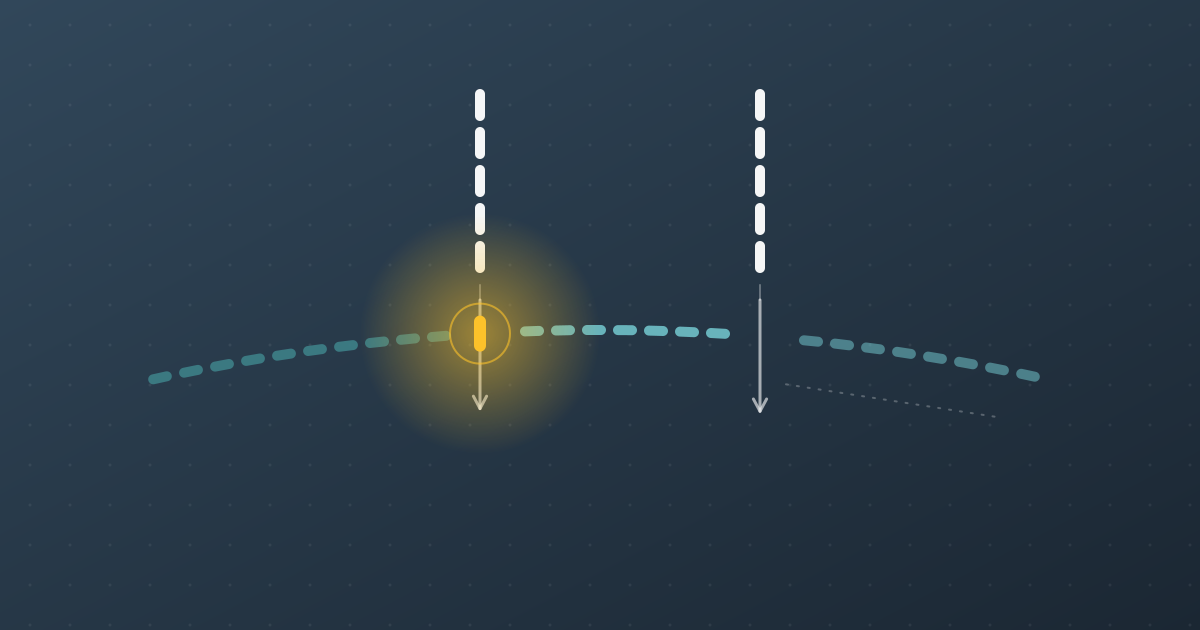
Two columns thrust down across a long line of ships and cut it in gold – like Horatio Nelson at Trafalgar.
01
An outnumbered fleet
Situation
On October 21, 1805, off Cape Trafalgar on Spain’s Atlantic coast, 27 British ships of the line meet 33 French and Spanish ones. The allied fleet is commanded by Vice Admiral Pierre-Charles Villeneuve, with the Spanish ships under Admiral Federico Gravina. The British are led by Vice Admiral Horatio Nelson, with Vice Admiral Cuthbert Collingwood as his second in command.
Link to the principle
According to the square law, a ship-against-ship fight in two long lines would have ended badly for the British. A sample calculation in which all ships count as equally strong: 33 squared is 1,089, and 27 squared is 729. On paper, the larger fleet would keep around 19 ships, while the smaller one would be destroyed. Through the square, a difference of six ships becomes a clear advantage.
02
The plan: cut the line
Situation
On October 9, 1805, almost two weeks before the battle, Nelson gives his captains a memorandum with his plan of attack. Instead of sailing parallel to the enemy line, as was customary at the time, the British are to bear down on the enemy in columns, almost at right angles, and break through the line. In the battle, Nelson in the Victory leads one column against the center, and Collingwood in the Royal Sovereign leads the other against the rear. Nelson aims at a point just ahead of Villeneuve’s flagship, the Bucentaure.
Link to the principle
This is the square law translated into practice. If you cut the line, you no longer fight 33 ships at once but only parts of them. Assume that the van is out of action for a while and only the center and rear are fighting, and the calculation changes completely: 27 against around 23 ships gives 729 against 529 – a clear British advantage. Lanchester read Nelson’s memorandum in exactly this way: as a plan to mass his own strength in one place and defeat the enemy piece by piece.
03
What happened in the battle
Situation
The approach costs the heads of the columns dearly because they come under fire without being able to answer with their broadsides. Then the line breaks, and a close-quarters melee develops in which British ships fire on individual opponents from several sides. Nelson is hit by a musket ball fired from the rigging of the Redoutable and dies a few hours later. The British do not lose a single ship. Depending on how they are counted, the allies lose 18 to 22 ships of the line, most of them captured. In the storm after the battle, many of these prizes sink or run aground; only four reach England.
Link to the principle
The losses show the imbalance that the square law predicts. If you are locally superior, you lose little, because the enemy quickly loses firepower. According to the usual figures, the British counted 458 dead, the allies around 4,400 dead and 7,000 to 8,000 taken prisoner. That is not a slightly better result but a disproportionate one.
04
What the law does not explain
Situation
Trafalgar is not a laboratory experiment. The British crews were better trained and fired faster. Many allied ships were poorly manned. The allied van under Rear Admiral Pierre Dumanoir intervened late and only in part. Later comparisons with land battles, such as those in the Ardennes or at Kursk, also suggest that in reality fighting strength grows with an exponent between 1 and 1.5 rather than exactly with the square. That is how an article in Pointer, the journal of the Singapore Armed Forces, sums it up.
Link to the principle
The principle remains valid, just less mathematically. Concentration pays off disproportionately; fragmentation costs disproportionately. How strong the effect is depends on training, leadership and the situation.
Key takeaways
Key lessons
01
Do not just count your forces; ask how many you are facing at the same time.
02
Divide the enemy before you attack instead of dividing yourself.
03
A small edge in the right place grows into a large one as things unfold.
04
Expect costs during the approach: on the way to concentration, you are often vulnerable.
05
Treat formulas as a thinking aid, not as a prediction.
Summary
At Trafalgar, a smaller British fleet faced a larger one. Horatio Nelson did not allow it to become an even exchange of blows. He cut the enemy line and so fought parts of the enemy with superior force. Frederick William Lanchester used this plan as an example of his square law: concentrated force has a disproportionate effect. The calculation is a simplification, but the basic idea has proven sound.