In 2004, the Lego Group is on the verge of collapse. In 2005, the new chief executive Jørgen Vig Knudstorp and owner Kjeld Kirk Kristiansen sell the Legoland parks, keep only a stake and concentrate their scarce resources on the core: the bricks. Within a year, Lego is back in the black.
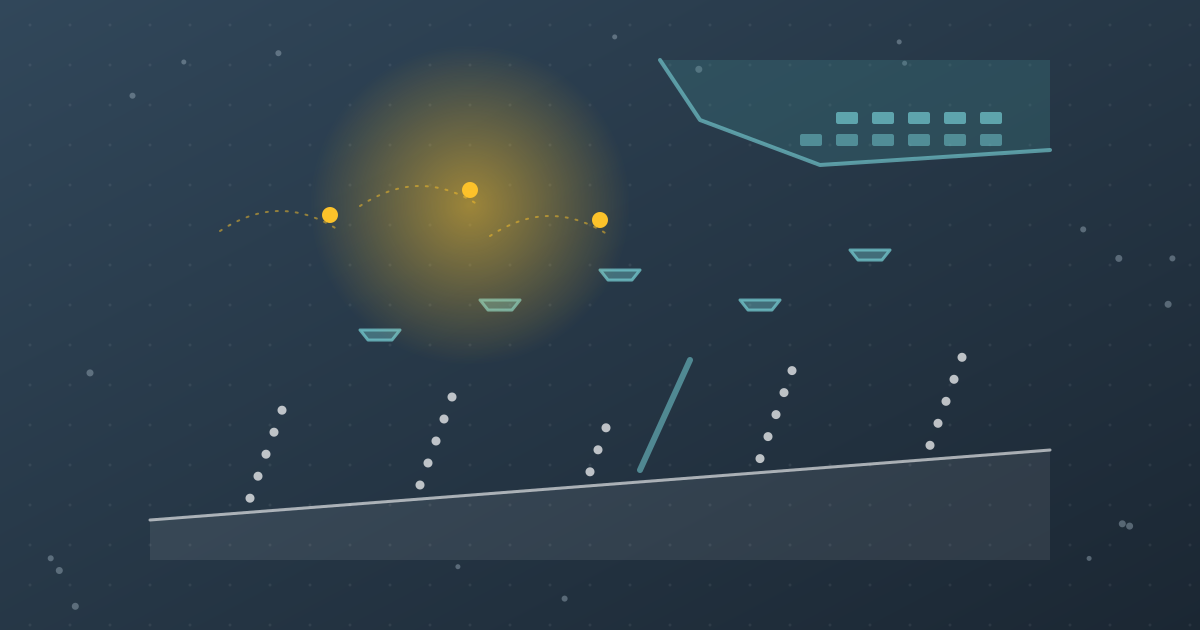
A large circle in the center and two small circles at the edge receive equal numbers of mist-blue dots from a single source; the large one stays pale while the small ones overflow. Restart: the outer circles get a few targeted dots, just enough to stay teal, and the main stream goes into the center circle, which grows golden; when one outer circle briefly fades, a single dot saves it.
Principle #9
Economy of Force: Give secondary theaters only as much as they need to hold, so that the main theater gets enough.
3 min read5 sectionsSituationLink to the principle
Contents
Economy of Force does not only mean keeping secondary theaters lean. Sometimes it means handing them over, but without losing them. Lego’s rescue in the mid-2000s shows this form: a business that helps the brand but ties up resources goes to others who can run it better. The core gets whatever is freed up.
A golden brick with eight studs stands in the center, while a Ferris wheel and other side businesses fade and move aside – like Lego under Knudstorp.
01
A company in too many fields
Situation
Around the turn of the millennium, Lego had expanded in many directions: theme parks, video games, media and a host of new product lines. In 2003, the group posted a loss of DKK 1.4 billion. In 2004, it lost DKK 1.93 billion on revenue of around DKK 7.9 billion, including the parks. Almost 1,000 employees lost their jobs in 2004.
Link to the principle
The company’s forces were tied up in too many places. The parks absorbed capital and management attention in a business connected to the toys only through the brand. The core – the bricks and sets – was no longer getting enough.
02
An owner who makes room
Situation
In October 2004, Kjeld Kirk Kristiansen, grandson of the company’s founder, stepped down as chief executive and put DKK 800 million of his private fortune into the company. Day-to-day management passed to Jørgen Vig Knudstorp, a former management consultant who was then in his mid-thirties.
Link to the principle
Economy of Force needs people who are willing to scale back their own pet projects too. The fact that the owner himself put in money and made room gave the new direction credibility.
03
Handing over the parks without losing them
Situation
In July 2005, Lego sold its four Legoland parks in Denmark, England, Germany and California to the investment firm Blackstone for €375 million. The parks were merged with Merlin Entertainments. Lego received 30% of the new Merlin group and seats on its board. Kjeld Kirk Kristiansen explained the move by pointing to a shrinking, fiercely competitive toy market and the aim of focusing on closeness to customers and on the core products.
Link to the principle
This is the subtle point. The parks remained important for the brand, but they were not a place where Lego should spend its scarce resources. Lego handed over operations and kept its influence. The secondary theater received as much attention as it needed: that of a co-owner, not of an operator.
04
Tidying up the details
Situation
At the same time, Lego cut costs, closed its plant in Baar, Switzerland, in 2004 and streamlined its product range. According to the innovation researcher David C. Robertson, the number of different components fell significantly, because many special bricks had been made for just a single set.
Link to the principle
Economy of Force also works on a small scale. Every special part costs molds, storage space and planning. If you reduce variety to what is necessary, you free up resources for what customers really want.
05
The comeback
Situation
For 2005, Lego was back in profit, reporting DKK 702 million. In the years that followed, the company grew strongly. In 2011, revenue again rose significantly, driven in part by Ninjago, a new line of its own. In the first half of 2015, net profit exceeded DKK 3.5 billion.
Link to the principle
The freed-up strength flowed into what makes Lego Lego: bricks, sets and stories built around building. Selling the parks was not a retreat from the brand but the precondition for making the core strong again.
Key takeaways
Key lessons
01
Check which fields are connected to your core only through your name.
02
Hand over secondary theaters when others can run them better.
03
Keep your influence where the secondary theater remains important to you.
04
Tidy up the details too: variants, parts, processes.
05
Put freed-up resources to work in the core immediately.
Summary
In the early 2000s, Lego had spread itself across too many fields, and by 2004 it was on the verge of collapse. Under Jørgen Vig Knudstorp, and with the commitment of owner Kjeld Kirk Kristiansen, the company sold the Legoland parks in 2005 but kept 30% of the new operating group. At the same time, it cleaned up its product range and costs. The freed-up strength went into the core. The story shows Economy of Force as smart divestment: the secondary theater stays connected but no longer ties up scarce resources.
David C. Robertson, Bill Breen: Brick by Brick: How LEGO Rewrote the Rules of Innovation and Conquered the Global Toy Industry. New York: Crown Business 2013.
Back to the basics
Read what lies behind Economy of Force: with explanation, animation, video and research.