Since 1946, the Fulbright Program has invited students and researchers from around the world to take part in exchanges. It forces no one and buys no one. And yet more than 40 of its participants later led their countries as head of state or government.
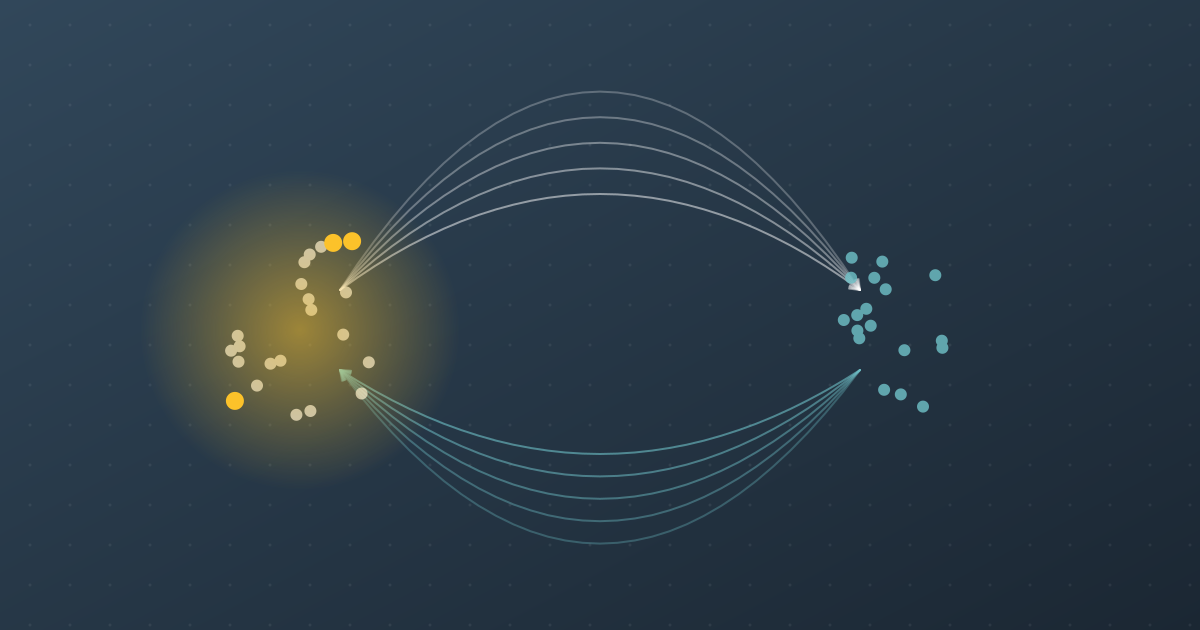
On the left a teal bar shoves a group of mist-blue dots forward in jerks; when it lets go, they roll back. On the right a gold circle lights up, the dots approach on their own and carry the light onward, until the circle points in a different direction from the one it is moving in, flickers and some dots drift away.
Principle #54
Soft Power: If you win others over through attraction, credibility and example, you need to threaten or pay less, and what you gain that way lasts longer.
3 min read4 sectionsSituationLink to the principle
Contents
The American political scientist Joseph S. Nye Jr. distinguishes between two kinds of power. Hard power coerces or pays: armies, sanctions, money. Soft power attracts: you get what you want because others want it too. A country whose culture, values and policies seem attractive has to push less. Hardly any instrument shows Soft Power as clearly as a scholarship program that was created after the Second World War.
Between two groups, dots travel back and forth in many arcs; among those who have returned, a few glow golden – as in the Fulbright Program.
01
An idea after the war
Situation
In 1946, Senator J. William Fulbright of Arkansas introduces a bill in Congress to create an international educational exchange. Congress passes it, and President Harry S. Truman signs it into law. The aim is mutual understanding between the people of the United States and those of other countries.
Link to the principle
The program is born at a moment of overwhelming American superiority. The United States could have relied on military and economic strength. Fulbright bets on something else: personal encounters. People who know a country from their own experience judge it differently from those who know it only from the news.
02
Exchange, not an assignment
Situation
According to the U.S. Department of State (as of 2025), the program awards around 8,000 grants a year to students, researchers, teachers, artists and professionals from the United States and more than 160 countries. Since its beginning, more than 400,000 people have taken part. In 49 countries there are binational Fulbright commissions whose boards are made up of citizens of both countries. The program is funded by the U.S. Congress, and many partner countries contribute substantially.
Link to the principle
Fulbright asks nothing of its participants except that they learn. There is no political assignment and no obligation. That is precisely where its effect lies. Soft power works only when it doesn’t smell of an agenda. The binational commissions also make the program a partnership rather than a one-way street.
03
What became of the participants
Situation
According to the U.S. Department of State, 62 Nobel Prize winners, 89 Pulitzer Prize winners and more than 40 current or former heads of state or government have taken part in the program. They include Fernando Henrique Cardoso, president of Brazil from 1995 to 2003; Juan Manuel Santos, president of Colombia from 2010 to 2018; Ashraf Ghani, president of Afghanistan from 2014 to 2021; Rishi Sunak, British prime minister from 2022 to 2024; and King Felipe VI of Spain.
Link to the principle
This list is the most visible fruit of soft power. Someone who has spent years in a country, made friends there and experienced its universities carries that picture into later office. That guarantees no agreement, but it creates channels, trust and a shared language. No army can produce anything like it.
04
The limits of attraction
Situation
In office, former grantees pursue the interests of their own countries, not those of the United States. Some governments led by former participants have failed; Ashraf Ghani’s presidency, for example, ended in 2021 with the Taliban takeover. And the program depends on political decisions in Washington, which can change. In June 2025, 11 of the 12 members of its supervisory body, the Fulbright Foreign Scholarship Board, resigned. They accused the U.S. government of injecting political requirements into the program and of withholding awards from selected grantees.
Link to the principle
Soft power is not a steering instrument. It works slowly, indirectly and without guarantees. It shapes attitudes, not decisions. And it is vulnerable: a country that loses its credibility also loses its power of attraction. The effect of decades can be squandered faster than it was built.
Key takeaways
Key lessons
01
Invite people instead of talking them into things.
02
Genuine encounters convince more than any advertising.
03
Ask for nothing when you want to build trust.
04
Think in decades, not quarters.
05
Your power of attraction depends on your credibility.
Summary
Since 1946, the Fulbright Program has brought people from more than 160 countries to the United States and Americans abroad. It asks for nothing but learning and personal encounters. That is exactly why it works: among its more than 400,000 participants are dozens of later heads of state and government. The program shows what Joseph S. Nye Jr. calls soft power. It also shows its limit: attraction shapes attitudes, but it does not steer policy.