The principle in detail
Three steps through the principle: grasp it, place it, put it to work. Open each topic on its own.
The core messageCore statement and 3 clarifications
If you attract others through credibility, values and example, you need threats and payment less often.
- It does not say
- That soft power is weakness. Friendliness without clear expectations does not earn respect.
- It does not say
- That soft power alone is enough. Against an opponent who is determined to use force, it falls short; Joseph S. Nye Jr. later spoke of smart power, the skillful combination of hard and soft means.
- It also says
- Soft power is not an image. If you only advertise and act differently, people will see through you.
The explanationSoft power cannot be manufactured, only cultivated.
- Soft power cannot be manufactured, only cultivated.
- It grows out of how you live, the values you stand for and the way you treat others.
- As soon as someone notices that friendliness is just a technique, the attraction disappears.
Why would anyone follow you if you could neither threaten nor pay?
The signs3 signs when you heed it · 3 when you overlook it
- People volunteer for tasks without your luring or pushing them.
- What you say and what you do match, even when it costs you something.
- Your team represents what you stand for even when you are not there.
- Cooperation depends on bonuses and oversight.
- You polish your image, but your actions tell a different story.
- A single broken promise costs you trust that took years to grow.
The backgroundTradition T4 Political Prudence
- 1990OriginJoseph S. Nye Jr.
Bound to Lead
- 2004Developed furtherJoseph S. Nye Jr.
Soft Power
- undatedSupplementedConfucius
A ruler who governs by virtue is like the North Star, around which the other stars take their places …
- Tradition T4TraditionPolitical Prudence
Thucydides, Niccolò Machiavelli, Baltasar Gracián
See the tradition on the Origin page
Read more: the full background
From Joseph S. Nye Jr.’s book “Bound to Lead” and his essay “Soft Power” (both 1990), developed further in “Soft Power” (2004). Supplemented by the Analects of Confucius (Book 2.1).
The research4 sources: 3 theories, 1 classic · 1990–2004 · with limitations of the research
- weak
- moderate
- strong
An influential concept with a clear theory, but hardly measured; the claim that attraction lasts longer than pressure and money has not been tested.
- 1990Joseph S. Nye Jr.
“Soft Power,” Foreign Policy 80: power consists not only of military and economic might but also of the ability to get others to want the same things.
- 1990Joseph S. Nye Jr.
“Bound to Lead”: introduces the term in the debate over American decline.
- 2004Joseph S. Nye Jr.
“Soft Power”: culture, political values and a foreign policy seen as legitimate as its sources; many of these resources lie outside the control of governments.
- Soft power is hard to measure and hard to steer.
- Much of it is created not by governments but by universities, churches, companies and culture.
- It works slowly and comes with no guarantee: people who are attracted still pursue their own interests.
- Against an opponent who is determined to use force, it is not enough on its own.
- It can be abused when attraction becomes a staged performance that conceals one’s own goals.
- Joseph S. Nye Jr. writes about states; applying his idea to leadership in teams is our own extension.
Read more: what research shows
Joseph S. Nye Jr. coined the term soft power in 1990, in his book “Bound to Lead” and in an essay in the journal Foreign Policy. He defines soft power as the ability to get others to want what you want, instead of moving them with threats or payment. In 2004 he developed the idea further in “Soft Power” and named three sources: culture, political values and a foreign policy that others regard as legitimate. The idea is older. In the Analects of Confucius, a ruler who governs by virtue is likened to the North Star, around which the other stars take their places. Soft power is hard to measure; rankings capture mainly resources, not actual effect. The claim that it lasts longer than hard power is a hypothesis, not a measured result.
The related principles47 Unity of Leaders and People · 53 Four Means · 55 Strategic Narrative · 92 The Soft Overcomes the Hard
To go deeper, see 55 Strategic Narrative (a credible story is one of the strongest sources of soft power) and 47 Unity of Leaders and People (if you win people over inwardly, you have the deepest source of strength on your side)
53 Four Means places soft power among the first two means, persuasion and gifts
92 The Soft Overcomes the Hard describes the same idea in Eastern philosophy
Read more: the full text
To go deeper, see 55 Strategic Narrative (a credible story is one of the strongest sources of soft power) and 47 Unity of Leaders and People (if you win people over inwardly, you have the deepest source of strength on your side); 53 Four Means places soft power among the first two means, persuasion and gifts. 92 The Soft Overcomes the Hard describes the same idea in Eastern philosophy.
The action steps5 action steps: Model what you expect from others, especially when it costs you something.
Model what you expect from others, especially when it costs you something.
- Keep your promises. Credibility grows slowly and can be lost with a single breach.
- Combine friendliness with clear expectations. Attraction without standards comes across as arbitrary.
Make visible what your team stands for, and let others experience it instead of merely claiming it.
- Check where you currently threaten or pay, and ask what example and trust could achieve there. Where hard means are necessary, use them openly and within limits.
The reflection questions3 questions: What would the people on your team recommend you for?
- What would the people on your team recommend you for?
- Where does what you say not match what you do?
- Which task does your team do only because you order it or pay for it?
Take your time with one question. Write down your answer – or talk it over with someone you trust.
The picture to rememberThe animation once more, with an explanation
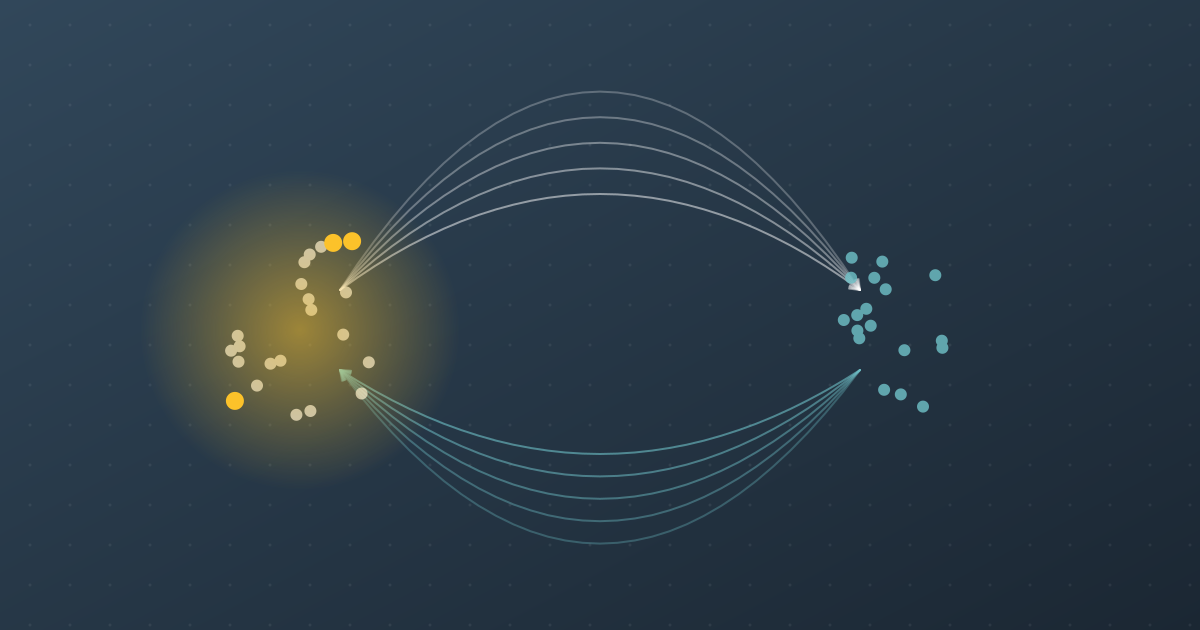
- On the left a teal bar shoves a group of mist-blue dots forward in jerks
- When it lets go, they roll back
- On the right a gold circle lights up, the dots approach on their own and carry the light onward, until the circle points in a different direction from the one it is moving in, flickers and some dots drift away
How the principle shows up in practice
The Fulbright Program
Since 1946, it has invited people from more than 160 countries to take part in exchanges without asking anything in return; its participants include more than 40 later heads of state and government.
Taizé and Brother Roger
A small ecumenical community in Burgundy draws tens of thousands of young people every year and deliberately sends them back to their own churches.
Patagonia, 2011
With its Black Friday ad “Don’t Buy This Jacket” and genuine repair and take-back offers, the company gains a credibility that no discount can buy.
Why do people follow you?
Get your profile across all 12 groups in about 10 to 15 minutes.
Start the Strategy CheckGroup 7: People, Morale and Power
Guiding question: What moves people to go along or to resist?
Stage 4 of 5: Act with others
Where the 92 principles come from: eight traditions of strategy, from classical war theory to dealing with uncertainty.
More about the originBackground: WEGVISOR’s own selection from the strategy literature · More about the origin