The principle in detail
Three steps through the principle: grasp it, place it, put it to work. Open each topic on its own.
The core messageCore statement and 3 clarifications
Hardness needs something hard to push against. If you don’t strike back, you deprive the other side of its pretext and often of its justification as well.
- It does not say
- That you should yield on the goal. The Mothers of the Plaza de Mayo yielded in form, never in their goal.
- It does not say
- That the soft always wins. In 1989, a peaceful movement in Tiananmen Square in Beijing was crushed.
- It also says
- The principle must never be used to demand that weaker people be patient with injustice.
The explanationSoft does not mean weak, and yielding does not mean giving up.
Soft does not mean weak, and yielding does not mean giving up. The soft has a discipline of its own: firm at the core, flexible in form, patient over time.
Where do you yield in form, and where do you hold on to the goal?
The signs3 signs when you heed it · 3 when you overlook it
- You absorb resistance, ask questions and redirect it instead of breaking it head-on.
- You calmly raise an important concern again and again.
- You yield in tone and approach and stay clear on substance.
- You answer hardness with more hardness, and the dispute gets louder.
- You pull rank as soon as success is slow in coming.
- Or you give in completely and call it gentleness.
The backgroundTradition T2 Eastern Strategy
- 4th/3rd c. BCOriginLaozi
Tao Te Ching, chapters 43, 76 and 78 (in German)
- 2011SupplementedErica Chenoweth and Maria J. Stephan
Why Civil Resistance Works
- Tradition T2TraditionEastern Strategy
Sun Tzu, Kautilya, the Thirty-Six Stratagems, the Tao Te Ching, Miyamoto Musashi, François Jullien
See the tradition on the Origin page
Read more: the full background
The principle comes from chapters 43, 76 and 78 of the Tao Te Ching, which Chinese tradition attributes to Laozi; the work probably took its present form in the 4th or 3rd century BC. In the German-speaking world, it became known through Richard Wilhelm’s translation (1911). It is supplemented by the research of Erica Chenoweth and Maria J. Stephan, “Why Civil Resistance Works” (2011).
The research4 sources: 2 primary studies, 1 classic, 1 review · 2011–2026 · with limitations of the research
- weak
- moderate
- strong
The core statement is a philosophical idea; the empirical finding concerns only resistance movements and has been called into question by a 2026 replication.
- 2011Erica Chenoweth and Maria J. Stephan
“Why Civil Resistance Works”: resistance movements 1900–2006; nonviolent campaigns succeeded more than twice as often as violent ones, partly because of broader participation and shifts in loyalty within the power apparatus.
- 2020Erica Chenoweth
“The Future of Nonviolent Resistance” in the Journal of Democracy 31 (3): nonviolent resistance was more widespread than ever in the 2010s, but its effectiveness had begun to decline.
- 2026Charles Crabtree and John Holbein
Working paper replicating the data of Erica Chenoweth and Maria J. Stephan: results partly misreported and dependent on the choice of model; a strong, unconditional advantage of nonviolent campaigns is not established.
- The soft does not always win.
- Nonviolence works above all against an opponent that depends on legitimacy or on its own people.
- According to Erica Chenoweth (2020), the effectiveness of nonviolent movements has declined since around 2010, and the advantage itself has been disputed since 2026.
- The claim that yielding and persistence win out in organizations in the long run is an extrapolation, not a measurement.
- And the principle must never be used to demand that victims be patient with injustice.
Read more: what research shows
The principle comes from the philosophy of the Tao Te Ching, where it is an image, not a finding: water is the softest of things and yet overcomes the hard; the living is soft and supple, the dead hard and rigid. A related idea has been tested empirically. Erica Chenoweth and Maria J. Stephan analyzed resistance movements from 1900 to 2006: nonviolent campaigns succeeded more than twice as often as violent ones. As reasons, they cite broader participation and defections by parts of the power apparatus. A replication by Charles Crabtree and John Holbein (2026) concludes that the data do not support such a clear advantage; they do not infer from this that nonviolence does harm. None of these studies measured anything about leadership in everyday life.
The related principles27 Victory without Fighting · 31 Indirect Approach · 44 Annihilation and Exhaustion · 54 Soft Power
To go deeper, see 31 Indirect Approach (avoiding a frontal attack on the strongest point) and 44 Annihilation and Exhaustion (the soft usually wins by exhaustion, not by a quick blow)
54 Soft Power applies the idea to attraction and legitimacy
27 Victory without Fighting likewise seeks success without using up your own strength in a clash
Read more: the full text
To go deeper, see 31 Indirect Approach (avoiding a frontal attack on the strongest point) and 44 Annihilation and Exhaustion (the soft usually wins by exhaustion, not by a quick blow); 54 Soft Power applies the idea to attraction and legitimacy. 27 Victory without Fighting likewise seeks success without using up your own strength in a clash.
The action steps5 things you can actually do
In a deadlocked conflict, write down what your goal is and where you can yield without losing it.
Answer the next hard objection with a question instead of a counterargument.
- Give the other side no reason to harden in return: no reproach, no threat, no mockery.
- Plan important concerns in months, not in a single meeting. Raise them again regularly and calmly.
- Check whether someone around you is being pressured to keep quiet. Demand softness of yourself, not of those who are weaker.
The reflection questions3 questions: Where are you currently answering hardness with hardness?
- Where are you currently answering hardness with hardness?
- Where could you yield in a deadlocked conflict without giving up your goal?
- Which concern do you lack the patience to pursue calmly for a few more months?
Take your time with one question. Write down your answer – or talk it over with someone you trust.
The picture to rememberThe animation once more, with an explanation
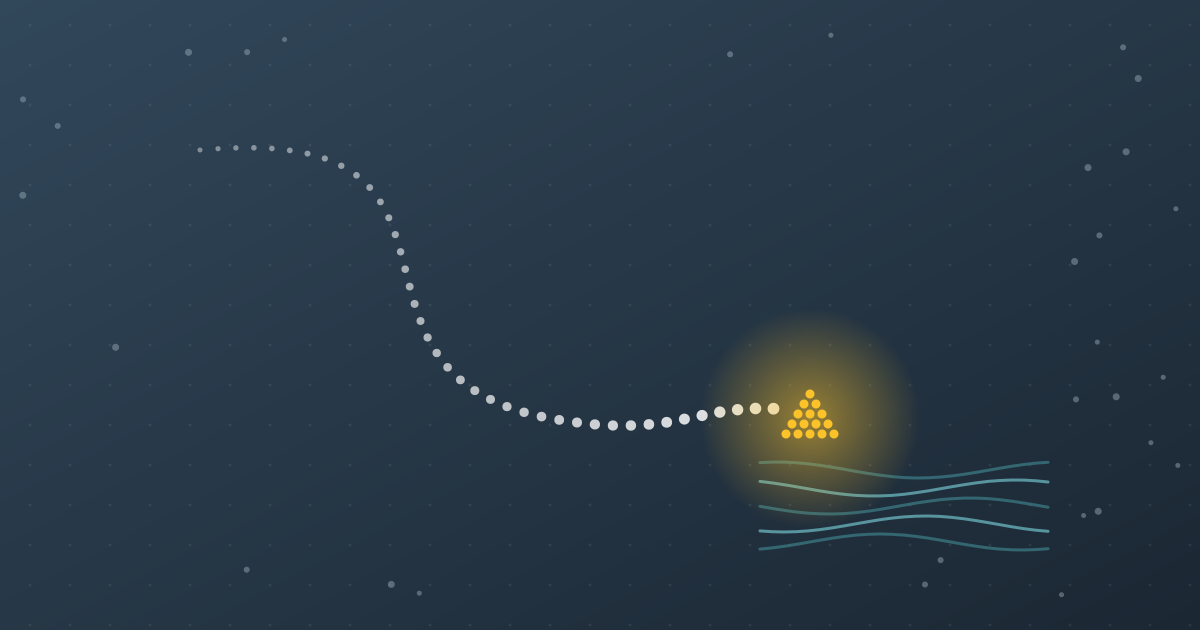
- A gold drop falls again and again onto a hard block of teal lines until an arch and finally a passage form in it
- Then a rigid line breaks in the mist-blue storm, while a gold arc bends and straightens up again
- In the final image an onrushing circle hits nothing, because the gold circle evades it and deflects it
How the principle shows up in practice
The Mothers of the Plaza de Mayo
Starting in 1977, mothers of the disappeared walk peacefully across the square in Buenos Aires every Thursday. They outlast the junta and force a reckoning with the past.
Leipzig, October 9, 1989
Around 70,000 people march around the ring road with candles, chanting “No violence.” The state finds no hard opponent and pulls back.
Jigorō Kanō
In 1882, he founds the Kodokan in Tokyo and teaches judo, the gentle way that uses the opponent’s strength. Later, he sums it up in the principle of the best use of energy.
Where do you answer hardness with hardness?
Get your profile across all 12 groups in about 10 to 15 minutes.
Start the Strategy CheckGroup 12: Eastern Philosophy of Strategy
Guiding question: How do you make use of what the situation itself provides?
Stage 5 of 5: Persevere and adapt
- TraditionEastern Strategy
Sun Tzu, Kautilya, the Thirty-Six Stratagems, the Tao Te Ching, Miyamoto Musashi, François Jullien
Where the 92 principles come from: eight traditions of strategy, from classical war theory to dealing with uncertainty.
More about the originBackground: WEGVISOR’s own selection from the strategy literature · More about the origin