On July 4, 1954, in the World Cup final in Bern, West Germany beats Hungary, a team considered unbeatable, 3–2. Fighting spirit, rain and clever preparation tip the balance. The match shows how passion, chance and reason work together.
Three dots in teal and mist-blue form the corners of a triangle; in the middle, a golden circle hangs from a fine line and swings, drawn now toward one corner, now toward another, its path never tracing the same line twice. Then one corner fades, a straight line shows the planned route, and the golden circle still veers off, because the faded corner keeps pulling.
Principle #20
Paradoxical Trinity: Every conflict is shaped at once by passion, chance and reason, and if you overlook one of these three forces, you miscalculate.
4 min read5 sectionsSituationLink to the principle
Contents
Carl von Clausewitz called war a “paradoxical trinity.” Three forces are at work in it at the same time: primordial violence with hatred and enmity, the play of probability and chance, and sober reason, which treats war as an instrument of policy. None of the three, he said, may be ignored. A soccer match is not a war. But hardly any match shows as clearly as the 1954 final that an outcome arises from all three forces at once.
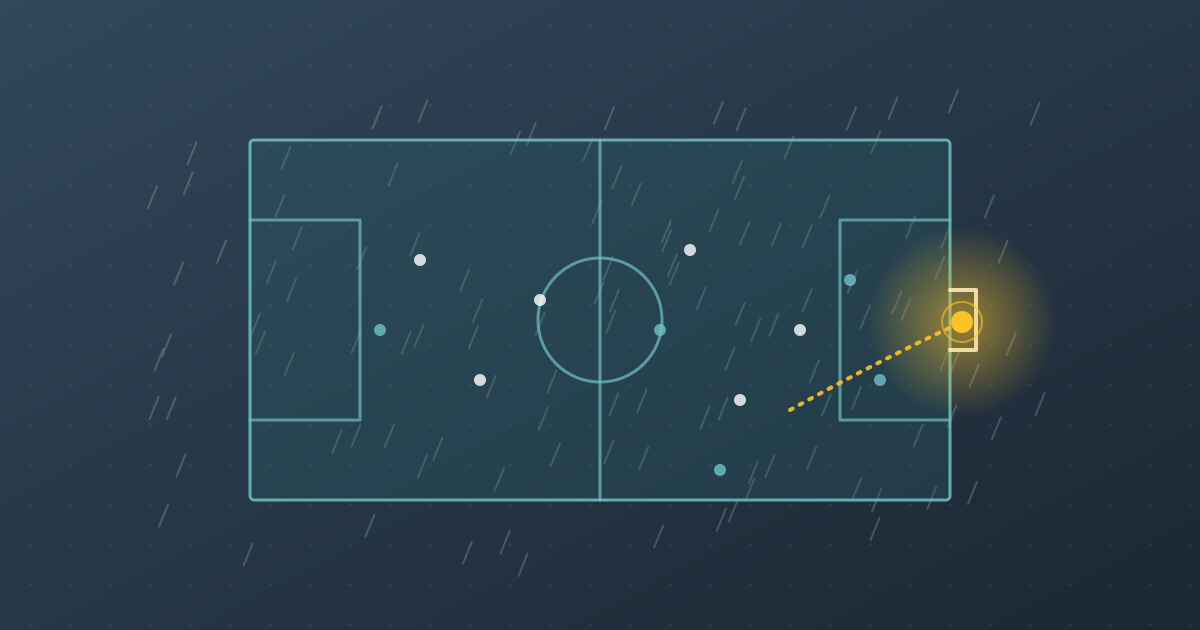
A playing field in heavy rain; between white and teal dots, a golden ball flies into the goal – as in the Miracle of Bern in 1954.
01
A favorite and an underdog
Situation
Hungary travels to the World Cup in Switzerland as the clear favorite. The team is the 1952 Olympic champion and has gone 31 official matches unbeaten. In the group stage, it meets West Germany and wins 8–3. In that match, national coach Sepp Herberger has deliberately rested several regular players. West Germany nonetheless advances to the next round via a play-off against Turkey (7–2).
Link to the principle
Here reason is at work. Herberger accepts a heavy defeat, apparently to save strength for the decisive matches. That is not passion but calculation. It is the side of the trinity that Clausewitz assigns to the government: thinking in terms of purposes.
02
Rain over Bern
Situation
The final takes place on July 4, 1954, at the Wankdorf Stadium in Bern, in front of around 62,500 spectators. It is raining heavily. In Germany, such weather later came to be called “Fritz Walter weather,” because the German captain Fritz Walter is said to have played especially well in the rain. Hungary’s star Ferenc Puskás returns to the lineup, even though he had injured his ankle in the group match against West Germany.
Link to the principle
This is chance. No one plans the weather on the day of a final. No one can say for sure how fit an injured player is. These factors lie beyond anyone’s control, and yet they change the game. Clausewitz assigns this side to the commander and his army, that is, to those who have to deal with the unforeseeable on the field.
03
The screw-in studs
Situation
The German team plays in boots with interchangeable screw-in studs that suit the wet field. Adi Dassler, the founder of Adidas, equips the team. The legend that he invented screw-in studs, however, is not true. According to the German Patent and Trade Mark Office, the shoemaker Alexander Salot from Blumenthal near Bremen filed a patent for them as early as 1949, and it was granted in 1951. There were other inventors even before him.
Link to the principle
Here reason and chance meet. No one could plan the rain, but you could prepare for it. If you cannot control chance, you can at least make sure it works in your favor. That is perhaps the most important lesson of the trinity: reason does not work against chance but with it.
04
Two goals down
Situation
After eight minutes, Hungary leads 2–0 through Puskás and Zoltán Czibor. The German team does not give up. Max Morlock scores in the tenth minute, and Helmut Rahn equalizes after about 18 minutes. Six minutes before the end, Rahn scores to make it 3–2. Shortly before the final whistle, Puskás scores again, but the goal is disallowed for offside.
Link to the principle
This is passion. A team that is two goals down after eight minutes, against an opponent that beat it 8–3 two weeks earlier, needs more than tactics. It needs will. And the disallowed goal shortly before the end shows how close together passion and chance lie.
05
What was told afterward
Situation
In the young Federal Republic of Germany, the victory becomes the “Miracle of Bern.” To this day, many see it as a moment when the country regained its self-confidence after the war. Later, rumors arise that German players received performance-enhancing substances before the final. The players spoke of glucose injections, and in 2004 the team doctor, Franz Loogen, spoke of vitamin C. A 2010 study to which Erik Eggers contributed considered it possible that some players were given the stimulant Pervitin without their knowledge. Doping was not yet prohibited in 1954.
Link to the principle
The memory of an event also follows the trinity. Passion turns a victory into a miracle. Reason asks questions. And much remains uncertain. If you want to understand what happened, you have to give all three forces their due.
Key takeaways
Key lessons
01
Reckon with all three forces: emotion, chance and calculation.
02
Prepare for chance instead of ignoring it.
03
Never underestimate the passion of a group that is already behind.
04
A favorite can fail because of things beyond its control.
05
Check legends, even if they sound good.
Summary
The 1954 World Cup final shows Carl von Clausewitz’s paradoxical trinity on a small scale. Herberger’s calculation in the group stage stands for reason, the rain and Puskás’s injury for chance, and the fighting spirit after going 2–0 down for passion. The screw-in studs show how reason can make chance useful. Only all three together explain the result.