Contents
Everyone knows that practice makes perfect. What was new in 1936 was that someone made learning in a factory measurable and derived a rule from it. Theodore Paul Wright was not an economics professor but an engineer from the aircraft industry. His observation later became known as Wright’s law and was generalized by the Boston Consulting Group into the Experience Curve.
An engineer from aircraft manufacturing
Situation
Theodore Paul Wright is born in 1895 in Galesburg, Illinois. He studies at Lombard College and the Massachusetts Institute of Technology and works for the Curtiss Aeroplane and Motor Company, one of the major aircraft manufacturers of the interwar period. In 1930, he receives the Wright Brothers Medal. His father is the economist Philip Green Wright; his brothers are the geneticist Sewall Wright and the political scientist Quincy Wright.
Link to the principle
The experience curve does not arise at a desk but in production. Wright watches airplanes being built in series and observes how labor time and costs change with every machine. The principle begins with looking closely.
The 1936 article
Situation
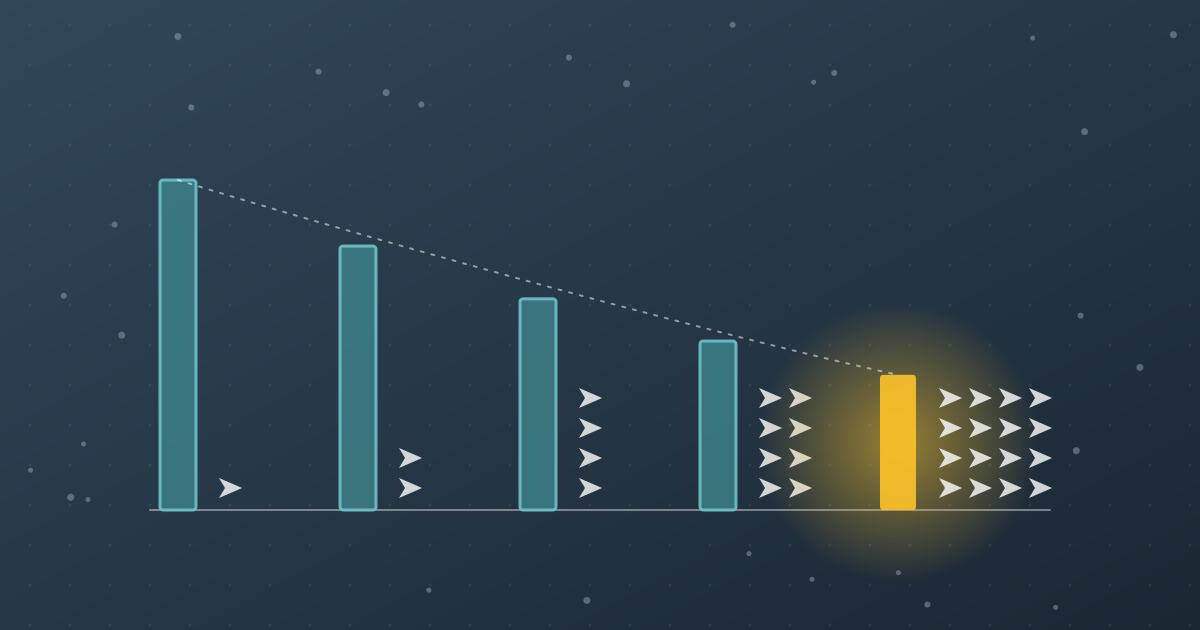
In February 1936, his article “Factors Affecting the Cost of Airplanes” appears in the Journal of the Aeronautical Sciences. In it, Wright describes how the cost per unit falls as the total quantity built rises. For the labor required per airplane, he observes a decline of about 20% with every doubling of the total number. From this, he develops a mathematical model that can be used to estimate future costs.
Link to the principle
One detail is decisive: Wright measures not by time but by cumulative quantity. So what matters is not how long a plant has existed but how much it has built in total. Whoever builds more, faster, learns faster. That is the heart of the experience curve.
What the rule means
Situation
A simplified calculation shows the effect. If the first airplane costs 100 units and costs fall by 20% with each doubling, the second costs 80, the fourth 64, the eighth about 51 and the sixteenth about 41. Costs keep falling, but every further step of 20% requires a doubling of the total quantity. At first, progress is quick; later, it is slow.
Link to the principle
A strategic insight follows from this. Whoever has a large market share early comes down the curve faster than their competitors. They can produce more cheaply and sell more cheaply. A latecomer with half the volume has permanently higher costs unless it catches up. Volume becomes a lead.
From the factory to strategy
Situation
Wright himself takes a different path. From 1944 to 1948, he heads the U.S. Civil Aeronautics Administration; after that, he is vice president for research at Cornell University until 1960. Strategists discover his rule later. In the 1960s, the Boston Consulting Group around its founder Bruce D. Henderson generalizes Wright’s model for entire industries and calls it the experience curve. Starting in 1968, Henderson puts the consequences for strategy at the center. In the 1960s and 1970s, the consulting firm’s studies find declines of between 10 and 25% per doubling, depending on the industry.
Link to the principle
An engineering rule turns into a strategy doctrine. Henderson draws far-reaching conclusions from it: market share pays off, cost advantages should be passed on to customers, and whoever fails to achieve enough share should exit a business.
What the rule does not say
Situation
Earlier still, in 1885, the psychologist Hermann Ebbinghaus had shown that people get better at memorizing with every repetition. Wright transfers this idea to an entire factory. Henderson later stresses that the learning curve and the experience curve are related but different. The experience curve covers more than the learning of individual workers: better processes, standardization, new technology, changes in design.
Link to the principle
Costs do not fall by themselves. They fall because people learn from experience and improve processes. If you merely produce without reviewing and improving, you won’t get the curve for free.
Key takeaways
Key lessons
- Measure your progress by volume, not only by time.
- At first you learn quickly; later you need many more repetitions.
- If you do a lot early on, you can become cheaper in the long run.
- Experience lowers costs only if you learn from it.
- Look closely before you lay down a rule.
Summary
Theodore Paul Wright observed in aircraft manufacturing that the labor required per airplane fell by about 20% with every doubling of the quantity built. His 1936 article made learning in the factory measurable. In the late 1960s, Bruce D. Henderson and the Boston Consulting Group turned it into the experience curve and a strategy built on market share and a cost lead.
Sources
- Theodore Paul Wright: Factors Affecting the Cost of Airplanes. In: Journal of the Aeronautical Sciences 3 (1936), no. 4, pp. 122–128.
- Bruce D. Henderson: Henderson on Corporate Strategy. Cambridge (Mass.): Abt Books 1979.