Richard Swanson, Solar Modules and the Experience Curve
In 1977, solar cells cost about $77 per watt; in 2014, just 36 cents. In 2012, The Economist gave the rule a name: Swanson’s law. With every doubling of cumulative shipped volume, module prices fall by about 20%. It is the Experience Curve in one of the most important industries of our time.
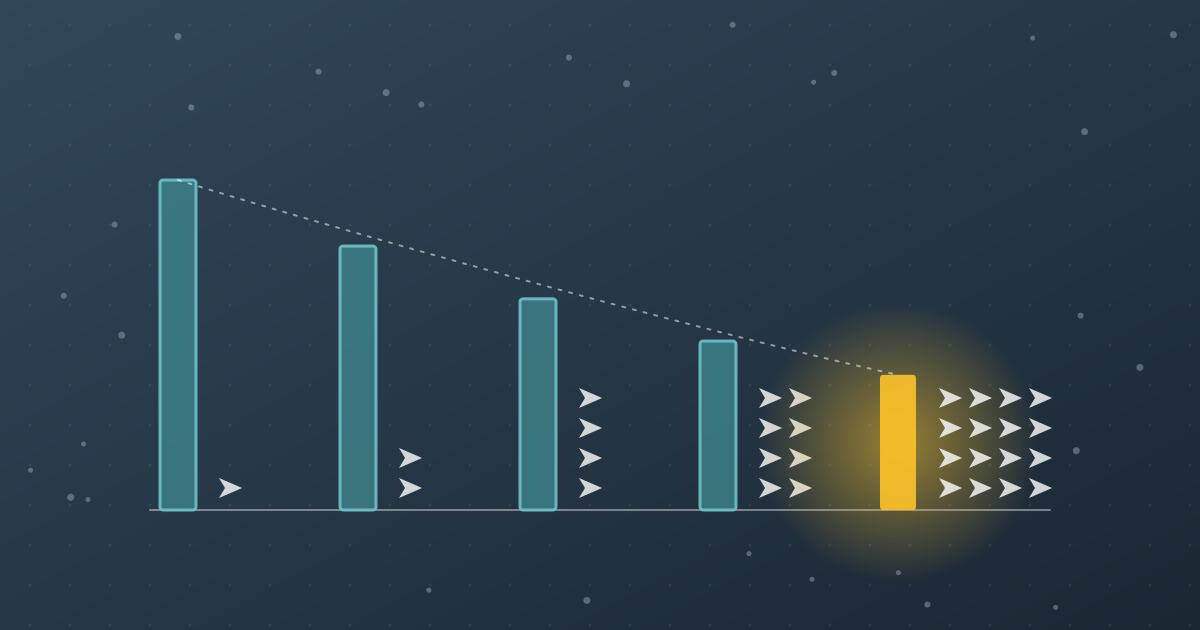
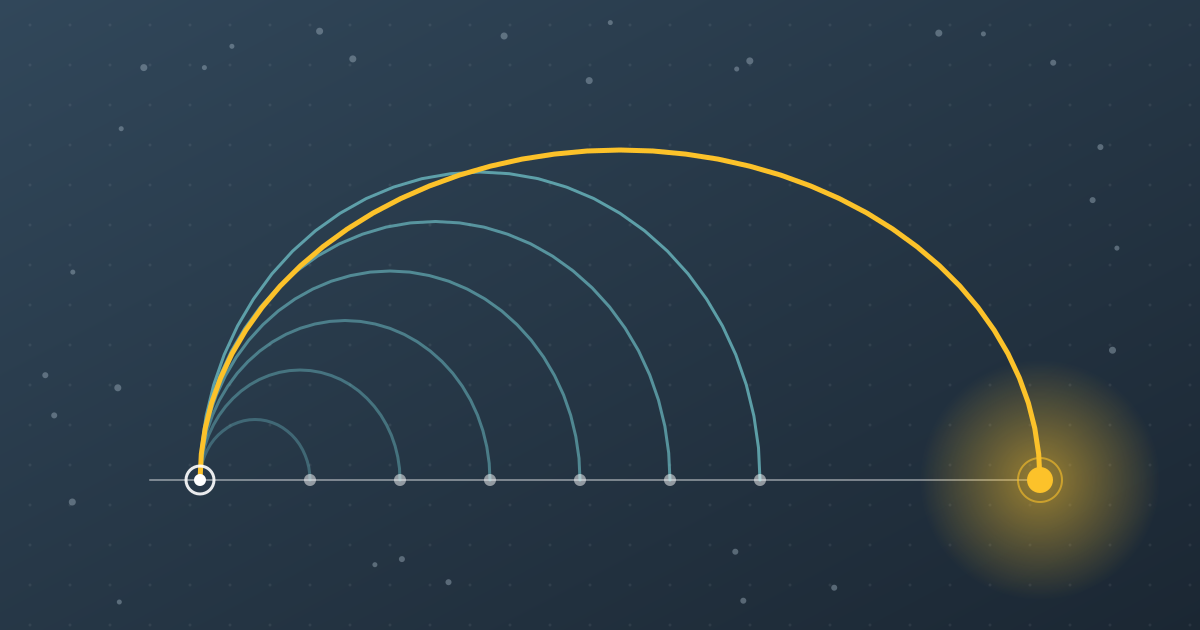
A gold dot traces a curve from the top left to the bottom right; with every doubling, a row of small teal dots is added (1, 2, 4, 8, 16), and the steps down get smaller. At the turning point, a mist-blue curve next to it runs more slowly and stays higher; in the final image, a new, lower gold line slides in from the right and passes beneath the old one.
Principle #75
Experience Curve: The more you produce, the faster you learn, which lowers your unit costs and lets you turn volume into a lead.
3 min read5 sectionsSituationLink to the principle
Contents
What Theodore Paul Wright observed in aircraft manufacturing in 1936 shows up 80 years later on roofs and fields all over the world. Hardly any technology has become cheaper as dramatically and as steadily as photovoltaics. The reason is not a single breakthrough but the experience that grows with every module built. An example of the Experience Curve.
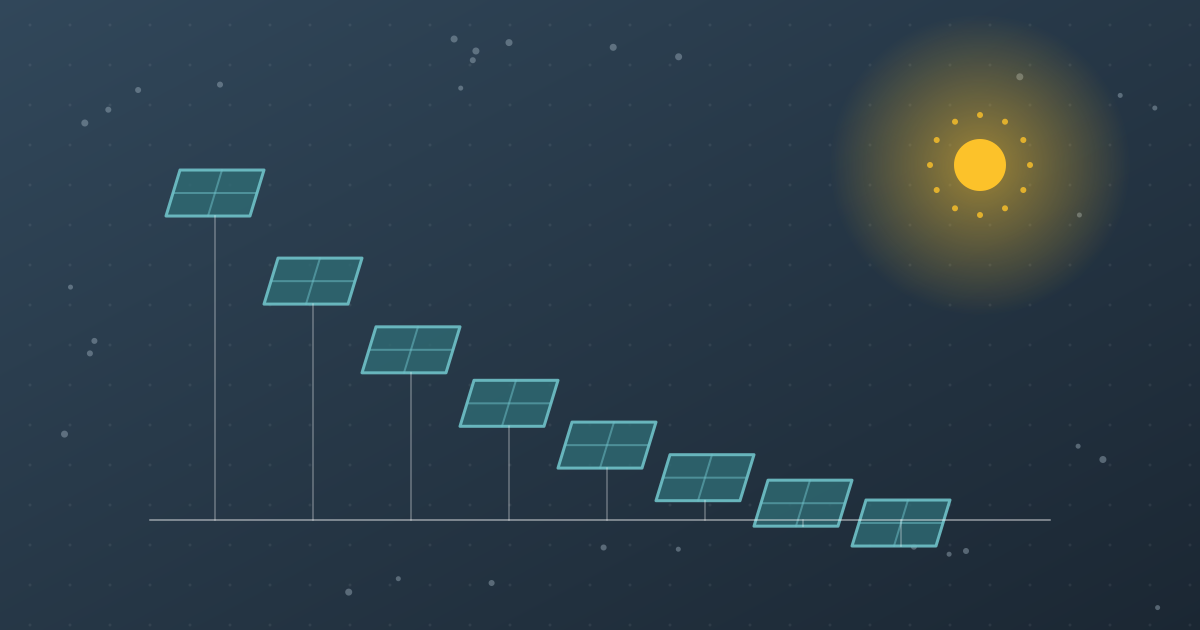
A staircase of solar modules descends from the top left to the bottom right, with a gold sun shining above it – as with Swanson’s law.
01
A name from The Economist
Situation
At the end of 2012, the British magazine The Economist names a rule after Richard Swanson, the founder of the solar manufacturer SunPower. The rule states that prices fall by about 20% with every doubling of cumulative shipped volume.
Link to the principle
Swanson’s law is not a new discovery but the application of Wright’s law to a particular industry. Like Wright, Swanson measures not by years but by cumulative quantity. The experience curve thus becomes a forecast: if you know how fast volume is growing, you can estimate how fast prices will fall.
02
The figures
Situation
In 1977, crystalline silicon cells cost about $76.67 per watt. By 2014, the figure is about 36 cents. At past rates, the rule means that costs fall by about three-quarters roughly every 10 years. Reportedly, the experience curve method was first applied to photovoltaics as early as 1975.
Link to the principle
These figures show how powerful the curve becomes over a long period. A decline of 20% per doubling sounds modest. But because volume has doubled many times over, a luxury product for satellites has become one of the cheapest ways of generating electricity.
03
Why costs fall
Situation
The causes are many. Thinner silicon wafers, higher efficiencies, larger factories, automated manufacturing, well-established supply chains and experience in installation all contribute. Research on the experience curve generally names labor efficiency, standardization, better methods, technological learning, better use of equipment and redesign as causes.
Link to the principle
As with the Liberty ships, the experience curve here is more than individual learning. It is the result of an entire industry that learns with every doubling of its production. The economist Ernst R. Berndt has pointed out that experience effects and economies of scale can hardly be separated. Both work together.
04
Demand as the engine
Situation
For volume to grow, someone has to buy the expensive first modules. In Germany, starting in 2000, the Renewable Energy Sources Act (Erneuerbare-Energien-Gesetz) creates large, reliable demand through fixed feed-in tariffs. Other countries introduce similar subsidies. In the years that follow, manufacturers in China above all expand their production massively.
Link to the principle
The experience curve has a political side. Whoever creates early demand pushes the curve along for everyone. Whoever produces the most benefits the most. That is exactly the logic Bruce D. Henderson described for companies: market share brings experience, and experience brings a cost lead.
05
The downside for the pioneers
Situation
Many German solar manufacturers that were among the largest in the world in the 2000s come under pressure in the early 2010s. Several file for insolvency or are taken over, while Asian manufacturers with much larger volumes gain market share.
Link to the principle
This shows the hard side of the experience curve. The advantage belongs not to whoever starts early but to whoever produces the most. If you cannot keep up with the volume, you fall behind, even if you once led the industry.
Key takeaways
Key lessons
01
Small learning steps become enormous over many doublings.
02
Measure progress by volume; then it becomes predictable.
03
Early demand is the fuel of every experience curve.
04
Whoever does the most learns the fastest, not whoever starts the earliest.
05
Be prepared for competitors on the same curve to move faster.
Summary
Swanson’s law describes how solar modules become about 20% cheaper with every doubling of the volume shipped. From 1977 to 2014, the price of solar cells fell from about $77 to 36 cents per watt. The experience curve has turned photovoltaics from an expensive niche technology into one of the cheapest sources of electricity. In the end, the manufacturers with the greatest volume had the greatest advantage.