Contents
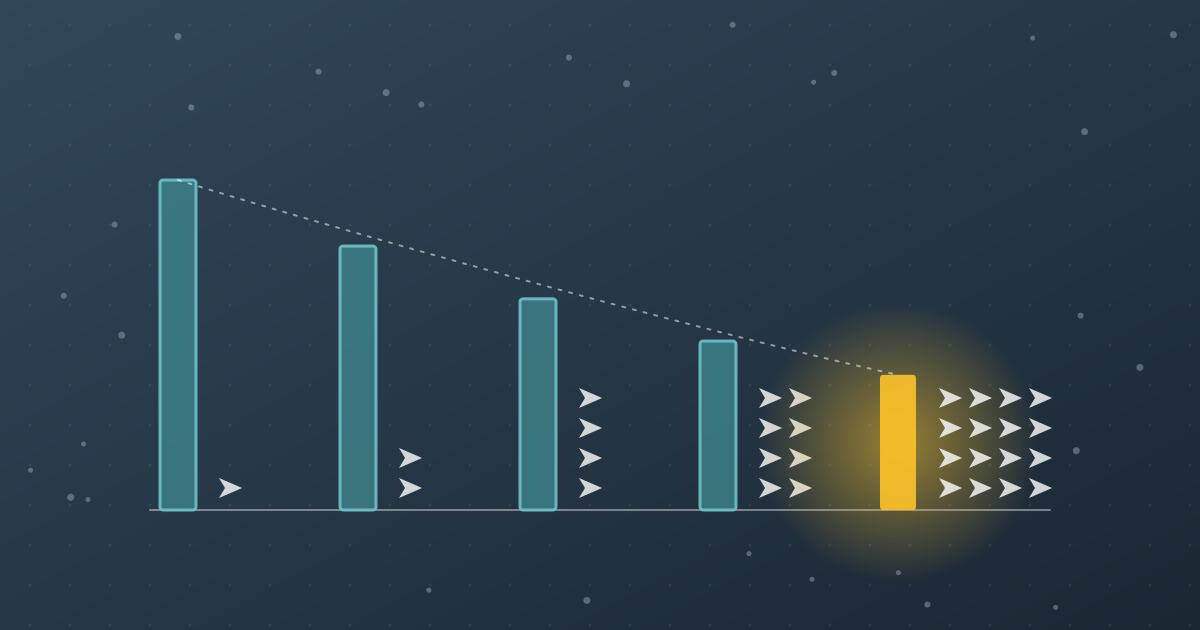
The experience curve was discovered in aircraft manufacturing. It faced its greatest practical test a few years later in the shipyards of the United States. There, a huge merchant fleet had to be created in the shortest possible time to carry troops and supplies across the Atlantic and the Pacific. The way to get there was not individual genius but repetition on a grand scale – the Experience Curve at work.

An emergency program on a British model
Situation
In 1940, Britain orders 60 freighters of the Ocean class from American shipyards. Their design goes back to a plain ship from the J. L. Thompson shipyard in Sunderland. The United States adopts and simplifies the design for a program of its own. On September 27, 1941, known as Liberty Fleet Day, 14 ships are launched, the first being the SS Patrick Henry. President Franklin D. Roosevelt calls the ship “a dreadful looking object,” and Time magazine an “ugly duckling.”
Link to the principle
The experience curve needs a product that is built often enough. A plain, standardized design is the prerequisite. Beauty and sophistication are deliberately sacrificed so that the same thing can be produced thousands of times.
Welding instead of riveting
Situation
The American version replaces a large share of the rivets with welds. In earlier designs, riveting had accounted for about a third of labor costs. The ships are assembled from prefabricated sections. A large share of the orders goes to a consortium of West Coast construction and engineering firms led by the industrialist Henry J. Kaiser. Because many men are joining the military, more and more women work in the shipyards.
Link to the principle
This shows that the experience curve is more than the practice of individual workers. New methods, prefabrication and a new organization of work contribute just as much. Bruce D. Henderson later stressed exactly this: costs fall through learning, standardization, better methods and technology all at once.
From 230 to 39 days
Situation
The first ships take about 230 days, the Patrick Henry itself 244. With every further ship, the yards become faster. In 1943, the average construction time is down to just 39 days. By 1945, 18 shipyards have produced 2,710 Liberty ships. One ship costs about $2 million.
Link to the principle
This is the experience curve in its purest form. The same design, repeated thousands of times, leads to a dramatic decline in construction time. To this day, studies of the learning curve draw on this program because there were so many identical units in so short a time.
The record of the Robert E. Peary
Situation
One ship becomes famous. For the SS Robert E. Peary, only four days and 15.5 hours pass between keel laying and launch. That is an exceptional figure, not an average.
Link to the principle
The record shows how far the curve can take you when all processes are well practiced. But it also shows that peak values and averages are two different things. For strategy, the average counts, not the showpiece.
The price of speed
Situation
The quickly built ships have a weakness. During the war, almost 1,500 serious brittle fractures are counted. Twelve ships break in two without warning, three of them Liberty ships. The British materials scientist Constance Tipper of the University of Cambridge shows that the fractures do not start in the welds but that the steel becomes brittle in the cold.
Link to the principle
The experience curve lowers time and costs. It does not guarantee quality. If you pay attention only to volume and speed, you can multiply mistakes just as fast as successes. Learning also means recognizing mistakes and improving the design.
Key takeaways
Key lessons
- Simplify what you want to do often; repetition needs a clear standard.
- Experience lives not only in heads but also in processes and tools.
- Don’t mistake a record for your average.
- Make sure speed doesn’t eat up quality.
- If you repeat a lot, you also have to find mistakes faster.
Summary
During World War II, the United States built 2,710 Liberty ships to a plain, standardized design. Through welding, prefabrication and repetition, construction time fell from about 230 to 39 days. The program shows the experience curve on a large scale, and it shows its limit: faster and cheaper is not automatically better.
Sources
- Wikipedia: Liberty ship
- Theodore Paul Wright: Factors Affecting the Cost of Airplanes. In: Journal of the Aeronautical Sciences 3 (1936), no. 4, pp. 122–128.