Franz Beckenbauer turns the sweeper (libero), the last man in defense, into a player who directs the game from the middle. In 1972, West Germany wins the European Championship with him. From the central position, he can switch play faster than the opponent can reorganize.
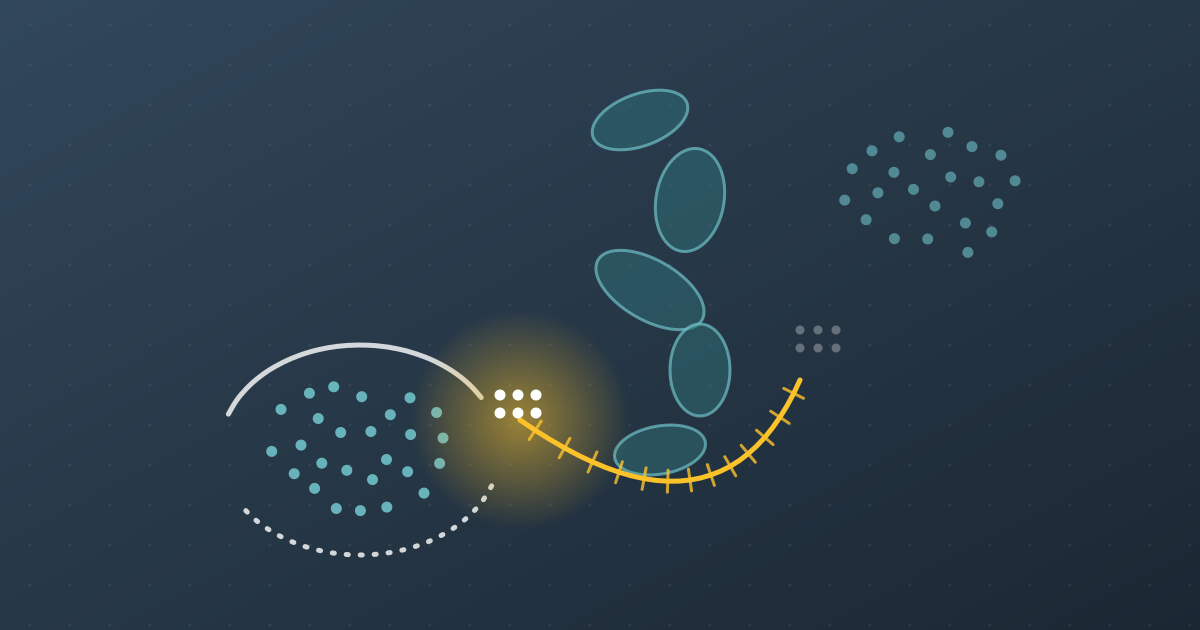
In the middle, a group of golden dots gathers; to the left and right stands a larger teal circle, and above, a long mist-blue arc separates them. Short golden lines carry almost all the dots first to the left circle, which falls apart, then to the right one; in the final image of a second version, the two circles find each other across the arc and close in on the middle like a frame.
Principle #36
Interior Lines: If you stand in the middle with short routes, you can shift your forces faster than separated opponents and defeat them one after another before they unite.
4 min read5 sectionsSituationLink to the principle
Contents
Interior lines are an idea from military theory, but the image also fits a soccer field. If you are positioned centrally and have no fixed opponent to mark, a few steps are enough to turn up on either side. Your opponents have to cover longer distances to react. Franz Beckenbauer is regarded as the inventor of the modern, attacking sweeper. At the 1972 European Championship, it became clear what this role, a picture of Interior Lines on the field, can achieve.
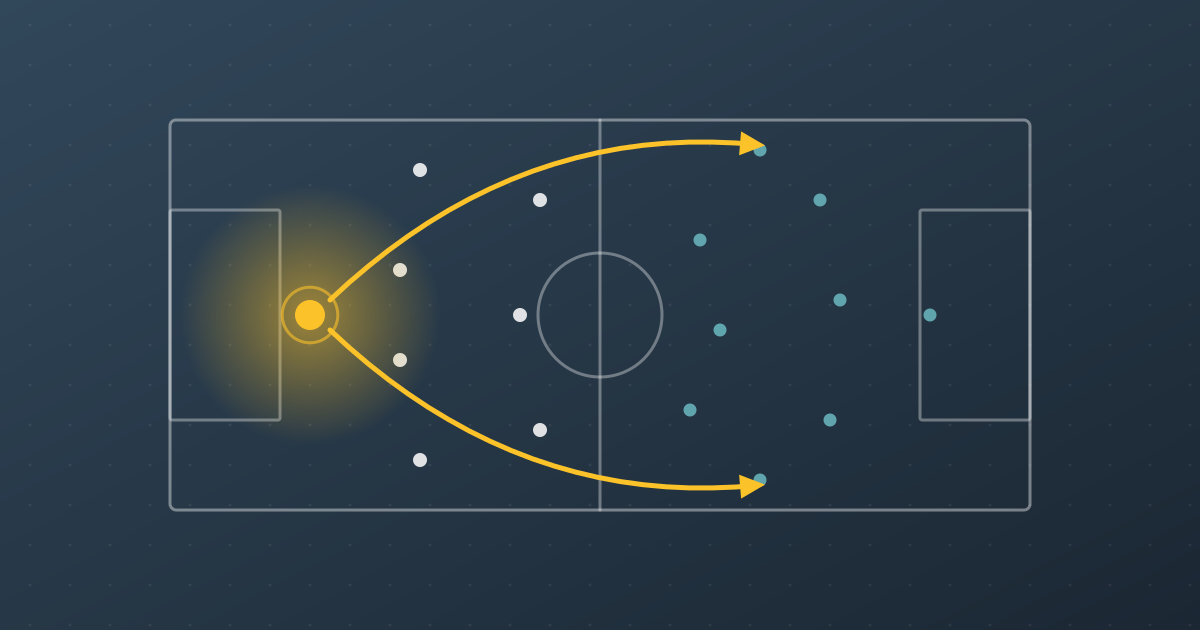
Behind the defensive line stands a golden dot, playing two arcs out to both wings – like Franz Beckenbauer as sweeper at Euro 1972.
01
From pure defender to playmaker
Situation
In many systems, the sweeper was a purely defensive player. He stood behind the defensive line and cleared whatever got through. Beckenbauer, born in Munich in 1945, started out in midfield and around 1968 and 1969 began to experiment with the role at Bayern Munich. He played it in a very attacking style: he combined defensive work with runs forward and launched attacks.
Link to the principle
The sweeper stands in the middle of the field and behind everyone else. He has no direct opponent to mark. From there, he can go left, right or forward, while every opponent is tied to their own space. That is the logic of interior lines.
02
Wembley, April 1972
Situation
In the first leg of the European Championship quarterfinal at Wembley on April 29, 1972, West Germany beat England 3–1, the first victory by a German national team at Wembley Stadium. Günter Netzer scored from the penalty spot to make it 2–1, and Gerd Müller made it 3–1. The press celebrated the birth of a new team, with the playmaker Netzer as the link between Müller in attack and the sweeper Beckenbauer in defense.
Link to the principle
The team ran along an axis through the middle: the sweeper at the back, the playmaker in front of him. If you are positioned centrally, you can quickly switch the ball to wherever the opponent is thin at that moment. The opponent has to cover longer distances to react.
03
The final in Brussels
Situation
In the final in Brussels on June 18, 1972, West Germany beat the Soviet Union 3–0. Gerd Müller scored twice, Herbert Wimmer once. Beckenbauer was captain and was named to the team of the tournament. That same year he won the Ballon d’Or, the award for Europe’s best soccer player.
Link to the principle
A title has many fathers. But the 1972 team thrived on Beckenbauer’s ability to distribute the game from the middle. He was the hub through which the ball ran from back to front and from one side to the other.
04
What came next
Situation
With Bayern Munich, Beckenbauer won the European Cup three times in a row from 1974 to 1976, and in 1974, as captain, the World Cup as well. In 1976 he received the Ballon d’Or again. To this day, he is the only defender with two such awards. He died on January 7, 2024.
Link to the principle
The role of the attacking sweeper worked because Beckenbauer combined two things: a secure position in the middle and the freedom to leave it. Interior lines are not a holding position but a starting position for rapid movement.
05
The limit
Situation
The attacking sweeper requires someone to cover behind him when he goes forward. Many teams in later decades abandoned the role and played with a flat back four.
Link to the principle
The middle is only an advantage if you can get back to it quickly enough. If you leave it and don’t return, you open the shortest route to your opponent.
Key takeaways
Key lessons
01
Look for the position from which you can quickly reach either side.
02
Keep yourself free of fixed commitments if you want to shift.
03
Create superior numbers where the opponent is thin at that moment.
04
Use the middle as a starting point, not as a hiding place.
05
Make sure someone holds the middle when you leave it.
Summary
Franz Beckenbauer turned the sweeper from a pure defender into a playmaker. From the central position behind the defense, he could turn up on either side and up front, faster than his opponents could reorganize. At the 1972 European Championship, with the 3–1 at Wembley and the 3–0 in the final against the Soviet Union, it became clear what this could achieve. His game is reminiscent of the principle of Interior Lines: if you stand in the middle and are free, you shift your strength faster than your opponent.