The principle in detail
Three steps through the principle: grasp it, place it, put it to work. Open each topic on its own.
The core messageCore statement and 3 clarifications
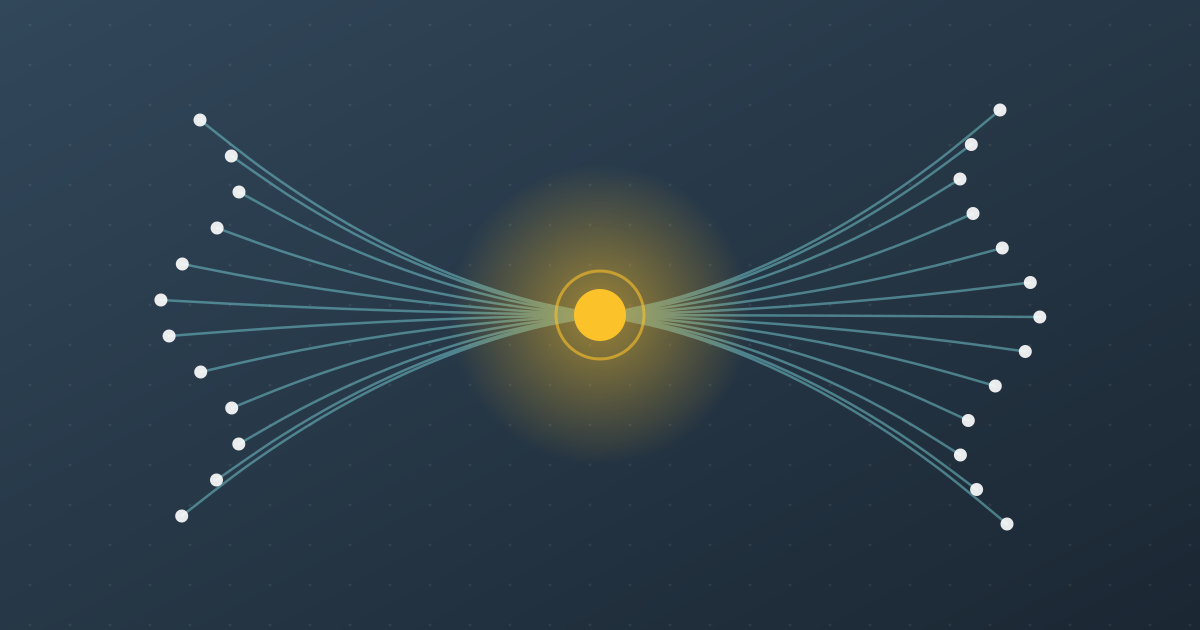
Short routes turn time and space into strength. If you can shift faster, you can be superior at the decisive point even though you are weaker overall.
- It does not say
- That the middle is always an advantage. If your opponents coordinate and arrive at the same time, whoever is in the middle gets enveloped.
- It does not say
- That you should serve both sides at once. The advantage arises only when you take on one side fully and deliberately keep the other thin.
- It also says
- A center has to be protected. If the middle fails, every route is hit at once.
The explanationThe advantage lasts only as long as the others are separated and you are fast enough.
The advantage lasts only as long as the others are separated and you are fast enough. If you hesitate in the middle, you give them time to coordinate, and then the middle turns into an encirclement.
Where are you standing between two sides right now, and are you using your short routes before they come to an understanding?
The signs3 signs when you heed it · 3 when you overlook it
- You tackle one problem area after another with full force.
- You know how long the other side can manage without you.
- You notice early when two opponents begin to coordinate.
- You spread time and people evenly across all fronts, and nowhere is it enough.
- Decisions sit unmade until the others have come to an understanding.
- You feel safe in the middle, even though you were encircled long ago.
The backgroundFrom Antoine-Henri Jomini’s work “Précis de l’art de la guerre” (1838). · T1 Classical Theory of War
- 1838OriginAntoine-Henri Jomini
Précis de l’art de la guerre
- Tradition T1TraditionClassical Theory of War
Carl von Clausewitz, Antoine-Henri Jomini, Helmuth von Moltke the Elder, Frederick William Lanchester
See the tradition on the Origin page
Read more: the full background
From Antoine-Henri Jomini’s work “Précis de l’art de la guerre” (1838). Supplemented by experience with networks that run through a center, such as the Federal Express hub in operation since 1973.
The research2 sources: 1 classic, 1 case study · 1838–2021 · with limitations of the research
- weak
- moderate
- strong
The proposition is a rule drawn from military history without measurement, and the campaigns of Helmuth von Moltke the Elder already show conditions under which it does not hold.
- 2021Alice Myers
“Federal Express Begins Operations”: on April 17, 1973, 14 jets deliver 186 packages overnight to 25 cities; everything runs through the central hub in Memphis.
- The middle can become a trap.
- Interior lines work only as long as the opponents are separated and slow; the railway and the telegraph already reduced the advantage in the 19th century.
- A center is also vulnerable: if it fails, the whole network comes to a standstill.
Read more: what research shows
Antoine-Henri Jomini made the term widely known. In his “Précis de l’art de la guerre” (Summary of the Art of War) of 1838, he distinguishes interior and exterior lines of operations and derives the advantage of interior lines mainly from the campaigns of Napoleon Bonaparte. He wanted to draw fixed rules from military history; there is no measurement behind them. In 1866 at Königgrätz, Helmuth von Moltke the Elder showed the counterpoint: with the railway and the telegraph, armies marching separately united only on the battlefield. Outside war, the idea appears in networks with a center. Starting on April 17, 1973, Federal Express routed all packages through Memphis at night, connecting 25 cities via a single hub.
The related principles07 Concentration of Force · 15 Logistics · 38 Maneuver · 41 Speed
To go deeper, see 07 Concentration of Force (gathering your forces at one point after another) and 41 Speed (without tempo, the window of time closes)
15 Logistics is a reminder that short routes are above all short supply routes
38 Maneuver stands in tension with it: envelopment from outside is the answer to interior lines
Read more: the full text
To go deeper, see 07 Concentration of Force (gathering your forces at one point after another) and 41 Speed (without tempo, the window of time closes); 15 Logistics is a reminder that short routes are above all short supply routes. 38 Maneuver stands in tension with it: envelopment from outside is the answer to interior lines.
The action steps5 things you can actually do
- Map your situation: who is pressing from which side, and how long are your routes to each of them compared with their routes to each other?
- Decide which side you will take on fully first. Deliberately keep the other side thin and tell the people there for how long.
Estimate how much time you have before the others can coordinate, and plan the shift within that window.
- Keep the routes in the middle short: clear responsibility for reallocations, few rounds of coordination.
- Regularly check whether the others are still separated. If they come to an understanding, change your deployment instead of relying on the middle.
The reflection questions3 questions: Between which two sides are you standing right now, and how long will it take them to coordinate?
- Between which two sides are you standing right now, and how long will it take them to coordinate?
- Where are you serving two problem areas halfway instead of one fully?
- How would you notice that your middle has turned into an encirclement?
Take your time with one question. Write down your answer – or talk it over with someone you trust.
The picture to rememberThe animation once more, with an explanation
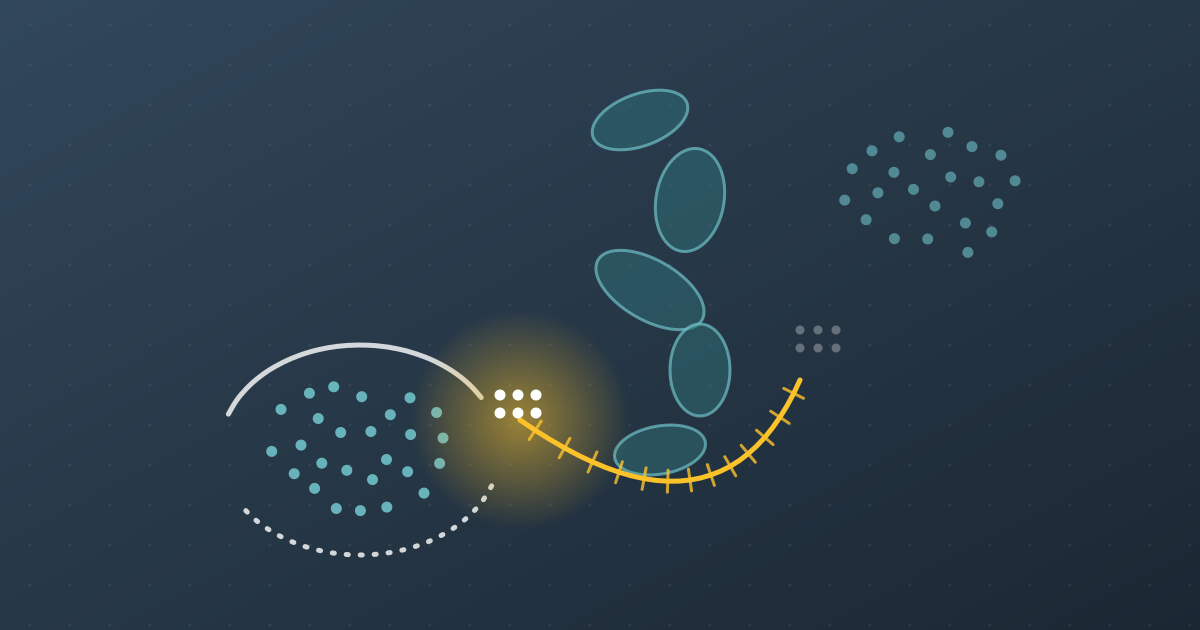
- In the middle, a group of golden dots gathers
- To the left and right stands a larger teal circle, and above, a long mist-blue arc separates them
- Short golden lines carry almost all the dots first to the left circle, which falls apart, then to the right one
- In the final image of a second version, the two circles find each other across the arc and close in on the middle like a frame
How the principle shows up in practice
Tannenberg 1914
The German Eighth Army stands between two separated Russian armies, shifts its corps by rail and forced march against one of them and encircles it. Then it turns against the other.
Frederick W. Smith, FedEx
Starting in 1973, all packages run through Memphis at night. The hub connects 25 cities with 25 routes instead of 300.
Franz Beckenbauer, Euro 1972
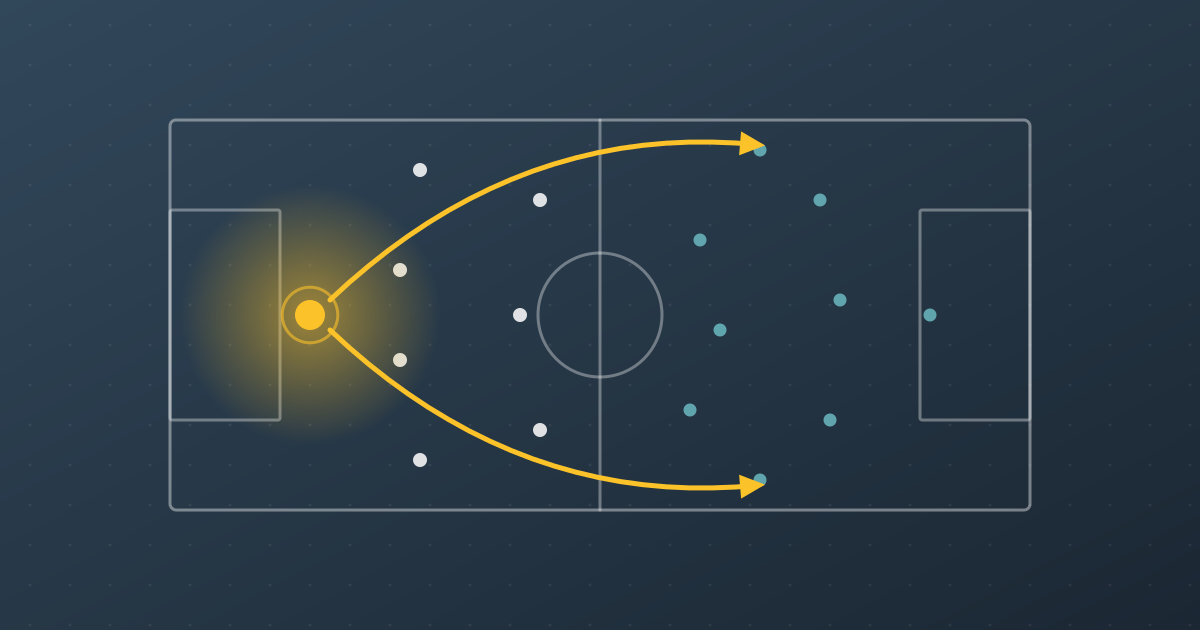
As an attacking sweeper, Beckenbauer switches play from the middle faster than the opponent can reorganize. In 1972, West Germany becomes European champion.
Where are you standing in the middle right now?
Get your profile across all 12 groups in about 10 to 15 minutes.
Start the Strategy CheckGroup 5: Position and Space
Guiding question: Where do you stand, and how much room do you have to move?
Stage 2 of 5: Understand the situation
- TraditionClassical Theory of War
Carl von Clausewitz, Antoine-Henri Jomini, Helmuth von Moltke the Elder, Frederick William Lanchester
- Related principles
Where the 92 principles come from: eight traditions of strategy, from classical war theory to dealing with uncertainty.
More about the originBackground: WEGVISOR’s own selection from the strategy literature · More about the origin