In the 1964 film “Zulu,” around 150 British soldiers defend a mission station against an enemy many times their number. They survive because, in a confined space, they get their men to the threatened point faster than the attackers on the outside can shift their assaults.
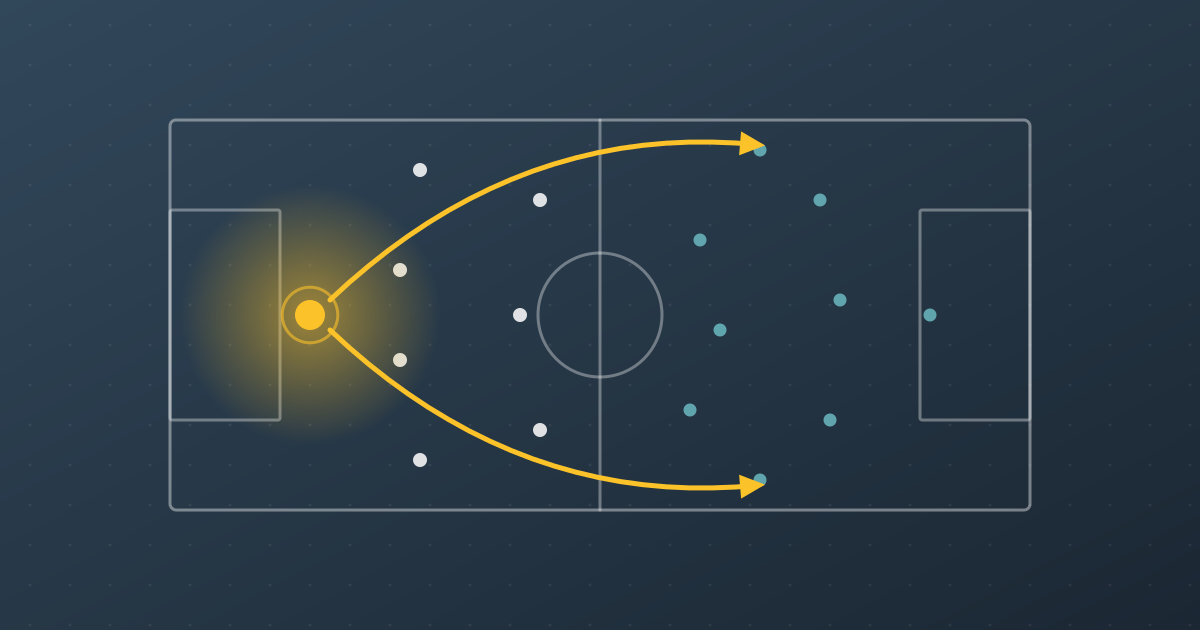
In the middle, a group of golden dots gathers; to the left and right stands a larger teal circle, and above, a long mist-blue arc separates them. Short golden lines carry almost all the dots first to the left circle, which falls apart, then to the right one; in the final image of a second version, the two circles find each other across the arc and close in on the middle like a frame.
Principle #36
Interior Lines: If you stand in the middle with short routes, you can shift your forces faster than separated opponents and defeat them one after another before they unite.
3 min read5 sectionsSituationLink to the principle
Contents
“Zulu,” directed by Cy Endfield, tells the story of the defense of Rorke’s Drift in January 1879, during the war between Britain and the Zulu Kingdom. Stanley Baker plays Lieutenant John Chard of the Royal Engineers, and Michael Caine, in his first major role, plays Lieutenant Gonville Bromhead. The film is a war film of its time, with weaknesses in its portrayal of the Zulu. But tactically it vividly shows what Interior Lines mean on a small scale.
A small redoubt, ringed by a vast superior force; inside, short golden paths carry strength from side to side – as in the film “Zulu.”
01
A station with no way out
Situation
Rorke’s Drift is a mission station with a storehouse and a hospital at a river crossing. After the British defeat at Isandlwana that same day, the few soldiers learn that a large Zulu force is heading toward them. Chard, who has been a lieutenant slightly longer than Bromhead and therefore takes command, decides not to withdraw. There is no time to evacuate the sick from the hospital.
Link to the principle
Interior lines require a position that can be held. Chard chooses the smallest space that can be defended. The smaller the circle, the shorter the routes inside.
02
Walls of mealie bags
Situation
The soldiers build a breastwork of overturned wagons, mealie (corn) bags and biscuit boxes connecting the storehouse and the hospital. As the pressure mounts, in the film Chard pulls the defenders back to a smaller redoubt in front of the chapel. Historically, he also had a wall of biscuit boxes built across the post.
Link to the principle
The breastwork shortens the line that has to be defended. The smaller redoubt is a second, even shorter line. That way, the defense stays connected even after a breach.
03
Shifting instead of spreading
Situation
The Zulu attack in waves, with warriors using captured British rifles to give them covering fire. Chard realizes that the north side is too thinly manned. In the last great assault, he commits his reserve: in three ranks, the soldiers fire volley after volley without pause until the attackers fall back.
Link to the principle
This is the core of interior lines. To change direction, the attackers have to go around the outside of the station. The defenders only have to cross a few meters of the yard. They are outnumbered everywhere, but at the decisive point they are strong enough for a moment.
04
The hospital falls
Situation
The hospital lies at the edge and is hard to hold. The attackers set the roof on fire. In the film, Private Henry Hook and the sick hold off the attackers until they escape from the burning building. Historically, soldiers knocked holes through the interior walls to get the sick out.
Link to the principle
If you stand in the middle, you have to be ready to give up outer parts. The line gets shorter, the middle stronger. Clinging to every point would splinter your forces.
05
In the morning
Situation
After a night of fighting, further attacks follow in the morning, until the Zulu withdraw. A total of 11 Victoria Crosses, the highest British award for gallantry, were awarded for the defense. The film ends with the Zulu on a hill singing a song in honor of the defenders. Historically, this is not documented.
Link to the principle
Interior lines do not replace troops. But they get the most out of few forces, as long as the middle holds together.
Key takeaways
Key lessons
01
Choose a space that you can really hold with your forces.
02
Shorten your lines when the pressure rises.
03
Keep a reserve in the middle that can quickly get anywhere.
04
Give up outer posts before they tie down your forces.
05
Bring your strength to wherever the decision is being made at that moment, and then back.
Summary
“Zulu” shows the defense of Rorke’s Drift in 1879. A small force builds a short breastwork, commits its reserve at the decisive moment and, using short routes, reacts faster than the attackers on the outside can change direction. When the hospital can no longer be held, it falls back to an even shorter line. The film makes the principle of Interior Lines visible on a small scale: short routes make few forces strong.