On April 17, 1973, Federal Express flies packages overnight to 25 cities for the first time. Every package goes to Memphis first, is sorted there and flies on from there. Frederick W. Smith turns the central position into a business model.
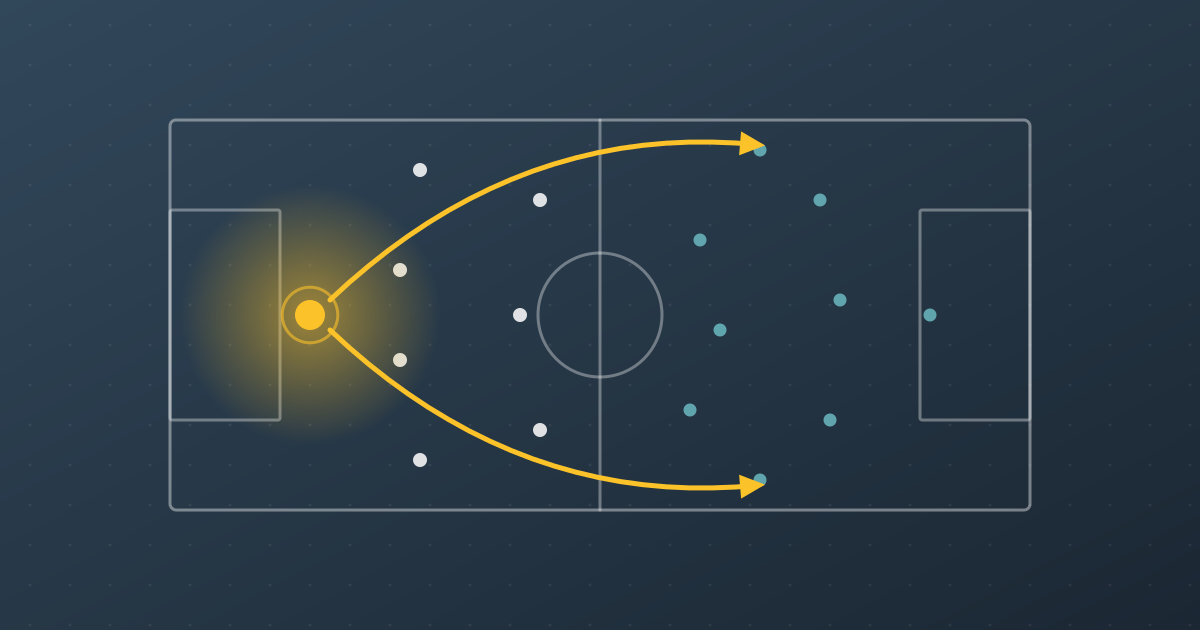
In the middle, a group of golden dots gathers; to the left and right stands a larger teal circle, and above, a long mist-blue arc separates them. Short golden lines carry almost all the dots first to the left circle, which falls apart, then to the right one; in the final image of a second version, the two circles find each other across the arc and close in on the middle like a frame.
Principle #36
Interior Lines: If you stand in the middle with short routes, you can shift your forces faster than separated opponents and defeat them one after another before they unite.
3 min read5 sectionsSituationLink to the principle
Contents
Interior lines are a concept from military theory. If you stand in the middle, you have short routes to every point and can quickly send your resources to wherever they are needed. A logistics network works by the same logic. In the early 1970s, Frederick W. Smith used the logic of Interior Lines to build a company that changed the package delivery industry.
On the left and right, 25 dots, with every line running through a golden node in the middle – as with FedEx and its Memphis hub.
01
An idea from college
Situation
According to EBSCO’s account, Smith described the weaknesses of air freight while still a student at Yale. The paper received only a middling grade. Afterward, as an officer in the Marine Corps, he saw how often supplies were sent to the wrong places. His alternative was a hub-and-spoke system: a central collection point from which every destination could be reached.
Link to the principle
If you connect point to point, you need a great many routes. With 25 cities, there are 300 possible direct connections. With a center, 25 are enough. The center is the interior line: it is directly connected to every point, and everything converges there.
02
Why Memphis
Situation
Smith founded the company in June 1971 in Little Rock, Arkansas. He soon moved its headquarters to Memphis, Tennessee. The city was centrally located in relation to the destination cities, and the airport had enough room for hangars. Consulting firms found that around 90% of commercial aircraft sat on the ground at night. At night, the airspace was free.
Link to the principle
The choice of center determines the length of every route. Memphis was located so that flight times to most destinations stayed short. The night gave the system time to bring everything into the middle and back out again before the business day began.
03
The first night
Situation
A first launch in March 1973 failed; six jets carried only six packages. On April 17, 1973, 389 employees with 14 Dassault Falcon jets delivered 186 packages overnight to 25 cities, from Rochester, New York, to Miami. All the packages ran through Memphis.
Link to the principle
A package between two neighboring cities still flew to Memphis first, which was a detour. Even so, the network as a whole was faster and more reliable, because all the flows converged in the middle and were redistributed. Interior lines are not the shortest route for every individual; they are an advantage for the whole.
04
Lean years and breakthrough
Situation
In its first two years, Federal Express lost around $30 million; pilots sometimes paid for fuel with their own credit cards. In July 1975, the company made a profit for the first time. In 1977, a law allowed cargo airlines to use larger aircraft without route restrictions, and the company bought Boeing 727s. In 1983, it became the first U.S. company to reach $1 billion in revenue within 10 years of its launch without acquisitions.
Link to the principle
A center pays off only once enough runs through it. At first the network was too thin; later the central position became a major advantage: each new city needed only one new spoke.
05
The limit of the middle
Situation
A network with one center has a vulnerable point. If the center fails, for example through severe weather or a technical fault, the whole system comes to a standstill. Large package delivery companies today operate several hubs.
Link to the principle
In military theory, too, the middle is strong as long as it remains able to act. If it is hit, every line is hit at once.
Key takeaways
Key lessons
01
Check whether a center makes your routes shorter than many individual connections.
02
Choose the middle so that most routes stay short.
03
Accept detours for individuals if the whole becomes faster.
04
Be prepared for lean years until enough runs through the middle.
05
Protect your center, because any failure there hits you twice as hard.
Summary
Frederick W. Smith built Federal Express on the principle of Interior Lines. Instead of connecting every city with every other, he brought all packages to Memphis at night, sorted them there and sent them back out. On April 17, 1973, there were 186 packages for 25 cities. After difficult early years, the central position became a major advantage. It also shows the limit: if you stand in the middle, you have to protect the middle.