The principle in detail
Three steps through the principle: grasp it, place it, put it to work. Open each topic on its own.
The core messageCore statement and 3 clarifications
You often win not by surpassing the other side’s strength but by making it irrelevant.
- It does not say
- That movement comes free. If you move without knowing the situation and without supplies, you lose your way.
- It does not say
- That hard fighting becomes unnecessary. In real conflicts, maneuver and attrition almost always mix.
- It also says
- A successful maneuver is not a permanent state. As soon as the other side catches up, everything starts over.
The explanationHow the principle works and what matters
A maneuver demands strength, knowledge of the situation and supplies, and it works only until the other side catches up.
Where are you pushing head-on right now against a strength you could go around?
The signs3 signs when you heed it · 3 when you overlook it
- Before you increase the pressure, you ask where the other side is not strong.
- You change the place, the timing or the topic when a dispute has become deadlocked.
- You hold the other side’s attention in one place and move in another.
- You do more of the same because it worked last time.
- You get into a price war with a bigger rival.
- You consider a success secure and don’t notice that the other side has long since been catching up.
The backgroundFrom William S. Lind’s “Maneuver Warfare Handbook” (1985), based on John Boyd. · T3 Indirect Strategy and Maneuver
- 1985OriginWilliam S. Lind
Maneuver Warfare Handbook
- 2022SupplementedU.S. Army
Operations
- Tradition T3TraditionIndirect Strategy and Maneuver
Basil Henry Liddell Hart, John Richard Boyd, Edward N. Luttwak, André Beaufre
See the tradition on the Origin page
Read more: the full background
From William S. Lind’s “Maneuver Warfare Handbook” (1985), based on John Boyd. Supplemented by the U.S. Army’s Field Manual 3-0 and by the older idea of going around the opponent in Sun Tzu.
The research3 sources: 2 theories, 1 review · 1985–2022 · with limitations of the research
- weak
- moderate
- strong
Maneuver warfare is military doctrine drawn from experience and military history; the sources cite no measurements, and the contrast with attrition is disputed.
- 1985William S. Lind
“Maneuver Warfare Handbook”: the opponent is to be defeated by disrupting its ability to react, not by destroying its forces; based on John Boyd’s decision cycle.
- 2005W. Chan Kim and Renée Mauborgne
“Blue Ocean Strategy”: open up a new, uncontested market instead of competing against the strengths of others in a contested market.
- 2022U.S. Army
Field Manual 3-0, “Operations”: lists maneuver among the principles of war: placing the enemy in a position of disadvantage through the flexible application of combat power.
- The contrast between maneuver and attrition is disputed among experts.
- Critics object that the two almost always mix in real conflicts and that maneuver without the capacity for hard fighting remains empty.
- In confined space, against a well-informed opponent or without mobility of your own, there is often no way around the front.
- Transferring the idea to companies, families and churches is an argument by analogy.
Read more: what research shows
Thinking in maneuvers is old: Sun Tzu describes going around the enemy, and Napoleon Bonaparte demonstrated it at Ulm in 1805. Maneuver warfare took shape as a fully developed doctrine in the 20th century. In 1985, William S. Lind published the “Maneuver Warfare Handbook,” drawing on John Boyd, who described conflict as a race for faster decisions. The aim is to disrupt the opponent’s ability to respond to the situation and so to break its cohesion, instead of destroying its forces piece by piece. The U.S. Marine Corps made maneuver warfare its basic doctrine in the late 1980s; the U.S. Army’s Field Manual 3-0 counts maneuver among the principles of war. In business, W. Chan Kim and Renée Mauborgne describe a related idea: opening up a new market instead of holding your own in a contested one.
The related principles15 Logistics · 25 OODA Loop · 31 Indirect Approach · 41 Speed
To go deeper, see 31 Indirect Approach (maneuver is its practical form) and 25 OODA Loop (if you observe and decide faster, you move before the other side reacts)
41 Speed keeps the opponent from closing the gap
15 Logistics sets the limit: every movement ends where the supplies end
Read more: the full text
To go deeper, see 31 Indirect Approach (maneuver is its practical form) and 25 OODA Loop (if you observe and decide faster, you move before the other side reacts); 41 Speed keeps the opponent from closing the gap. 15 Logistics sets the limit: every movement ends where the supplies end.
The action steps5 action steps: Describe the other side’s strength precisely and ask which direction it faces.
- Describe the other side’s strength precisely and ask which direction it faces. Where is it unprepared?
- If resistance has held twice against a head-on approach, don’t try it the same way a third time. Change the situation the resistance rests on.
Start where people are already open, and let visible success make the case for you.
- Before every move, be clear about what you need to hold out where you want to go: knowledge, people, money.
Plan your next move before the other side catches up.
The reflection questions3 questions: Against which resistance are you once again using the same means right now?
- Against which resistance are you once again using the same means right now?
- Which direction does the other side’s strength face, and where is it unprepared?
- What would you have to change about the situation so that the resistance loses its grounds?
Take your time with one question. Write down your answer – or talk it over with someone you trust.
The picture to rememberThe animation once more, with an explanation
- Two blocks of dots face each other, a large teal one and a smaller golden one
- The golden block crashes into the other head-on, both lose dots, and then the picture rewinds
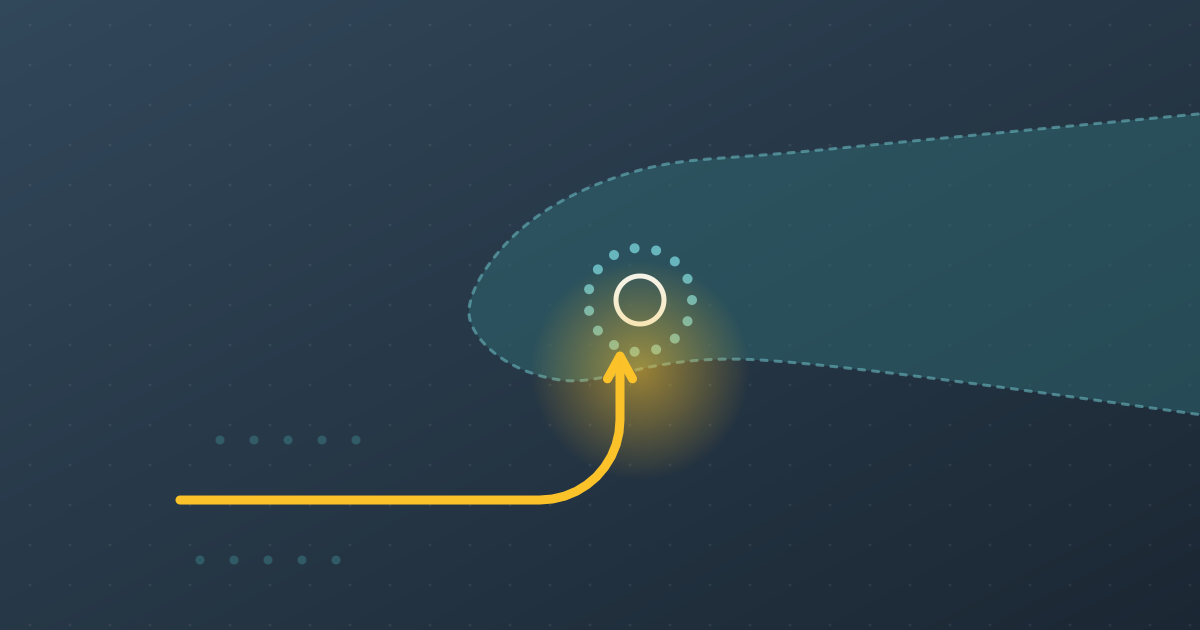
- In the second run, part of the gold stays put while the rest flows past the side in an arc
- A dashed line shows the severed connection to the rear, and the teal block breaks up into single mist-blue dots without any collision
How the principle shows up in practice
Napoleon, Ulm 1805
Napoleon marches around the Austrian army and forces it to capitulate without fighting a decisive battle.
Nintendo, the Wii
Nintendo sidesteps the technology arms race between Sony and Microsoft and wins over people who did not play before.
Daniel Ek, Spotify
Instead of fighting piracy with lawsuits, Spotify makes it superfluous with a more convenient legal service.
Where are you pushing head-on against a strength?
Get your profile across all 12 groups in about 10 to 15 minutes.
Start the Strategy CheckGroup 5: Position and Space
Guiding question: Where do you stand, and how much room do you have to move?
Stage 2 of 5: Understand the situation
- TraditionIndirect Strategy and Maneuver
Basil Henry Liddell Hart, John Richard Boyd, Edward N. Luttwak, André Beaufre
- Related principles
Where the 92 principles come from: eight traditions of strategy, from classical war theory to dealing with uncertainty.
More about the originBackground: WEGVISOR’s own selection from the strategy literature · More about the origin