Contents
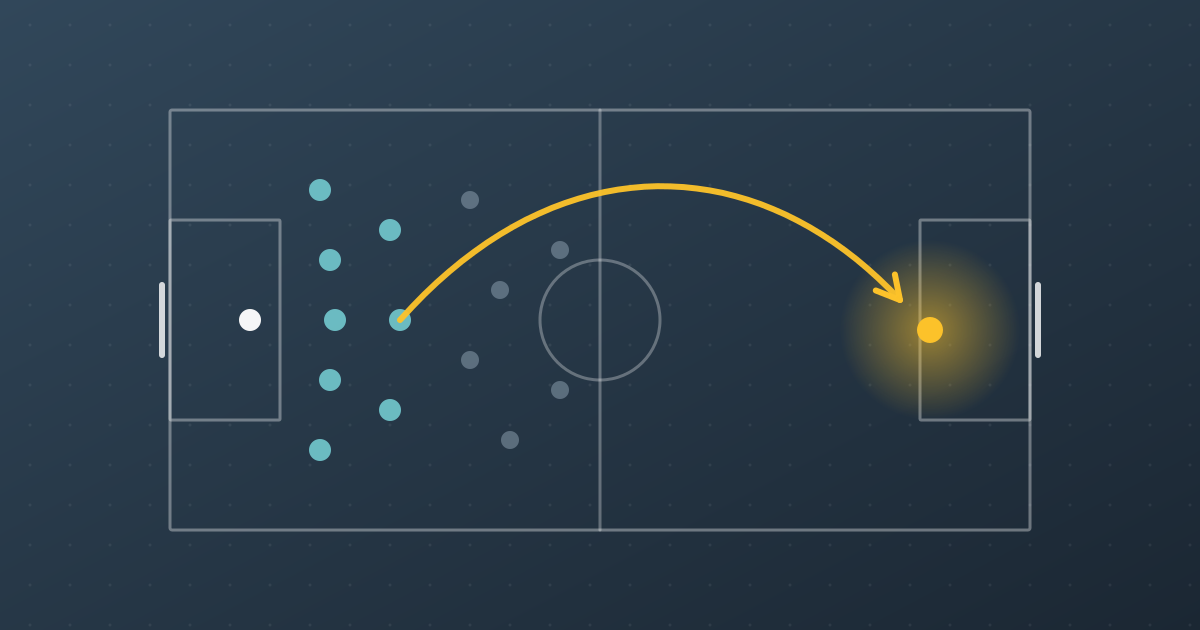
Catenaccio is Italian for “door bolt.” To this day, the term stands for defensive soccer, often disparagingly. Yet Helenio Herrera’s version contains exactly what Carl von Clausewitz wrote about the Strength of the Defense: defense is the stronger form, but you can win only with the counterattack. Herrera’s Inter combined both.
A coach with a plan
Situation
Herrera, born in Buenos Aires in 1910, came to Inter Milan at the start of the 1960s after successes with Atlético Madrid and FC Barcelona. He brought the midfielder Luis Suárez with him from Barcelona. Inter had not won a title since 1954. Herrera put great emphasis on fitness and mental preparation and, according to UEFA, relied on a worldwide network of contacts to scout opponents.
Link to the principle
Defense is preparation. If you know your opponents and adjust to them, you can wait for them instead of running after them. Herrera prepared his team for the opponent before the players got off the bus.
The bolt
Situation
In catenaccio, one player dropped back behind the defense and became the libero, or sweeper; at Inter, this was Armando Picchi. The other defenders marked their opponents strictly man to man. Herrera did not invent the basic idea. He refined the bolt (the verrou) that the Austrian coach Karl Rappan had used in Switzerland and geared it more toward counterattacks.
Link to the principle
An extra man behind the defense is like a second wall. The attacker has to get past not only his direct opponent but also the player waiting behind. In this way the defense becomes stronger than the attack, even against teams with better players.
The fast counterattack
Situation
Man marking freed the left back Giacinto Facchetti, who is regarded as one of the first attacking fullbacks and scored 75 goals for Inter. Suárez directed play from deep, and forwards like Jair and Sandro Mazzola supplied the goals up front. Herrera wanted his players to be in front of goal within three passes at most.
Link to the principle
Clausewitz calls the sudden transition to the attack the greatest moment for the defense. Herrera’s counterattacks were exactly that: the opponent had spent itself attacking and given up its shape, and at that moment Inter struck.
Vienna 1964 and Milan 1965
Situation
On May 27, 1964, at Vienna’s Prater Stadium, Inter won the European Cup final against Real Madrid 3–1, with Mazzola scoring twice. In 1965, Inter defended the title in Milan with a 1–0 win over Benfica, Jair scoring the goal. Under Herrera, the club also won three Italian championships and two Intercontinental Cups.
Link to the principle
The successes show the power of the combination. Inter conceded little and therefore needed few goals. The defense created security, the counterattack the decision.
Lisbon 1967: the limit
Situation
In the final on May 25, 1967, in Lisbon, Inter faced Celtic. Inter took an early lead from a penalty and then dropped far back. Celtic attacked relentlessly and won 2–1.
Link to the principle
If you only defend and give up the counterattack, you lose the effectiveness of the attack. The defense remains stronger, but it decides nothing. Sooner or later the attacker finds the gap.
Key takeaways
Key lessons
- Make your defense so tight that your opponents exhaust themselves.
- Prepare for your opponents, not only for yourself.
- Plan the counterattack as carefully as the defense.
- Strike when your opponents have lost their shape.
- Never give up the counterattack entirely, or defense becomes waiting for defeat.
Summary
Helenio Herrera made Inter Milan the strongest team in Europe with catenaccio. A sweeper behind the defense and strict man marking made the defense hard to break down, and fast counterattacks through Facchetti, Suárez, Jair and Mazzola decided matches. Inter won the European Cup in 1964 and 1965. The defeat against Celtic in 1967 showed the limit: without the counterattack, the stronger form decides nothing.
Sources
- Carl von Clausewitz: Vom Kriege (in German). 1832–1834.