In the Korean War, the Soviet MiG-15 fighter outperforms the American F-86 Sabre in many respects. Even so, the Sabre pilots come off better. John Richard Boyd later explains this with faster perception and faster transitions, and out of this the OODA Loop is born. The explanation is influential, but not undisputed.
Two circles of four arc segments lie side by side, and in each a dot runs around the circle: on the left a fast golden one, on the right a slow mist-blue one. Each time the golden dot reaches its Act field, a grid of dots in the middle shifts, and the slow dot aims at a spot that no longer exists. Then the image zooms into the Orient field: several rings lie there like lenses, and one distorted lens sends even the fast dot into empty space.
Principle #25
OODA Loop: If you perceive faster, read the situation more accurately, decide and act, you shape events while the other side is still reacting to the last situation.
4 min read5 sectionsSituationLink to the principle
Contents
Some ideas grow out of a puzzle. For John Richard Boyd, a U.S. Air Force fighter pilot, it was the question of why, in the Korean War, the inferior aircraft of all things won most of the dogfights. His answer became one of the best-known models for decisions under pressure. Today it is taught in armed forces, companies and law firms. That is precisely why its origin deserves a close look. An example of the OODA Loop.
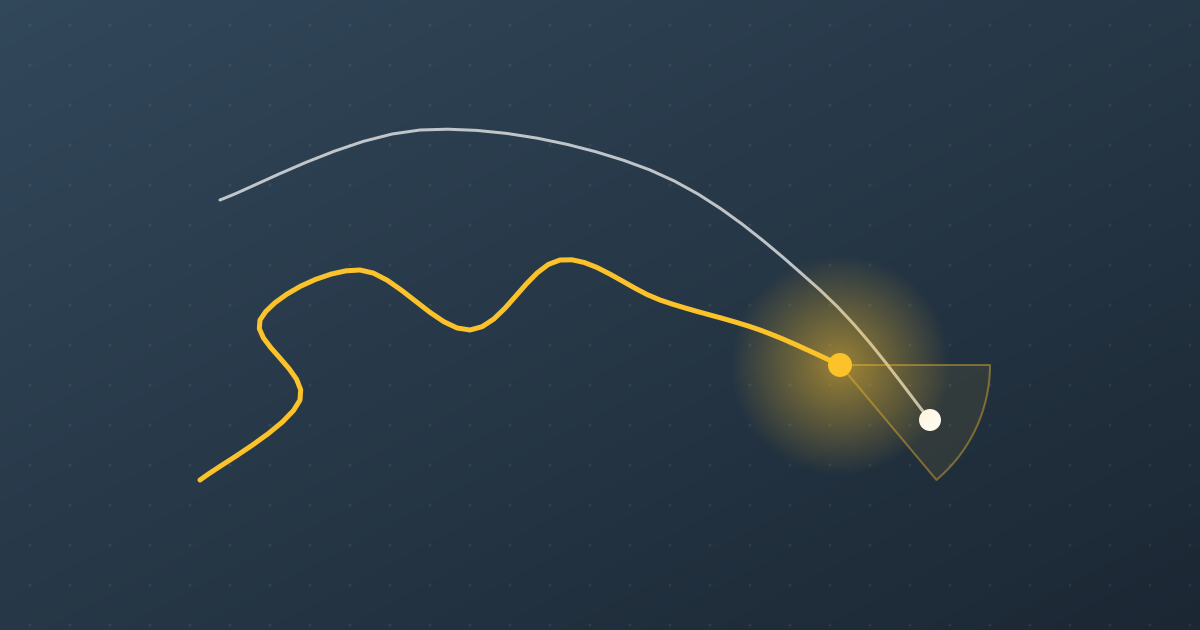
A white track sweeps a wide curve; a golden one switches direction in quick, short turns and gets behind it – like Boyd’s F-86 over Korea.
01
A young pilot at the end of the war
Situation
John Richard Boyd is born in 1927 in Erie, Pennsylvania. In March 1953 he arrives in Korea as an F-86 pilot. Until the armistice in July, he flies 22 to 29 missions, depending on the source, without scoring a kill. Afterward he becomes an instructor at the Air Force’s Fighter Weapons School, writes its tactics manual and is known as “Forty Second Boyd”: he bets that he can beat any opponent from a disadvantageous starting position within 40 seconds.
Link to the principle
Boyd’s real field is not combat but analysis. He wants to understand what decides a dogfight. His bet already points the way: what counts is not the starting position but how quickly you change it.
02
The puzzle of the MiG-15
Situation
The MiG-15 can climb and accelerate faster than the F-86. Even so, the Sabre pilots report far more kills than losses. Boyd sees two less obvious advantages of the F-86: a high bubble canopy that offers much better all-around visibility, and fully hydraulic flight controls that let the pilot move faster from one maneuver to the next. According to his analysis, the MiG has poorer visibility and controls that slow down such transitions.
Link to the principle
Boyd looks at pilot and aircraft as one system. The canopy improves observing; the hydraulics speed up acting. If you are a moment faster in every phase, you force the opponent to react to situations that are already over. Boyd calls this getting inside the opponent’s decision loop.
03
From the cockpit to theory
Situation
In 1960, Boyd publishes the “Aerial Attack Study,” which becomes the basis of Air Force air combat tactics. In the 1960s, together with the mathematician Thomas Christie, he develops the energy-maneuverability theory, which shapes the design of fighter aircraft. In the 1970s he formulates the OODA Loop: observe, orient, decide, act. He presents it in an hours-long briefing, “Patterns of Conflict,” whose final version dates from 1986.
Link to the principle
The explanation of a dogfight becomes a general model. Boyd puts particular emphasis on orientation: experience, culture and prior knowledge determine how you interpret what you see. If you are poorly oriented, speed will not make you any better.
04
Influence reaching into the Gulf War
Situation
In 1980, Boyd presents “Patterns of Conflict” at the Marine Corps Amphibious Warfare School, which then changes its curriculum. In 1981 he briefs Dick Cheney, the future secretary of defense. Charles Krulak, a former commandant of the Marine Corps, calls him an architect of victory in the 1991 Gulf War. Boyd dies in 1997 and is buried at Arlington National Cemetery.
Link to the principle
The OODA Loop becomes part of the doctrine of maneuver warfare. It shifts the focus from materiel and mass to speed, initiative and confusing the opponent.
05
A myth in the foundation
Situation
The often-cited 10-to-1 kill ratio in favor of the F-86 does not hold up in more recent studies; it probably goes back to wartime propaganda. The authors Douglas Dildy and Warren Thompson estimate about 5.8 to 1 overall and only 1.4 to 1 against two elite Soviet units. Other reasons played a part: the MiG’s instability at very high speeds, American pilots who were mostly more experienced, plus gunsights, flight helmets and anti-g suits. The aviation historian Michael W. Hankins considers the OODA model so vague that supporters and critics alike see in it what they want to see.
Link to the principle
This weakens the story, but not the core of the model. It is a reminder that even a good idea needs evidence. If you use the OODA Loop, treat it as a thinking tool, not as a proven law of nature.
Key takeaways
Key lessons
01
When results surprise you, look for inconspicuous advantages.
02
Improve your view before you improve your power.
03
Make the transitions between actions faster.
04
Tend your orientation: experience and prior knowledge shape what you see.
05
Check the evidence for your favorite models too.
Summary
John Richard Boyd asked why the F-86 did well in the Korean War against the more capable MiG-15. His answer: better visibility and faster controls allowed faster cycles of perception and action. This gave rise to the OODA Loop, whose influence reached into the Gulf War and into business. More recent research shows that the kill ratios were exaggerated and that many factors played a part. The loop remains a powerful thinking tool, but its founding example holds up only in part.