In Tony Scott’s 1986 film, the naval aviator Maverick learns at an elite school that in air combat, the winner is often the one who perceives and switches faster. But he also learns that speed without clear orientation and without regard for the team can be deadly.
Two circles of four arc segments lie side by side, and in each a dot runs around the circle: on the left a fast golden one, on the right a slow mist-blue one. Each time the golden dot reaches its Act field, a grid of dots in the middle shifts, and the slow dot aims at a spot that no longer exists. Then the image zooms into the Orient field: several rings lie there like lenses, and one distorted lens sends even the fast dot into empty space.
Principle #25
OODA Loop: If you perceive faster, read the situation more accurately, decide and act, you shape events while the other side is still reacting to the last situation.
4 min read5 sectionsSituationLink to the principle
Contents
“Top Gun” is not an instructional film but an action movie with lots of music, sunglasses and rivalry. The school it shows, however, has a serious background. The U.S. Navy founded its Fighter Weapons School in 1969 because its pilots’ air combat skills had noticeably declined in the Vietnam War. In the Air Force, John Richard Boyd had already analyzed air combat as an instructor in the 1950s; he formulated the OODA Loop in the 1970s. The film never mentions Boyd. But in many scenes it shows what the OODA Loop means: observing, orienting, deciding and acting faster than the opponent.
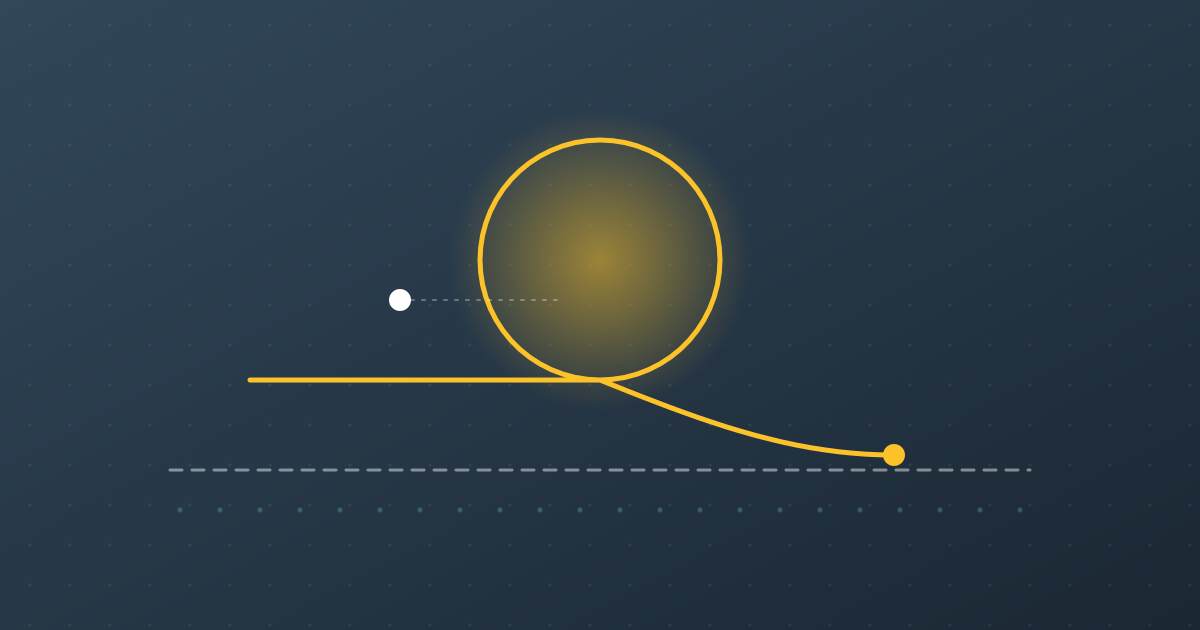
A golden track pulls a tight loop to just above a dashed limit, and the white wingman falls behind – as in “Top Gun.”
01
The school of the fast
Situation
Lieutenant Pete “Maverick” Mitchell (Tom Cruise) and his radar intercept officer Nick “Goose” Bradshaw (Anthony Edwards) are sent from the aircraft carrier USS Enterprise to the Fighter Weapons School at Naval Air Station Miramar near San Diego. There they meet the Navy’s best pilots, among them Tom “Iceman” Kazansky (Val Kilmer), who is cool, precise and Maverick’s strongest rival.
Link to the principle
The school is an institution whose entire purpose is to shorten decision loops. Through practice, perception and reaction become so automatic that no time is lost thinking about the basics when it counts.
02
Switching instead of a contest of strength
Situation
In the very first training engagement, Maverick beats the instructor Jester by going below the prescribed minimum altitude of 10,000 feet. Afterward, he and Goose buzz the control tower against orders. Both get him into trouble with the school’s commander, Viper.
Link to the principle
This contains Boyd’s idea: it is not the stronger machine that wins, but the side that changes the situation faster and more surprisingly. The opponent is still acting on the old situation and finds himself in a new one he did not expect. But the film also shows that to do it, Maverick breaks rules meant to keep training safe.
03
Speed without the team
Situation
In one exercise, Maverick leaves his wingman Hollywood to chase Viper; in the end, both are “shot down.” In a later exercise, he pushes Iceman to clear a target for him. In doing so, his F-14 flies into the jet wash of Iceman’s aircraft. Both engines flame out and the plane goes into a spin. Both men eject; Goose hits the jettisoned canopy and is killed.
Link to the principle
A fast loop for yourself alone is not enough. In air combat, as in every organization, many loops run inside one another. If you speed up your own and lose sight of the team, you win a moment and lose the whole.
04
Disrupted orientation
Situation
A board of inquiry clears Maverick of blame. But he is paralyzed by guilt, hesitates in training and thinks about quitting. Commander Mike “Viper” Metcalf (Tom Skerritt), who once flew with Maverick’s father, tells him what really happened to his father and encourages him to carry on.
Link to the principle
Boyd considered orientation the most important part of the loop. Experience, emotions and self-image determine how you interpret what you see. A pilot whose orientation has been shattered still sees everything, but he can no longer decide. The loop does not stall at the eye but in the mind.
05
The real thing
Situation
Maverick, Iceman and Hollywood are ordered to the USS Enterprise. Their task is to provide air cover for the rescue of a disabled ship in hostile waters. In the dogfight against enemy jets, fictional MiG-28s in the film, Maverick shoots down three aircraft and Iceman one more. Afterward, the rivals respect each other.
Link to the principle
With his orientation restored, the loop runs again. This time Maverick acts quickly and in concert with his wingman. Only the interplay of both loops makes the difference.
Key takeaways
Key lessons
01
Practice the basics until they no longer cost you time when it counts.
02
Change the situation faster than the other side can grasp it.
03
Never speed up your loop at the expense of your team.
04
Tend your orientation, especially after setbacks.
05
Get help when guilt or fear paralyzes your judgment.
Summary
“Top Gun” shows the Navy’s elite fighter school as a place where decision loops are shortened. Maverick wins by switching quickly and, through speed without the team, loses his friend Goose. Afterward, guilt disrupts his orientation, and the loop stalls. Only when he regains it does he act quickly and together with others. In this way, the film tells Boyd’s idea in all three of its parts: speed, orientation and interplay.