A boulder pins a climber’s arm in a canyon in Utah. No one knows where he is. When every other way out has been used up, he finds the strength for the one step he had refused to think about before.
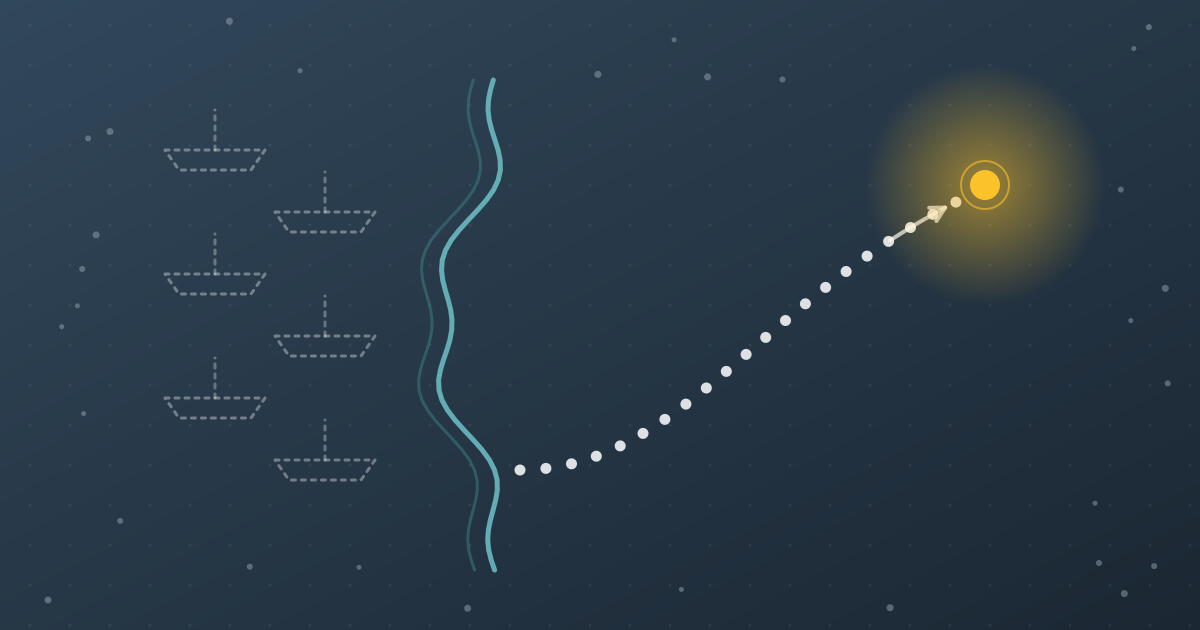
Many small dots stand at a fork; one line leads back to an arch at the bottom edge, one forward onto a rise, and the dots split into teal and mist-blue, some of them drifting back. Then the arch fades, all the dots turn gold and move forward together; in the final image, a ring closes around a dark circle that grows until a gap opens in the ring and it slips out.
Principle #85
Death Ground: If you have no way back, you release strengths that would otherwise stay hidden; that is why it can be wise to cut off your own retreat deliberately – and unwise to take it away from an opponent.
4 min read5 sectionsSituationLink to the principle
Contents
Danny Boyle’s 2010 film “127 Hours” tells the true story of the climber Aron Ralston, played by James Franco. Almost the entire film takes place in a single spot, a narrow crevice in the rock. That makes it a study of Death Ground: what happens to a person when there is no way back anymore? Unlike generals and entrepreneurs, Ralston did not choose this situation. Precisely for that reason, the film shows the inner process especially clearly.
In a narrow canyon, a boulder is wedged, with a dot beneath it; a golden path along the ground leads out into the open – as in “127 Hours.”
01
Out alone, without telling anyone
Situation
In April 2003, Aron Ralston heads alone into the canyons of Utah. He tells no one where he is going. At the start, the film shows him as a self-assured, fast-moving adventurer who enjoys encounters and doesn’t need help. In a narrow slot canyon, a boulder comes loose and pins his right forearm against the wall.
Link to the principle
Ralston did not cut off his way back deliberately but through carelessness. Because no one knows where he is, no one will come looking for him. That is the first lesson: death ground that you stumble into through negligence is something different from death ground that you choose deliberately.
02
Trying every way out
Situation
The film shows Ralston trying day after day to free himself. He chips away at the rock with a blunt tool, rigs a pulley system out of ropes and rations his water. Nothing moves the boulder. He records farewell messages with his camera.
Link to the principle
As long as there is still another option, people try it first. That is reasonable. Death ground is reached only when every easier path has been exhausted. The film takes a great deal of time over this and so makes you feel why the last step is so hard.
03
Memory and future
Situation
As his exhaustion grows, the film shows memories and waking dreams: family, a lost relationship, moments Ralston missed. Finally, he sees a child he does not yet have. These images awaken in him the will to get home.
Link to the principle
Death ground does not release strength automatically. The strength needs a reason. For Ralston, it is not the rock that drives him but the life he wants to return to. If you lead others into a situation with no way back, you must therefore also be able to tell them what makes it worthwhile.
04
The step that was unthinkable before
Situation
After about five days, Ralston breaks the bones of his forearm by levering the trapped arm against the rock and cuts the arm off with a blunt multi-tool. He rappels down, walks out through the canyon and meets hikers. A helicopter takes him to the hospital.
Link to the principle
This is the core of the principle. In a situation with no way out, a person does what they previously considered impossible. Sun Tzu describes this for soldiers who can no longer flee. The film shows it in a single body and a single will.
05
After the rescue
Situation
Ralston writes about the experience in the book “Between a Rock and a Hard Place” (2004), on which the film is based. The film receives six Oscar nominations, including Best Picture and Best Actor for James Franco. At the end of the film, we learn that the real Ralston keeps climbing and ever since has always left a note saying where he is going.
Link to the principle
The lesson is twofold. Death ground can awaken extraordinary strength. But the wise do not step onto it out of carelessness. If you cut off your own way back, you should know it and want it.
Key takeaways
Key lessons
01
If you stumble into a situation with no way back through carelessness, that is not courage but a mistake.
02
Try the reasonable ways out first before you take the radical step.
03
Strength in an emergency needs a purpose: people and a life you want to return to.
04
In the most extreme situation, you can do more than you think possible.
05
Tell others where you are going, whether in the mountains or at work.
Summary
“127 Hours” shows Aron Ralston, who in 2003 is pinned by a boulder, alone in a canyon in Utah. Only when every other way out is exhausted and images of family and the future give him a reason does he find the strength to sacrifice his arm. The film shows death ground as an inner process and at the same time warns against bringing about such a situation out of carelessness.
Sources
127 Hours. Directed by Danny Boyle. Screenplay by Danny Boyle and Simon Beaufoy. U.S./United Kingdom 2010.
Aron Ralston: Between a Rock and a Hard Place. New York: Atria Books 2004.
Wikipedia: 127 Hours (plot, Oscar nominations)
Back to the basics
Read what lies behind Death Ground: with explanation, animation, video and research.