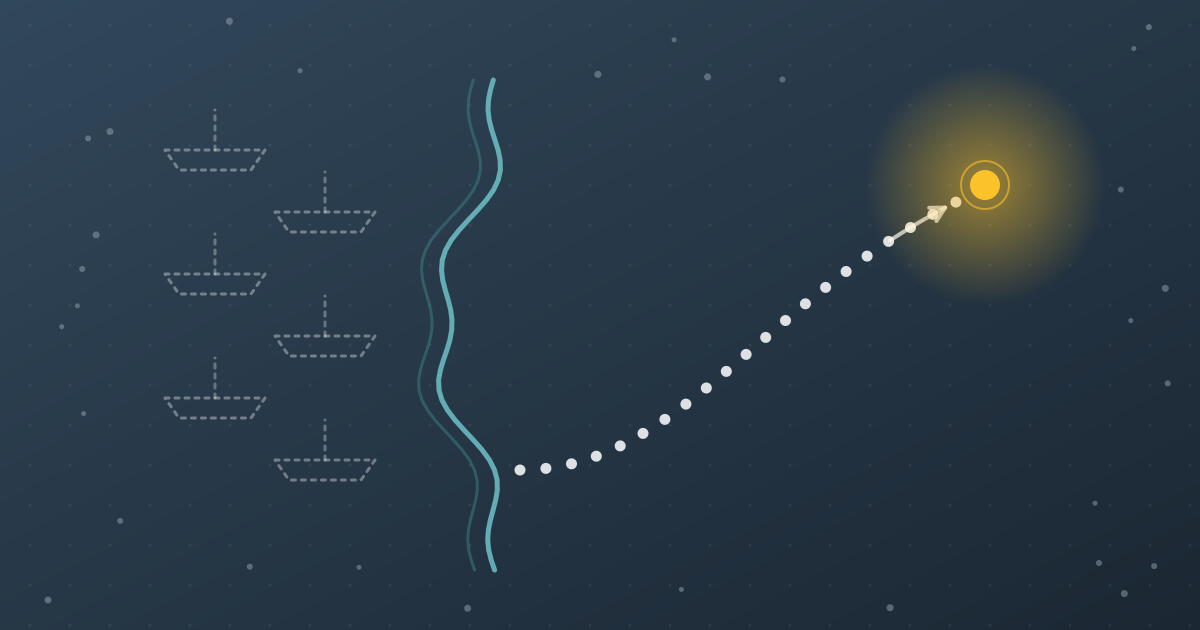
The principle in detail
Three steps through the principle: grasp it, place it, put it to work. Open each topic on its own.
The core messageCore statement and 3 clarifications
A missing way back can end doubt and unite a group. A leader can choose this situation deliberately for themselves and their own people.
- It also says
- You had better not take away an opponent’s way out, or they will fight desperately.
- It does not say
- That a closed way back makes success more likely. It increases resolve, not the odds.
- It does not say
- That you may take away other people’s way back without asking them and without telling them what for.
The explanationIf you drive an opponent into a situation with no way out, you awaken these very strengths in them.
The principle has a second side.
- If you drive an opponent into a situation with no way out, you awaken these very strengths in them.
- That is why Sun Tzu advises leaving a surrounded opponent a way out.
Where would a closed way back help you, and whose way back are you taking away right now?
The signs3 signs when you heed it · 3 when you overlook it
- You burn your bridges only once the goal has been tested.
- Those who go with you know what makes the effort worthwhile, and they have agreed.
- You leave an opponent a path on which they can withdraw without losing face.
- Your team keeps every door open and makes no headway.
- Or you stumble carelessly into a situation with no way out instead of choosing it.
- An opponent you have backed into a corner fights harder than expected.
The backgroundFrom Sun Tzu’s “The Art of War” (probably 5th century BC), chapters 11 and 7. · T2 Eastern Strategy
- 5th c. BCOriginSun Tzu
The Art of War
- 1960SupplementedThomas C. Schelling
The Strategy of Conflict
- 2002SupplementedDaniel T. Gilbert and Jane E. J. Ebert
Decisions and Revisions
- Tradition T2TraditionEastern Strategy
Sun Tzu, Kautilya, the Thirty-Six Stratagems, the Tao Te Ching, Miyamoto Musashi, François Jullien
See the tradition on the Origin page
Read more: the full background
From Sun Tzu’s “The Art of War” (probably 5th century BC), chapters 11 and 7. Supplemented by Thomas C. Schelling’s “The Strategy of Conflict” (1960) and the finding by Daniel T. Gilbert and Jane E. J. Ebert (2002).
The research4 sources: 1 classic, 1 theory, 1 experiment, 1 primary study · 1960–2002 · with limitations of the research
- weak
- moderate
- strong
The core comes from a classic without any measurement; Thomas C. Schelling offers a theory, and the experiment by Daniel T. Gilbert and Jane E. J. Ebert measures satisfaction, not released strength.
- 1960Thomas C. Schelling
“The Strategy of Conflict”: if you visibly limit your own options, you can strengthen your position.
- 1976Barry M. Staw
“Knee-Deep in the Big Muddy”: after losses, people put more into a course they have chosen.
- 2002Daniel T. Gilbert and Jane E. J. Ebert
“Decisions and Revisions”: people prefer to choose reversibly but are more satisfied with irreversible decisions, and they do not foresee this.
- Death ground increases resolve, not the prospects of success.
- What looks like courage in hindsight is sometimes just escalation that happened to turn out well; Hernán Cortés’s success is explained above all by alliances and circumstances.
- If you burn your bridges, you lose the chance to learn from new information.
- No one has measured whether a missing way back releases hidden strength.
- The principle becomes ethically delicate when a leader cuts off the way back for others who were never asked.
Read more: what research shows
In chapter 11 of “The Art of War,” Sun Tzu describes death ground as terrain on which an army can escape destruction only by fighting at once. If you put soldiers in a position from which there is no escape, he says, they will prefer death to flight. Conversely, in chapter 7 he advises leaving a surrounded army a way out and not pressing a desperate enemy too hard. In 1960, Thomas C. Schelling showed that you can strengthen a bargaining position by visibly limiting your own options because threats and promises then become credible. In 2002, Daniel T. Gilbert and Jane E. J. Ebert found that people prefer reversible decisions but are more satisfied with irreversible ones. In 1976, Barry M. Staw described the downside: after losses, people often put even more into a course they have chosen.
The related principles35 Terrain · 46 Moral Forces · 52 Golden Bridge · 64 Credible Commitment
To go deeper, see 64 Credible Commitment (if you take away your own retreat, you make your resolve visible to others) and 46 Moral Forces (death ground works through courage, cohesion and will)
In 35 Terrain, Sun Tzu develops it as the most extreme of his kinds of terrain
Its opposite is 52 Golden Bridge: you leave the opponent a way out so that they do not fight in desperation
Read more: the full text
To go deeper, see 64 Credible Commitment (if you take away your own retreat, you make your resolve visible to others) and 46 Moral Forces (death ground works through courage, cohesion and will); in 35 Terrain, Sun Tzu develops it as the most extreme of his kinds of terrain. Its opposite is 52 Golden Bridge: you leave the opponent a way out so that they do not fight in desperation.
The action steps5 action steps: Test the goal thoroughly before you cut off your way back.
- Test the goal thoroughly before you cut off your way back. A burned bridge turns a mistake into a disaster.
When a project stalls, ask yourself which open way back is tying up strength, such as a plan B that people keep talking about.
When you close a way back, tell your team openly what makes the effort worthwhile, and get the consent of those it affects.
- Tell someone where you are going. Even death ground you choose deliberately needs a person who knows about it.
Leave an opponent, competitor or critic a way out that saves face before you put pressure on them.
The reflection questions3 questions: Which open way back is tying up strength in your most important project right now?
- Which open way back is tying up strength in your most important project right now?
- Which goal would you need to test more thoroughly before you commit?
- Whose way out have you blocked, and how could you leave them one?
Take your time with one question. Write down your answer – or talk it over with someone you trust.
The picture to rememberThe animation once more, with an explanation
- Many small dots stand at a fork
- One line leads back to an arch at the bottom edge, one forward onto a rise, and the dots split into teal and mist-blue, some of them drifting back
- Then the arch fades, all the dots turn gold and move forward together
- In the final image, a ring closes around a dark circle that grows until a gap opens in the ring and it slips out
How the principle shows up in practice
Hernán Cortés, 1519
He runs his ships aground off Veracruz and takes away the doubters’ way back to Cuba. Cohesion grows, but his success is explained above all by alliances and circumstances.
Elon Musk, 2008
By his own account, he puts the rest of his money into Tesla and SpaceX. Death ground keeps both companies in the game until the rescue on Christmas Eve, but it guarantees nothing.
Francis Ford Coppola, 1976–1979
He is personally liable for the cost overruns on “Apocalypse Now” and keeps shooting through every crisis. The pressure carries him through, but at a high price.
Which way back is slowing you down?
Get your profile across all 12 groups in about 10 to 15 minutes.
Start the Strategy CheckGroup 10: Psychology and the Irrational
Guiding question: Which forces in the mind steer decisions?
Stage 2 of 5: Understand the situation
- TraditionEastern Strategy
Sun Tzu, Kautilya, the Thirty-Six Stratagems, the Tao Te Ching, Miyamoto Musashi, François Jullien
- Related principles
Where the 92 principles come from: eight traditions of strategy, from classical war theory to dealing with uncertainty.
More about the originBackground: WEGVISOR’s own selection from the strategy literature · More about the origin