In “Ocean’s Eleven” (2001), Danny Ocean plans with a team of specialists to empty a Las Vegas casino owner’s vault. A visible extortion with a cash handover draws every eye, while the real robbery unfolds in an entirely different way.
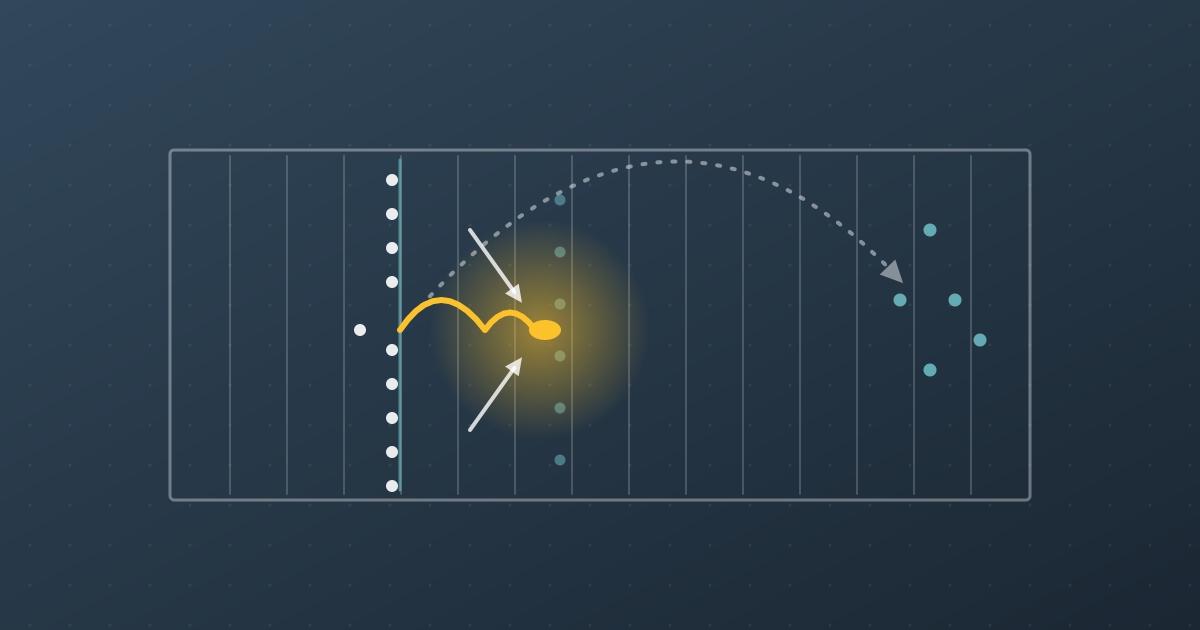
A line of teal dots runs across the image; a large mist-blue circle pushes against it head-on, and the dots crowd together at that point. A small golden dot swings in an arc around the thin end and strikes the line from behind; then the circle and the dot switch roles and circle each other.
Principle #28
The Direct and the Indirect: The expected, direct force pins the opponent down; the unexpected, indirect force decides – and neither works without the other.
4 min read5 sectionsSituationLink to the principle
Contents
Steven Soderbergh’s film, starring George Clooney, Brad Pitt, Matt Damon, Julia Roberts and Andy García, is a remake of the 1960 Rat Pack film. It grossed about $450 million worldwide. Beneath its light surface lies a precise arrangement of direct and indirect forces – the Direct and the Indirect at work. Almost every move the team makes is meant to hold the opponent in place at one point so that he notices nothing at another.
All eyes meet on a bright handover, while beneath it a golden path runs unnoticed into the vault – as in “Ocean’s Eleven.”
01
A target considered impossible
Situation
Danny Ocean is released on parole from prison in New Jersey, immediately violates its conditions and meets his partner Rusty Ryan in Los Angeles. With the former casino owner Reuben Tishkoff as their financial backer, they plan a heist against Terry Benedict. He owns the Bellagio, the Mirage and the MGM Grand, whose cash is kept in a shared, heavily secured vault. During a big boxing match, Danny calculates, more than $150 million will have to be stored there.
Link to the principle
Against surveillance, guards and armored doors, a direct attack is useless. The opponent is stronger at every visible point. If you want to win here, you have to use the direct force not to win but to pin down.
02
The team and the replica
Situation
Danny and Rusty recruit eight specialists, from the pickpocket Linus Caldwell to the explosives expert Basher Tarr to the acrobat Yen. The team builds an exact replica of the vault in order to rehearse the job. Linus watches Benedict and discovers that he is with Danny’s ex-wife, Tess. Rusty fears that Danny cares more about Tess than about the money.
Link to the principle
The replica looks like a practice space. Later it becomes the decisive indirect weapon. Good preparation often serves a double purpose, and the second is the one the opponent does not see.
03
Many pins, one target
Situation
On the evening of the fight, Danny walks openly into the Bellagio. Benedict has him taken to a room without surveillance, where a thug who secretly works for Danny is supposed to intimidate him. Linus poses as an official of the gaming commission. Saul Bloom plays a wealthy foreigner and has a case containing explosive charges taken into the vault. Yen is smuggled in on a cart. Basher uses a stolen device to cause a power outage across all of Las Vegas.
Link to the principle
Each of these moves ties up attention. Benedict watches Danny, the guards watch the power outage, the cashier’s cage watches the wealthy guest. Danny himself is the most visible direct force: if you know your enemy is in your own house, you watch him and miss everything else.
04
The visible extortion
Situation
Rusty calls Benedict and demands half the money, loaded into a waiting van; otherwise the rest will be blown up. On the surveillance feed, Benedict sees the thieves in the vault. He releases the money but has the van followed and calls in a SWAT team. During the raid, the charges explode and seemingly destroy the remaining money. The van is remote-controlled, and the bags contain only flyers. Benedict finally realizes that the surveillance feed came from the replica.
Link to the principle
The extortion is the film’s zheng. Everyone, Benedict and the audience alike, is watching the handover, the van and the raid. Exactly where the opponent strikes back, the real robbery does not take place.
05
The hidden heist
Situation
The team has intercepted the emergency call. The SWAT officers who storm the vault are Danny’s people in disguise. They carry more than $160 million openly out of the real vault. Danny returns to the room where he was being held. He gets Benedict to say on camera that he would trade Tess for the money. Tess sees it. Danny is arrested for violating his parole, but he has won back both the money and Tess.
Link to the principle
The qi decides, and it uses the opponent’s reaction to do so. Benedict’s own counterstrike, calling in the SWAT team, opens the way for the robbery. The strongest indirect force is often the one the opponent sets in motion himself.
Key takeaways
Key lessons
01
Use your visible forces to pin down, not to win.
02
Give every preparation a second, hidden purpose wherever possible.
03
Anticipate where the other side will look, and act somewhere else.
04
Plan the opponent’s reaction as part of your own plan.
05
Watch for moments when something loud is distracting you from what really matters.
Summary
“Ocean’s Eleven” is a textbook case of the interplay of the direct and the indirect. Danny Ocean ties up Benedict’s attention with his own presence, with distractions, a power outage and a visible extortion. While everyone is watching the cash handover, the team, posing as a SWAT team, takes the money out of the real vault. The film shows that the direct force does not have to win. Its task is to hold the opponent’s gaze.