In September 1950, UN troops in the Pusan Perimeter hold the North Korean army in place. While its forces are tied down there, Douglas MacArthur lands far in their rear at Inchon, cuts off their supply lines and thereby decides the campaign.
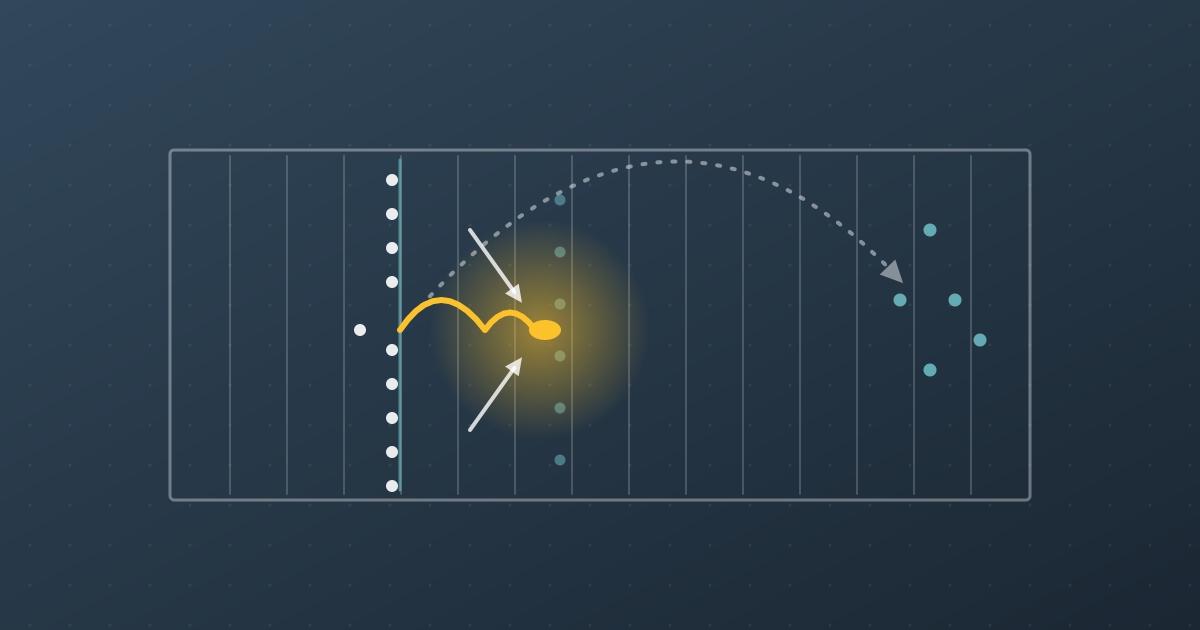
A line of teal dots runs across the image; a large mist-blue circle pushes against it head-on, and the dots crowd together at that point. A small golden dot swings in an arc around the thin end and strikes the line from behind; then the circle and the dot switch roles and circle each other.
Principle #28
The Direct and the Indirect: The expected, direct force pins the opponent down; the unexpected, indirect force decides – and neither works without the other.
4 min read5 sectionsSituationLink to the principle
Contents
In the fifth chapter of “The Art of War,” Sun Tzu distinguishes between two kinds of force. The direct, in Chinese zheng, is the expected one: the frontal attack, the visible defense, what the opponent is counting on. The indirect, qi, is the unexpected one: the blow from the side, from the rear, at an unexpected time. With the direct force you pin the opponent down; with the indirect force you win. The Battle of Inchon is a textbook example of the Direct and the Indirect.
In the south of a peninsula, dots press against an arc, and a golden arrow lands in their rear and cuts the line – as at Inchon in 1950.
01
Backs to the sea
Situation
By the summer of 1950, the North Korean army has occupied almost the entire Korean peninsula. In early August, the South Korean and UN troops are pushed back to a shrinking strip around the port city of Pusan in the southeast. General Walton Walker defends this perimeter with short interior lines, mobile artillery and reinforcements that arrive through the port. The danger of a breakthrough grows from week to week.
Link to the principle
That is the direct force. It is not brilliant, but it is indispensable. As long as Walker holds, the North Korean army has to concentrate its divisions in the south. Without this pinning effect, there would be no room for a blow elsewhere.
02
A plan against all objections
Situation
Douglas MacArthur proposes a landing at Inchon on the west coast, about 30 kilometers from Seoul. The aim is to cut the North Koreans’ supply lines and encircle their divisions in the south. Senior naval officers warn against it. The tides are extreme, the channels narrow, and the island of Wolmi-do blocks the harbor entrance. MacArthur sees an advantage precisely in these difficulties, because no one expects a landing there. On August 28, 1950, the Joint Chiefs of Staff approve the plan. During planning, Japanese tide tables prove more reliable than the American ones.
Link to the principle
The indirect force works where the opponent is not looking. Often they are not looking there because the place seems impossible. The difficulty itself becomes the source of surprise. That does not mean every gamble is wise. It means that the unexpected often lies exactly where all the experts wave it off.
03
The pinning holds
Situation
In the days before the landing, air strikes, a naval bombardment and a small landing operation draw attention to the port city of Kunsan farther south. Starting on September 10, aircraft attack the island of Wolmi-do. Some 260 ships gather off the coast. The defenders in the Inchon area are vastly outnumbered.
Link to the principle
These numbers show how the two forces work together. Because the bulk of the North Korean army is tied down in the south, the landing meets a thin defense. The direct force creates the gap; the indirect force exploits it.
04
The blow to the rear
Situation
On the morning of September 15, 1950, Marines take the island of Wolmi-do. In the evening, with the high tide, the main landing follows. The newly formed X Corps under Major General Edward Almond, with the 1st Marine Division and the 7th Infantry Division, takes Inchon within 24 hours. Starting on September 16, Walker’s Eighth Army breaks out of the Pusan Perimeter. On September 25, Almond declares Seoul liberated; the last fighting in the city lasts until September 28. The North Korean divisions in the south, cut off from their supplies, retreat in confusion, and tens of thousands of soldiers are taken prisoner.
Link to the principle
The indirect force decides. And at once the roles switch: the troops in the Pusan Perimeter, until a moment ago the force that pinned the opponent down, become the hammer that pursues the fleeing opponent. Sun Tzu describes exactly this: the direct and the indirect pass into each other like a circle without end.
05
When the unexpected becomes predictable
Situation
On September 30, China warns that it will intervene if UN troops cross the 38th parallel. Starting on October 1, South Korean troops advance north, and starting on October 7 other UN troops follow. On October 19, Chinese troops secretly cross the Yalu, the border river, and starting on October 25 they attack. At the end of November, a major Chinese offensive hits the UN troops.
Link to the principle
The success of the unexpected easily breeds overconfidence. After Inchon, the UN troops themselves became the expected force, and now the unexpected came from the other side. If you have mastered the principle, you have to assume that the opponent knows it too.
Key takeaways
Key lessons
01
Without a force that pins the opponent down, surprise has no room.
02
Value the unspectacular work of those who hold the position.
03
Look for the unexpected even where everyone says it can’t be done.
04
Let the roles switch as soon as the decision has been made.
05
After a great success, you yourself are easiest to see through.
Summary
In September 1950, the defense of the Pusan Perimeter tied down the bulk of the North Korean army in the south. Far in its rear, the landing at Inchon met a thin defense, cut off its supply lines and decided the campaign. That is Sun Tzu’s interplay of zheng and qi: the direct force holds the opponent in place, the indirect force decides, and then the roles switch. The further course of the war shows the downside: if you become predictable after such a success, you open the door for the opponent’s own qi.
Sources
History Skills: The Battle of Inchon
Wikipedia: Battle of Inchon
Wikipedia: Korean War
David Halberstam: The Coldest Winter: America and the Korean War. New York: Hyperion 2007.
Sun Tzu: The Art of War, Chapter 5. China, c. 5th century BC.
Back to the basics
Read what lies behind the Direct and the Indirect: with explanation, animation, video and research.