The principle in detail
Three steps through the principle: grasp it, place it, put it to work. Open each topic on its own.
The core messageCore statement and 3 clarifications
The direct and the indirect belong together. Without a force that pins the opponent down, surprise has no room; without surprise, pinning down remains a struggle without a decision.
- It does not say
- That the indirect is better. If you fall in love with the surprising and neglect the foundation, you lose both.
- It does not say
- That a surprise move can be repeated at will. Every qi wears out as soon as it is known.
- It also says
- The direct force has to be strong enough to hold until the indirect one takes effect.
The explanationThe idea works because attention is limited.
The idea works because attention is limited.
If you are watching the visible movement, you miss the hidden one.
- Zheng and qi are not fixed properties.
- What surprises today is familiar tomorrow and becomes the expected.
- What has just been pinning the opponent down can decide in the next move.
What holds your everyday work together, and where do you dare to take the step no one expects?
The signs3 signs when you heed it · 3 when you overlook it
- The routine runs reliably, and at one point you deliberately make an unusual move.
- You change your means before everyone knows them.
- New things get room without the core business suffering.
- You just keep increasing your effort at the same spot and wonder why nothing changes.
- Or you chase ideas while your day-to-day business crumbles.
- A recipe for success is repeated until everyone can predict it.
The backgroundTradition T2 Eastern Strategy
- 6th/5th c. BCOriginSun Tzu
Chapter 5
- 1954SupplementedBasil Henry Liddell Hart
Strategy,
- Tradition T2TraditionEastern Strategy
Sun Tzu, Kautilya, the Thirty-Six Stratagems, the Tao Te Ching, Miyamoto Musashi, François Jullien
See the tradition on the Origin page
Read more: the full background
From the fifth chapter of “The Art of War,” attributed to Sun Tzu (Sun Wu, 6th or 5th century BC), as interpreted in the commentary of the commander Cao Cao (around AD 200). Supplemented by Basil Henry Liddell Hart’s indirect approach (“Strategy,” 1954).
The research2 sources: 1 classic, 1 theory · 1954 · with limitations of the research
- weak
- moderate
- strong
Classical teaching and military theory without measurement; the examples show that things can work this way, not how often.
- 1954Basil Henry Liddell Hart
“Strategy”: develops the indirect approach into a strategic doctrine of its own.
- The principle presupposes that the direct force is strong enough to hold.
- If you divide your forces and overstrain the side that is meant to pin down, you lose both.
- Every qi wears out as soon as it is known, and an opponent who also knows the principle will expect the surprise.
- Where qi relies on deception, it belongs in competition, not in relationships that run on trust.
- This page cites no study supporting the transfer to core business and new ventures in companies.
Read more: what research shows
The pair of terms comes from the fifth chapter of “The Art of War,” attributed to Sun Tzu. In Lionel Giles’s translation, “the direct method may be used for joining battle, but indirect methods will be needed in order to secure victory.” Sun Tzu compares the two with five notes, five primary colors and five flavors whose combinations are countless, and their alternation with a circle that never ends. The commander Cao Cao wrote the oldest surviving commentary on the text around AD 200 and shaped its interpretation. In the 20th century, Basil Henry Liddell Hart developed the idea into the indirect approach. There are no measurements: the principle is a teaching drawn from experience, supported by examples from war, sports and business.
The related principles07 Concentration of Force · 26 Deception · 31 Indirect Approach · 32 Surprise
To go deeper, see 31 Indirect Approach (Basil Henry Liddell Hart develops qi into a strategy) and 32 Surprise (qi works through surprise in place, time or manner)
26 Deception shows how the direct force deceives about the real intention
07 Concentration of Force creates superiority where the opponent is not currently pinned down
Read more: the full text
To go deeper, see 31 Indirect Approach (Basil Henry Liddell Hart develops qi into a strategy) and 32 Surprise (qi works through surprise in place, time or manner). 26 Deception shows how the direct force deceives about the real intention; 07 Concentration of Force creates superiority where the opponent is not currently pinned down.
The action steps5 things you can actually do
In your area, separate the expected, which has to carry the load, from the point where an unexpected step could be decisive.
- Secure the direct first. Check whether it holds when you withdraw forces for something new.
Use the unexpected deliberately at one point, not everywhere at once.
- Watch for the moment a surprise move becomes known, and then switch the roles: the familiar becomes the force that pins down, and something else becomes the new move.
- Where the indirect relies on deception, limit it to competition. It has no place in relationships that run on trust.
The reflection questions3 questions: In your area, what is the expected thing that everyone relies on?
- In your area, what is the expected thing that everyone relies on?
- Which step would change your situation precisely because no one is counting on it?
- Which of your recipes for success does everyone know by now?
Take your time with one question. Write down your answer – or talk it over with someone you trust.
The picture to rememberThe animation once more, with an explanation
- A line of teal dots runs across the image
- A large mist-blue circle pushes against it head-on, and the dots crowd together at that point
- A small golden dot swings in an arc around the thin end and strikes the line from behind
- Then the circle and the dot switch roles and circle each other
How the principle shows up in practice
Inchon 1950
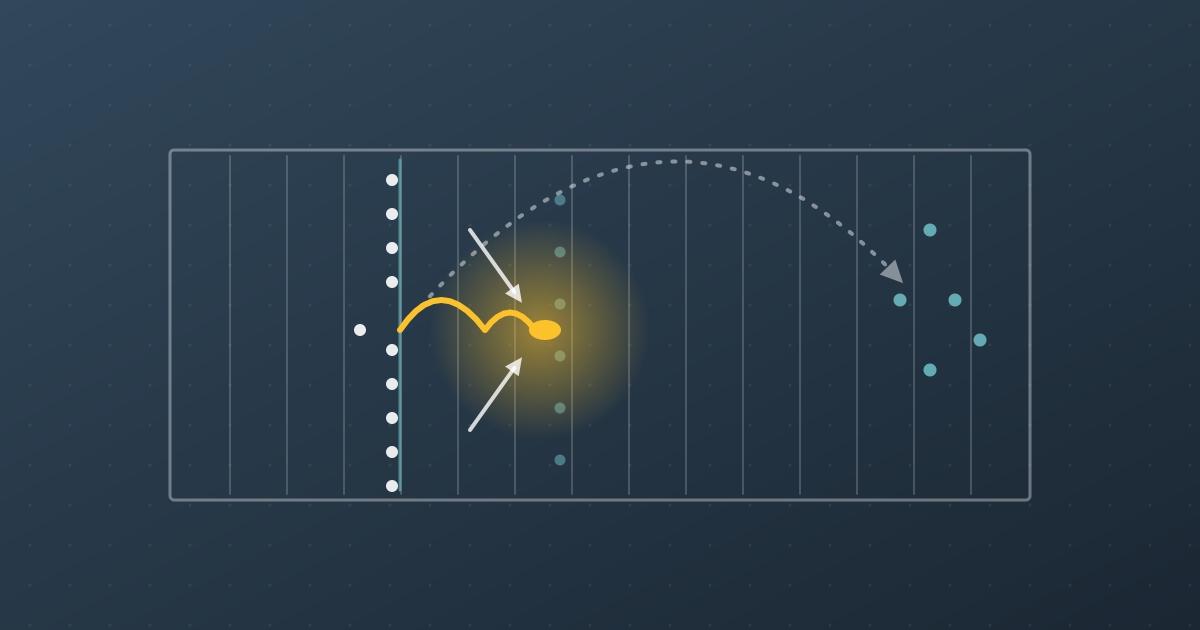
The Pusan Perimeter pins down the North Korean army in the south, and the landing at Inchon in its rear decides the campaign. Without the defenders who held, there would have been no decisive blow.
Super Bowl XLIV 2010
The New Orleans Saints open the second half with a surprise onside kick and win 31–17. The unexpected can be a familiar means used at an unexpected time.
Psycho 1960
Alfred Hitchcock holds the audience with his star, Janet Leigh, and has her character die early. The surprise strikes where the other side feels most secure.
What does no one expect from you?
Get your profile across all 12 groups in about 10 to 15 minutes.
Start the Strategy CheckGroup 4: Deception and Indirection
Guiding question: How do you reach your goal without charging head-on?
Stage 3 of 5: Choose the path
- TraditionEastern Strategy
Sun Tzu, Kautilya, the Thirty-Six Stratagems, the Tao Te Ching, Miyamoto Musashi, François Jullien
- Related principles
Where the 92 principles come from: eight traditions of strategy, from classical war theory to dealing with uncertainty.
More about the originBackground: WEGVISOR’s own selection from the strategy literature · More about the origin