In Rob Reiner’s 1987 fairy-tale comedy, the hero faces a self-proclaimed genius in a battle of wits: one of two goblets is supposedly poisoned. Every line of reasoning flips into its opposite because the other man can reason the same way. In the end, the winner is the one who changed the game.
A golden dot presses against a mist-blue circle, a second dot presses back from the other side, and the circle grows larger instead of smaller. Then a broad line and a narrow line split apart; all the dots stream onto the broad one, it clogs, and a single golden dot glides ahead freely on the narrow one.
Principle #34
Paradoxical Logic: In conflict, the obvious often turns into its opposite because the other side reacts: pressure strengthens what it is meant to break, and the best route becomes a bad one as soon as everyone expects it.
3 min read5 sectionsSituationLink to the principle
Contents
“The Princess Bride” is a film about love, sword fights and giants. One short scene in it has become one of the best-known images of strategic thinking, and of Paradoxical Logic in particular. In miniature, it shows what Edward N. Luttwak calls the paradoxical logic of conflict: where the opponent thinks along with you, the obvious choice becomes a bad one, and the bad one becomes the obvious one.
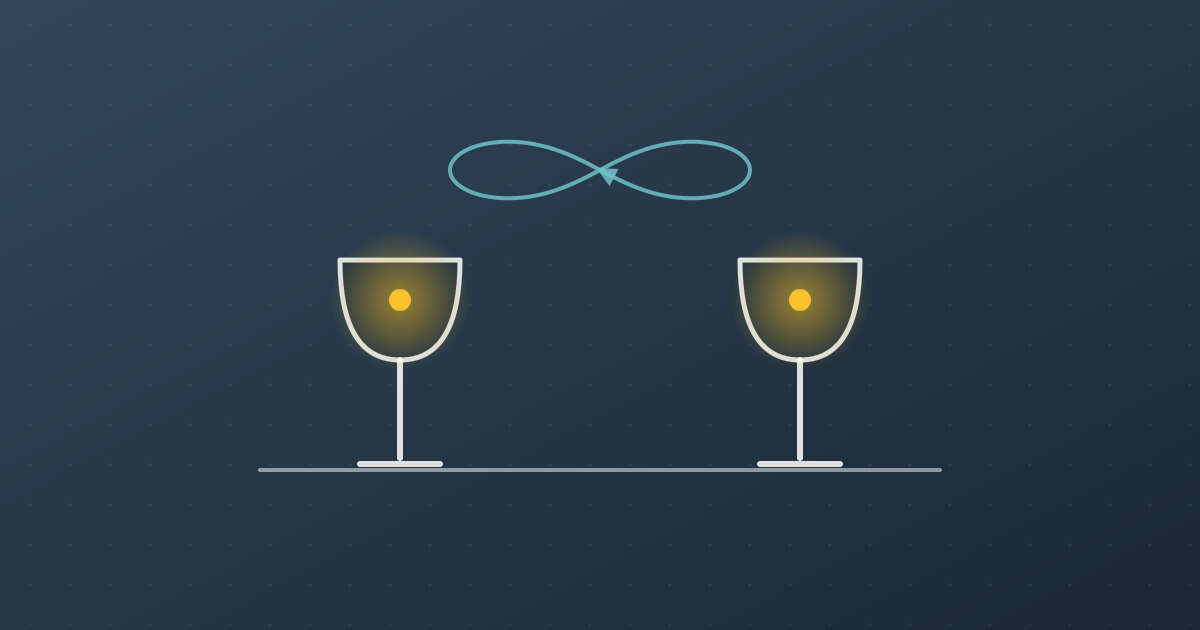
Above two goblets circles an endless loop of weighing up, and in each lies a golden drop – as in the duel in “The Princess Bride.”
01
A story within a story
Situation
A grandfather (Peter Falk) reads a book aloud to his sick grandson (Fred Savage). In it, Princess Buttercup (Robin Wright) is kidnapped by three villains: the Sicilian Vizzini (Wallace Shawn), the swordsman Inigo Montoya (Mandy Patinkin) and the giant Fezzik (André the Giant). A masked man pursues them; in truth he is Westley (Cary Elwes), her true love. William Goldman wrote the screenplay based on his own novel.
Link to the principle
Westley defeats the three one after another, each on his own ground: the swordsman at swordplay, the giant at wrestling, the thinker at thinking. The last test is the most interesting, because it takes place entirely in the mind.
02
Two goblets, one poison
Situation
Westley sets out two goblets of wine and puts poison in one of them without letting Vizzini see which. Vizzini is to choose. Both drink. Whoever has chosen wrongly dies. Vizzini considers himself incomparably clever and begins to reason.
Link to the principle
The duel is a conflict in its purest form. There is no chance, only two players trying to anticipate each other’s thoughts. According to Luttwak, it is precisely in situations like this that paradoxical logic is at its strongest.
03
Every line of reasoning flips
Situation
Vizzini spins his thoughts in ever new loops. Would a clever man put the poison in his own goblet or in his opponent’s? And what if he knows that his opponent knows that? Every reason for one goblet can be turned around with a counter-reason. Vizzini reaches no firm conclusion and finally resorts to a distraction trick in which he switches the goblets.
Link to the principle
This is what paradoxical logic looks like from the inside. What is obvious becomes bad because the other side expects it. What is far-fetched becomes good, until the other side expects that too. The reasoning finds no solid ground. If you are stuck in a loop like this, you can’t win by thinking even harder.
04
The way out of the loop
Situation
Vizzini drinks, laughs at his supposed victory and falls down dead. Westley explains to Buttercup that both goblets were poisoned. He had spent years building up an immunity to this poison.
Link to the principle
Westley did not win the paradoxical loop; he bypassed it. He changed the conditions of the game so that Vizzini’s choice no longer mattered. That is the real lesson: when every line of reasoning flips, look for a way that does not depend on the other side’s choice.
05
Why the scene is so well known
Situation
On its release, the film was only a moderate success at the box office, but it became a cult film on video. It won the Hugo Award in 1988 and was added to the U.S. National Film Registry in 2016.
Link to the principle
The scene is funny because it is true. Many negotiations, competitions and power struggles unfold like Vizzini’s loop of thought. And many are decided the way Westley decides his: through preparation that changes the frame.
Key takeaways
Key lessons
01
Where the other side thinks along with you, the obvious becomes dangerous.
02
Endless loops of “he knows that I know” lead to no reliable result.
03
Don’t mistake your cleverness for protection.
04
Look for solutions that don’t depend on your opponent’s choice.
05
Long preparation can end a loop that no amount of thinking will solve.
Summary
In “The Princess Bride,” Westley challenges the self-assured Vizzini to a duel with two goblets. At every step, Vizzini’s reasoning flips into its opposite, because the other man can anticipate every thought. Westley wins because he has changed the conditions: both goblets are poisoned, and he is immune. The scene shows the paradoxical logic of conflict and the way out of it.