In 1971, a handful of activists set out from Vancouver on an old fishing boat to stop a U.S. nuclear test in Alaska. The boat is intercepted, and the test goes ahead. And yet it remains the last one on the island. The activists won not at sea but in the court of public opinion.
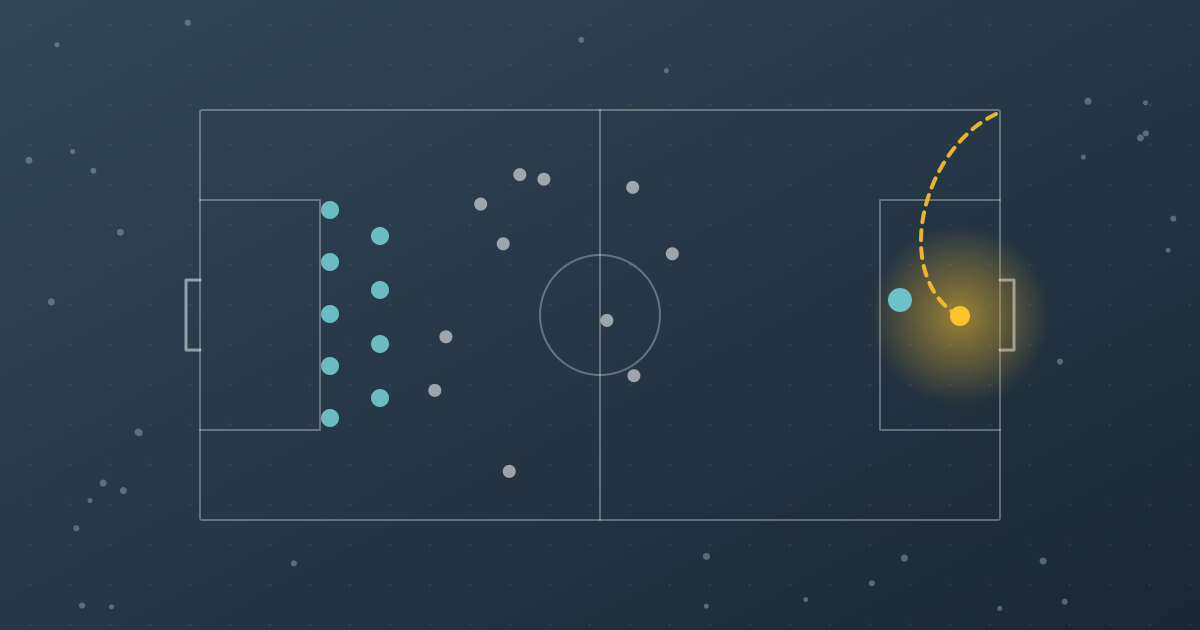
A large circle of many teal dots and a small circle of a few gold dots face each other on an even grid of mist-blue lines, and the gold dots are pushed back field by field. Then the grid tips away, revealing a field of narrow, winding lines and slim gates, in which the large circle gets stuck while the gold dots glide freely through.
Principle #56
Asymmetry: The weaker side does not win by playing the stronger side’s game better, but by choosing a different game in which that strength counts for little.
4 min read5 sectionsSituationLink to the principle
Contents
A fishing boat against the nuclear power of the United States: a balance of strength could hardly be more lopsided. The group that became Greenpeace could not physically prevent the test. It nevertheless turned the test into a problem, because it moved the fight to a different field: away from the island and onto radio, newspapers and television. There, what counted was not the strength of the navy but the power of a story. Asymmetry at its clearest.
A small golden boat off a distant island sends rays of dots in all directions – like Greenpeace off Amchitka.
01
A test on a small island
Situation
The U.S. government is planning an underground nuclear test on Amchitka, a small island in the Aleutians off Alaska. After 1965 and 1969, it would be the third there. Critics fear earthquakes and tsunamis, because the region is seismically active. The island also lies within a wildlife refuge. In late 1969, the Don’t Make a Wave Committee forms in Vancouver to stop the tests.
Link to the principle
On the fields where a state can bring its military, courts and budget to bear, a small group stands no chance. It cannot sue like a state, threaten like a state or pay like a state. It has to find a field on which its weakness is no disadvantage.
02
A boat as a message
Situation
With money from a benefit concert, the group charters the old fishing boat Phyllis Cormack and, for the voyage, christens it Greenpeace, after a word coined by the activist Bill Darnell. On September 15, 1971, the boat leaves Vancouver with a small crew, bound for Amchitka.
Link to the principle
The boat is not a weapon but a symbol. A small vessel standing in the way of a nuclear power tells a David-and-Goliath story. Asymmetry here means that the weakness itself becomes the message. The bigger the opponent, the stronger the image.
03
Intercepted and still effective
Situation
The boat does not reach Amchitka. The Confidence, a U.S. Coast Guard vessel, intercepts it, and the activists have to turn back. During the voyage, the test is postponed by about a month. The voyage attracts wide public attention.
Link to the principle
At sea, the group lost. On its own field, it won. That is typical of asymmetric contests: the stronger side can win every direct encounter and still lose the contest if it is decided somewhere else.
04
The test and the end of the tests
Situation
An attempt to stop the test in court fails. The U.S. Supreme Court denies an injunction by a vote of 4–3. On November 6, 1971, the U.S. government detonates the Cannikin test, at around five megatons the most powerful underground nuclear test in its history. But it remains the last one on Amchitka. After the test, which provokes widespread criticism, the United States forgoes further tests on the island.
Link to the principle
The direct route through the courts fails; the indirect route through public opinion works. Asymmetry demands patience. What the weaker side often wins is not the battle that seems to be at stake but the next decision, because it has raised the costs for the stronger side.
05
A pattern that lasts
Situation
The committee gives rise to the organization Greenpeace. It makes the principle its method: small boats, big opponents, images for the media.
Link to the principle
What succeeds once by chance becomes a strategy. This also applies to small associations, churches or start-ups: if you use images and stories instead of budgets, you can fight on a field where size is of little help. The limit: if you rely only on images, you have to vouch for their truthfulness, or you will lose the one thing that makes you strong, your credibility.
Key takeaways
Key lessons
01
Look for the field on which your size doesn’t matter.
02
Make your weakness the message when it makes your cause credible.
03
A lost encounter is not a lost cause.
04
Raise the costs for the stronger side instead of trying to beat it directly.
05
Protect your credibility. It is often your most important asset.
Summary
In 1971, a small group from Vancouver set out on an old fishing boat to stop a U.S. nuclear test on Amchitka. The boat was intercepted, a court case failed and the test went ahead. But the voyage attracted wide public attention, and Cannikin remained the last test on the island. The group had moved the fight to a field on which its weakness became a strength. Greenpeace grew out of it.