The principle in detail
Three steps through the principle: grasp it, place it, put it to work. Open each topic on its own.
The core messageCore statement and 3 clarifications
If you imitate the stronger side’s game, you usually lose. The chance lies in a fundamentally different way of conducting the contest.
- It does not say
- That the weaker side always wins. The stronger side can also adapt and change the way it plays.
- It does not say
- That a different game permits any breach of the rules. Terrorism is an asymmetric method, too; it marks the ethical limit of the principle.
- It also says
- The stronger side is mistaken when it judges the smaller one by its own standards.
The explanationChoosing a different game does not mean giving up fairness and decency.
Often the weaker side also cares more about the outcome, which is why it holds out longer. Choosing a different game does not mean giving up fairness and decency.
On which field does the other side’s strength count for little and yours for a lot?
The signs3 signs when you heed it · 3 when you overlook it
- Before every contest, you ask where the other side’s strength does not reach.
- You build on advantages it lacks, such as speed, closeness or local knowledge.
- You leave aside approaches that would only make you the smaller copy.
- You adopt the market leader’s structures and methods and lose your own advantages in the process.
- You measure yourself against figures on which you cannot win.
- As the stronger side, you underestimate a smaller one because it works differently from you.
The backgroundTradition T3 Indirect Strategy and Maneuver
- 1975SupplementedAndrew Mack
Why Big Nations Lose Small Wars
- 2001Ivan Arreguín-Toft
How the Weak Win Wars,
- 2005OriginIvan Arreguín-Toft
How the Weak Win Wars
- Tradition T3TraditionIndirect Strategy and Maneuver
Basil Henry Liddell Hart, John Richard Boyd, Edward N. Luttwak, André Beaufre
See the tradition on the Origin page
Read more: the full background
From Ivan Arreguín-Toft’s book “How the Weak Win Wars” (2005), prepared in his article of the same name (2001). Supplemented by Andrew Mack’s article “Why Big Nations Lose Small Wars” (1975) and by Sun Tzu’s older advice to avoid strengths and attack weaknesses.
The research4 sources: 2 primary studies, 1 theory, 1 review · 1975–2013 · with limitations of the research
- weak
- moderate
- strong
A quantitative analysis covering two centuries supports the thesis, but the group of opposite strategies is small, and transferring findings from wars to leadership is an inference.
- 1975Andrew Mack
“Why Big Nations Lose Small Wars”: the weaker side is fighting for its survival, the stronger side is not; that is why the weaker side is willing to bear higher costs.
- 2001Ivan Arreguín-Toft
“How the Weak Win Wars,” article: the interaction of both sides’ strategies best predicts the outcome of asymmetric conflicts; tested quantitatively and with cases.
- 2005Ivan Arreguín-Toft
The book “How the Weak Win Wars”: with the same approach, the stronger side wins in 76.8% of 151 cases; with opposite approaches, the weaker side wins in 63.6% of 22 cases.
- 2013Adrien Schu
Reading notes on the book: even with the same approach, the weaker side’s victories rise from 7% to 32%; so the interaction of strategies does not explain everything.
- Asymmetry is no recipe for success.
- The stronger side can adapt, and asymmetric wars often claim enormous numbers of victims, especially among civilians.
- Ivan Arreguín-Toft points out that stronger sides can succeed militarily with brutal measures against the population, but pay a high political and moral price.
- The weaker side rarely wins on its own, and wearing an opponent down does not yet build a new order.
- The findings come from wars; applying them to companies, churches and families is an inference drawn on this page.
- The figures have been checked via the reading notes, not against the book itself.
Read more: what research shows
In 2001, in the journal International Security, and in 2005, in his book “How the Weak Win Wars,” Ivan Arreguín-Toft analyzed wars between unequally strong sides since 1800. His thesis of strategic interaction: if both sides choose the same basic approach, direct against direct or indirect against indirect, the stronger side usually wins. If they choose opposite approaches, the weaker side wins much more often. In his tables, the stronger side wins in 76.8% of cases with the same approach, but in only 36.4% of cases with opposite approaches. The share of victories by the weaker side rose from 11.8% (1800 to 1849) to 51.2% (1950 to 1999). As early as 1975, Andrew Mack had pointed to the unequal resolve of the two sides. Adrien Schu objects that the weaker side’s victories also increased when both chose the same approach, so something else must be at work as well.
The related principles31 Indirect Approach · 35 Terrain · 44 Annihilation and Exhaustion · 76 Disruption
To go deeper, see 31 Indirect Approach (not attacking the opponent head-on) and 35 Terrain (choosing the field on which the other side’s strength does not reach)
44 Annihilation and Exhaustion shows why weaker sides usually rely on exhaustion
76 Disruption transfers the idea to markets in which small providers play a game that the market leaders don’t take seriously
Read more: the full text
To go deeper, see 31 Indirect Approach (not attacking the opponent head-on) and 35 Terrain (choosing the field on which the other side’s strength does not reach). 44 Annihilation and Exhaustion shows why weaker sides usually rely on exhaustion; 76 Disruption transfers the idea to markets in which small providers play a game that the market leaders don’t take seriously.
The action steps5 action steps: Write down what your strongest competitor’s strength consists of and what it is good for.
- Write down what your strongest competitor’s strength consists of and what it is good for. Next to it, note what it is not good for.
- Record your own advantages that cannot be bought: agility, local knowledge, credibility, closeness to people.
- Check every method you adopt from the bigger player: does it make you faster or just more similar? Drop whatever only makes you sluggish.
Choose the place and time of a contest yourself instead of letting the stronger side dictate them.
If you are the stronger side, ask on which field a smaller player could beat you, and take them seriously there.
The reflection questions3 questions: In which contest are you currently playing a stronger player’s game, only worse?
- In which contest are you currently playing a stronger player’s game, only worse?
- Which of your advantages counts where the big players can’t reach?
- Whom do you underestimate because they don’t work the way you do?
Take your time with one question. Write down your answer – or talk it over with someone you trust.
The picture to rememberThe animation once more, with an explanation
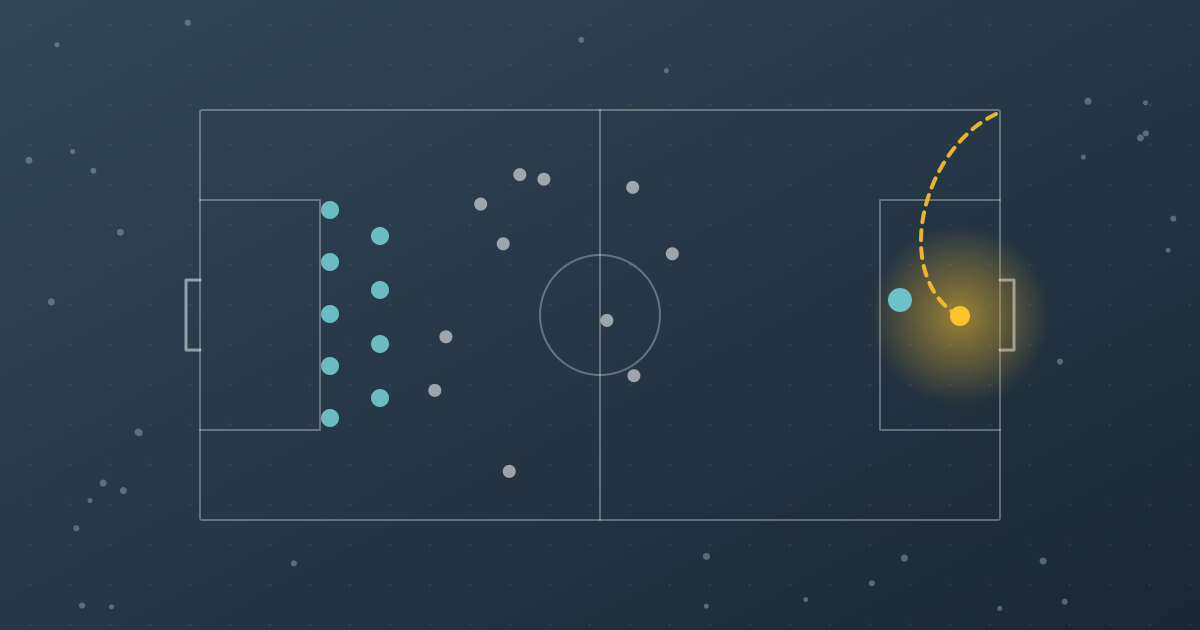
- A large circle of many teal dots and a small circle of a few gold dots face each other on an even grid of mist-blue lines, and the gold dots are pushed back field by field
- Then the grid tips away, revealing a field of narrow, winding lines and slim gates, in which the large circle gets stuck while the gold dots glide freely through
How the principle shows up in practice
The mujahideen in Afghanistan
From 1979 to 1989, they fight the Soviet army as guerrillas in the mountains, with ambushes and plenty of time. In February 1989, the last unit withdraws, at an enormous price for Afghanistan.
Greenpeace and Amchitka
In 1971, an old fishing boat sets out against a U.S. nuclear test. The boat is intercepted, but the public impact is great, and the test remains the last one on the island.
Otto Rehhagel and Greece
At Euro 2004, the outsider relies on organization, fighting spirit and headers instead of beautiful soccer and becomes European champion.
Which game do you choose?
Get your profile across all 12 groups in about 10 to 15 minutes.
Start the Strategy CheckGroup 7: People, Morale and Power
Guiding question: What moves people to go along or to resist?
Stage 4 of 5: Act with others
- TraditionIndirect Strategy and Maneuver
Basil Henry Liddell Hart, John Richard Boyd, Edward N. Luttwak, André Beaufre
- Related principles
Where the 92 principles come from: eight traditions of strategy, from classical war theory to dealing with uncertainty.
More about the originBackground: WEGVISOR’s own selection from the strategy literature · More about the origin