In 2004, Greece travels to the European Championship in Portugal as a rank outsider. Coach Otto Rehhagel does not try to beat his gifted opponents with beautiful soccer. He relies on fighting spirit, organization and set pieces, and wins the title.
A large circle of many teal dots and a small circle of a few gold dots face each other on an even grid of mist-blue lines, and the gold dots are pushed back field by field. Then the grid tips away, revealing a field of narrow, winding lines and slim gates, in which the large circle gets stuck while the gold dots glide freely through.
Principle #56
Asymmetry: The weaker side does not win by playing the stronger side’s game better, but by choosing a different game in which that strength counts for little.
4 min read5 sectionsSituationLink to the principle
Contents
In a soccer tournament, it looks as if everyone is playing the same game by the same rules. And yet it can be played in very different ways. In 2004, Otto Rehhagel demonstrated what Asymmetry means in sports: if you are technically inferior, you don’t win by imitating the others’ technique but by shifting the game toward what you can do yourself.
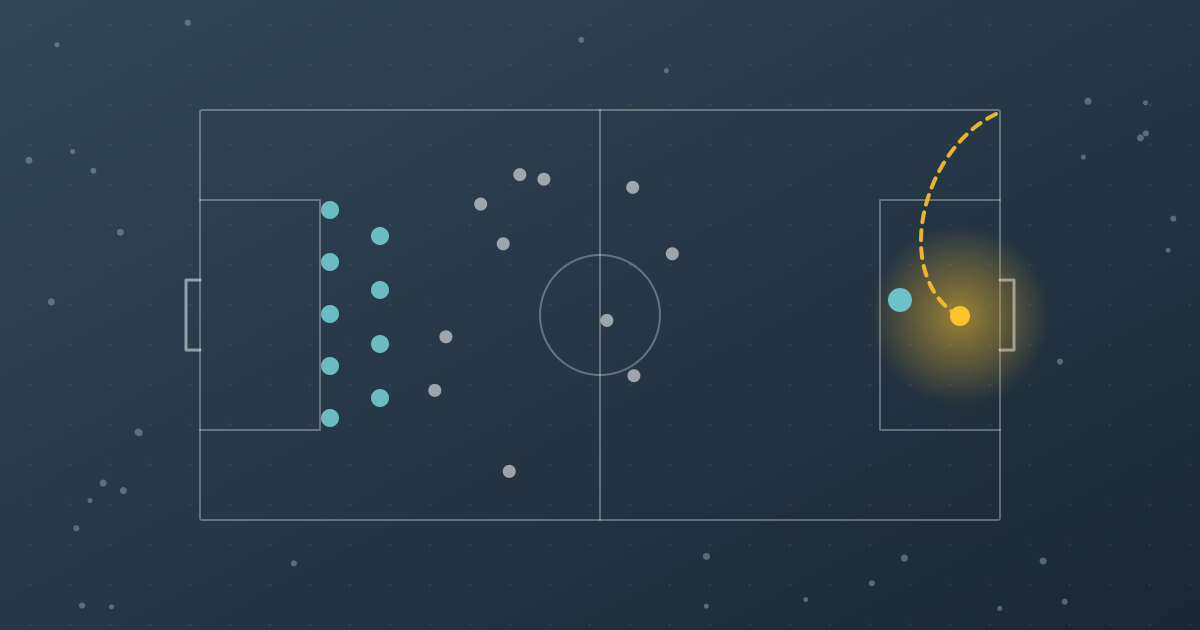
Two dense rows stand in front of their own goal, and a golden arc flies from the corner into the net – like Greece under Otto Rehhagel.
01
An outsider without a tournament win
Situation
Before 2004, Greece had not won a single one of its six games at major tournaments: five losses and one tie at the 1980 European Championship and the 1994 World Cup. Under Otto Rehhagel, a German coach in charge since 2001 after a long career in the Bundesliga, above all at Werder Bremen, the team wins its qualifying group. At the start of the tournament, it is considered a rank outsider, with bookmakers offering odds of between 100 to 1 and 150 to 1.
Link to the principle
The starting position is clearly asymmetric. Players such as Luís Figo, Cristiano Ronaldo or Zinédine Zidane’s France are technically superior. If you compete with them on possession and passing combinations, you are playing their game. Rehhagel chooses a different one.
02
A plan built on the team’s own strengths
Situation
Rehhagel relies on what his squad can do: center backs who are strong in the air, another strong header of the ball up front, counterattacks down the wings. Size, physical robustness and set pieces take priority over flair. The basic formation adapts to the opponent’s attack, with man-marking and an extra man at the back as a sweeper.
Link to the principle
Asymmetry means not just “different” but “different on the basis of your own strengths.” Rehhagel does not ask how a good team ought to play but what this team can do better than its opponents. Headers from set pieces are a field on which technical superiority helps little.
03
The opponent determines the shape
Situation
In the opening game on June 12, 2004, Greece beats the host, Portugal, 2–1. A 1–1 tie with Spain and a 2–1 loss to Russia follow, which is enough to reach the quarterfinals. There, on June 25, Greece beats the defending champion, France, 1–0, with Angelos Charisteas scoring with a header from a cross. In the semifinal on July 1, the team beats the Czech Republic with a headed goal by Traianos Dellas in extra time, the only silver goal in the history of the European Championship.
Link to the principle
The team adapts its shape to the opponent, not the other way around. It takes away the space in which the stronger side shines and waits for its own chance. The goals come on the field Rehhagel has chosen: headers.
04
The final
Situation
On July 4, 2004, Greece meets Portugal again, at the Estádio da Luz in Lisbon. Against Portugal’s lone center forward, Rehhagel switches to a back four and still keeps the extra man at the back. In the 57th minute, Angelos Charisteas heads a corner from Angelos Basinas into the net. Greece wins 1–0 and becomes European champion.
Link to the principle
In the final, too, Rehhagel sticks to his logic: deny the opponent its own game and use your own strength at the decisive moment. One goal is enough if you don’t concede any.
05
The price: criticism of “anti-football”
Situation
The title is not only celebrated. Critics fault the unattractive style and old-fashioned tactics, and some speak of a victory for “anti-football.” The tactics writer Michael Cox, by contrast, is quoted as calling it the tactical achievement of the decade.
Link to the principle
If you win asymmetrically, you rarely win beauty contests. The stronger side and its audience often perceive the different style of play as unfair or ugly. That comes with the territory. The question is whether you want to win or to be admired. What remains important: Rehhagel kept to all the rules. Asymmetry means choosing a different game, not breaking the rules.
Key takeaways
Key lessons
01
Don’t ask how the best play; ask what you can do better than they can.
02
Take away the space in which the stronger side shines.
03
Adapt your shape to your opponent, not to your ideal.
04
Expect criticism when you win differently.
05
Play differently, but fairly.
Summary
In 2004, Greece went to the European Championship as an outsider without a single tournament win. Otto Rehhagel did not have his team copy the style of its gifted opponents; instead, he built on organization, fighting spirit and headers from set pieces. With three 1–0 wins in the knockout rounds against France, the Czech Republic and Portugal, Greece became European champion. The example shows how asymmetry works even within fixed rules: by choosing a different game in which your own strength counts.