Unilateral Divorce in the United States and the Best Alternative
Starting in 1970, U.S. states gradually introduce divorce that one spouse can obtain alone. The economists Betsey Stevenson and Justin Wolfers show that, afterward, violence in marriages and suicides among women declined in those states. A better way out also changes relationships that never end.
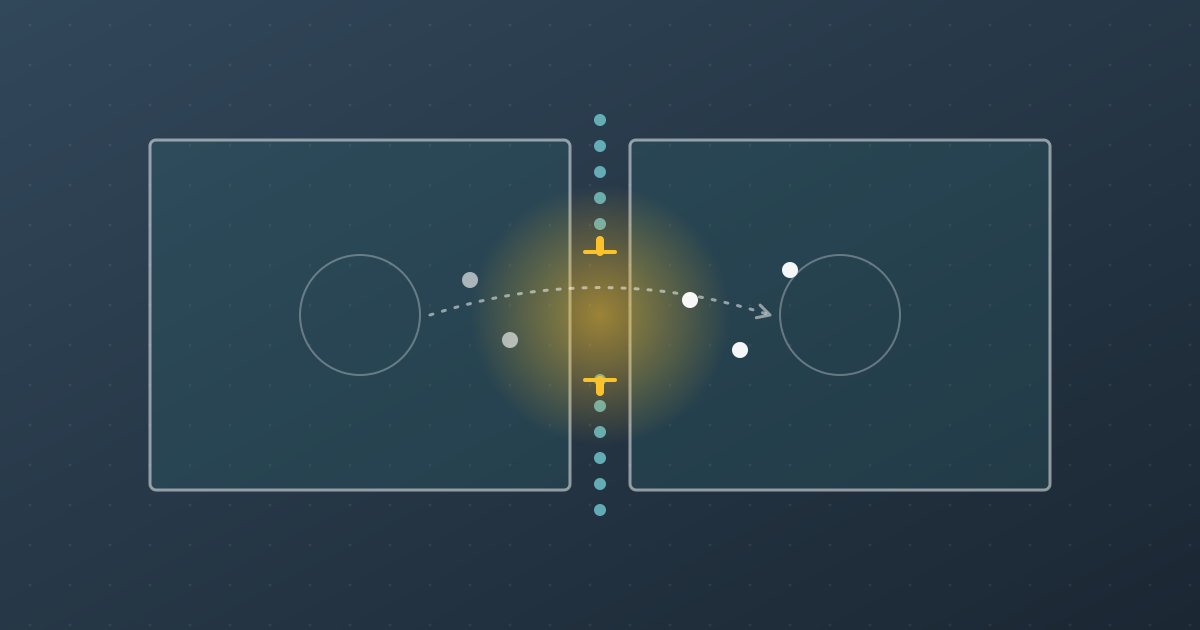
Two dots sit on a horizontal line with a small frame between them as the offer; behind one a gold gate opens into the light, behind the other stands a closed mist-blue line. Then the second dot draws a gate of its own into its line, and the frame moves to the middle.
Principle #69
Best Alternative: Your power in a negotiation depends above all on how well off you are if there is no agreement.
4 min read5 sectionsSituationLink to the principle
Contents
The principle of the Best Alternative sounds like a business negotiation. But it also applies where nobody sits at a table and negotiates: in marriages and families. If you know you could leave, your position in a relationship is different from that of someone who cannot. A legal reform in the United States made this effect measurable. The article touches on serious topics. It describes research findings, not individual lives.
A ring with an open gold gate, inside it two dots with a calm connection – as after unilateral divorce in the United States.
If the topic weighs on you or you are affected yourself, get help. In Germany, the TelefonSeelsorge crisis line is available around the clock and free of charge at 0800 111 0 111 and 0800 111 0 222. The Violence against Women Support Hotline (Hilfetelefon Gewalt gegen Frauen) can be reached at 116 016. In the United States, call or text 988; the National Domestic Violence Hotline is available at 1-800-799-7233.
01
Divorce only with grounds or consent
Situation
Until the 1960s, in most U.S. states you could only get a divorce if you proved the other spouse was at fault, for example through adultery or cruelty, or if both agreed. If you lived in a bad marriage and could not provide proof, you depended on the other’s consent.
Link to the principle
Under these rules, the alternative to the marriage was weak for many. If you cannot leave, you carry little weight in conflicts. The other spouse knows they need not fear the end of the relationship, however they behave.
02
The reform
Situation
In 1970, California became the first state to introduce divorce without proof of fault. Over the next few years, many states followed suit, many of them allowing one spouse to obtain a divorce alone. Because the states reformed at different times, a kind of natural experiment arose.
Link to the principle
With unilateral divorce, every spouse gained an alternative that no longer depended on the other. That changed the situation in every marriage, including the many that never ended in divorce.
03
What research shows
Situation
Betsey Stevenson and Justin Wolfers compared data from the states before and after the reform. Their study appeared in 2003 as a working paper and in 2006 in the Quarterly Journal of Economics. The result: where unilateral divorce was introduced, the number of suicides among women fell markedly, by around 20% in the long run. They found no such effect for men. Domestic violence declined markedly for both men and women. And there are indications that fewer women were killed by their partners.
Link to the principle
The title of the study sums up the principle: “Bargaining in the Shadow of the Law.” The possibility of leaving reaches into everyday life. If you can leave, you don’t have to put up with everything. And if you know the other person can leave, you behave differently.
04
The shadow of the law
Situation
The legal scholars Robert H. Mnookin and Lewis Kornhauser coined the phrase in 1979. They described how couples getting divorced usually settle out of court, but always with an eye on what a court would decide.
Link to the principle
That is the best alternative in other words. Most negotiations never end up in court. But the outcome that would loom without an agreement determines what the agreement looks like. Two years later, Roger Fisher and William Ury put a related idea, the best alternative, at the center of their book on negotiation.
05
What it does not mean
Situation
The study does not say that divorce is good or that marriages should be easier to end. It shows a connection between a change in the law and measurable consequences in families, using statistical methods that have their limits.
Link to the principle
This matters for the principle. A better alternative is not a call to use it. Above all, it protects the weaker party, because it prevents the stronger one from deciding everything. That applies equally in families, churches and companies.
Key takeaways
Key lessons
01
In every relationship, ask who could not manage without the other.
02
Recognize that power often arises from the other side’s lack of an alternative.
03
Strengthen the weaker party by giving them real choices.
04
Remember that alternatives have an effect even when nobody uses them.
05
Don’t confuse having a good alternative with wanting to use it.
Summary
When U.S. states introduced unilateral divorce starting in 1970, every spouse gained a way out that no longer depended on the other. Betsey Stevenson and Justin Wolfers then found fewer suicides among women and less domestic violence. Their result shows how strongly a better alternative changes behavior in a relationship, even if it is never used. Above all, it protects those who previously had no choice.
Sources
NBER: Betsey Stevenson and Justin Wolfers, Bargaining in the Shadow of the Law: Divorce Laws and Family Distress (Working Paper 10175, 2003)
Betsey Stevenson and Justin Wolfers: Bargaining in the Shadow of the Law: Divorce Laws and Family Distress. In: Quarterly Journal of Economics 121 (2006), No. 1, pp. 267–288.
Robert H. Mnookin and Lewis Kornhauser: Bargaining in the Shadow of the Law: The Case of Divorce. In: Yale Law Journal 88 (1979), pp. 950–997.
Back to the basics
Read what lies behind the Best Alternative: with explanation, animation, video and research.