The principle in detail
Three steps through the principle: grasp it, place it, put it to work. Open each topic on its own.
The core messageCore statement and 3 clarifications
Whoever acts first determines what is being discussed. Those who only react take their cue from someone else’s moves.
- It does not say
- That every first step is wise. Carl von Clausewitz considered defense the stronger form of war, and in markets the first mover does not always win.
- It does not say
- That a frantic counterstrike is initiative. It remains a reaction.
- It also says
- Initiative has to be sustained. If you slacken after the first step, you hand it back.
The explanationInitiative works because it shifts who dictates the course of events.
- Initiative works because it shifts who dictates the course of events.
- The other side has to respond, and if you set out, you learn things that stay hidden while you wait.
- Often those who had hesitated until then follow as well.
- But initiative does not mean charging ahead blindly, and without coordination it can split a team.
Which topic will you put on the agenda yourself before a crisis puts it there for you?
The signs3 signs when you heed it · 3 when you overlook it
- You put topics on the agenda before they turn into a crisis.
- You start difficult conversations yourself.
- After the first step, you follow up and coordinate with those affected.
- Your agenda is filled with complaints, deadlines and other people’s requests.
- You wait until someone makes a proposal and then wrestle with it.
- Or you charge ahead without asking those who have to come along.
The backgroundTradition T1 Classical Theory of War
- 1926OriginJohn Frederick Charles Fuller
The Foundations of the Science of War
- 2001SupplementedMichael Frese and Doris Fay
Personal Initiative: An Active Performance Concept for Work in the 21st Century
- Tradition T1TraditionClassical Theory of War
Carl von Clausewitz, Antoine-Henri Jomini, Helmuth von Moltke the Elder, Frederick William Lanchester
See the tradition on the Origin page
Read more: the full background
From the principles of war of John Frederick Charles Fuller, summarized in “The Foundations of the Science of War” (1926). Supplemented by U.S. operations doctrine and by Michael Frese and Doris Fay’s research on personal initiative.
The research3 sources: 1 classic, 1 theory, 1 review · 1926–2001 · with limitations of the research
- weak
- moderate
- strong
Research on personal initiative supports the value of self-starting, proactive action; that the first mover determines the topic and the rules is a principle of military doctrine without measurement.
- 2001Michael Frese and Doris Fay
“Personal Initiative: An Active Performance Concept for Work in the 21st Century”: personal initiative as self-starting, proactive and persistent behavior; links with performance and entrepreneurial success.
- currentU.S. Army, Field Manual 3-0
Operations doctrine (“Operations”): the initiative is to be seized, retained and exploited.
- Carl von Clausewitz considered defense the stronger form of war (Principle 37).
- If you attack without need, you can overextend yourself, and in markets, too, the first mover is not always the winner (Principle 78).
- Initiative without coordination can split a team or bypass superiors where unity of command would be needed.
- Michael Frese and Doris Fay’s research measures self-starting action at work, not the advantage of the first move in a contest.
Read more: what research shows
The British general and military theorist John Frederick Charles Fuller set out principles of war in the early 20th century, among them offensive action, and summarized them in 1926 in “The Foundations of the Science of War.” In 1921, the U.S. Army adopted a modified list; its field manual FM 3-0 still requires that the initiative be seized, retained and exploited. Fuller is a controversial figure because he joined the British fascist movement in 1934. Work psychology asks a different question: in 2001, Michael Frese and Doris Fay described personal initiative as behavior that is self-starting, proactive and overcomes obstacles. The research they summarize shows links with performance and entrepreneurial success.
The related principles37 Strength of the Defense · 40 Freedom of Action · 41 Speed · 78 First Movers and Followers
To go deeper, see 40 Freedom of Action (initiative secures the freedom to decide for yourself) and 41 Speed (speed is often the means to win it and keep it)
78 First Movers and Followers shows when the first mover wins in markets and when the second does
It stands in tension with 37 Strength of the Defense: not every first step is wise
Read more: the full text
To go deeper, see 40 Freedom of Action (initiative secures the freedom to decide for yourself) and 41 Speed (speed is often the means to win it and keep it); 78 First Movers and Followers shows when the first mover wins in markets and when the second does. It stands in tension with 37 Strength of the Defense: not every first step is wise.
The action steps5 things you can actually do
- Look at your last three meetings: how many topics did you put on the agenda, and how many came from outside?
Choose a topic that you can see coming toward you, and raise it yourself this week with a first proposal.
- On contentious questions, write the first draft. Whoever writes the draft gives the discussion its structure.
After every first step, plan the second one right away so that the initiative does not slip back.
Clarify beforehand whom you need to coordinate with so that your move does not split the team.
The reflection questions3 questions: Which topic is sure to come your way in the coming months, and what would your first step be?
- Which topic is sure to come your way in the coming months, and what would your first step be?
- In which contest are you currently playing by rules that someone else has set?
- Whom would you need to involve so that your move brings others along rather than going around them?
Take your time with one question. Write down your answer – or talk it over with someone you trust.
The picture to rememberThe animation once more, with an explanation
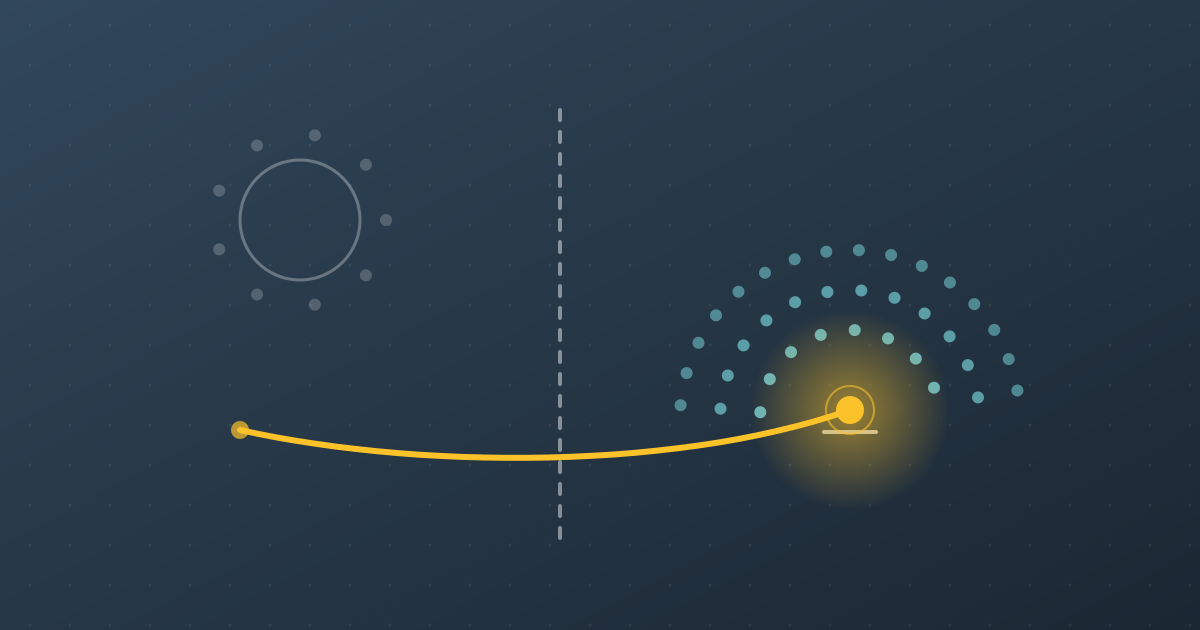
- Two dots stand on a field of fine mist-blue lines
- One of them sets a golden circle, and the lines align with it and close in on the space of the silent dot
- Then a small dot in the corner sets a golden circle of its own, and the lines turn toward it
How the principle shows up in practice
Anwar Sadat in Jerusalem
In 1977, Sadat did not wait for a peace conference but traveled to Jerusalem and forced Israel to respond; the path led to the peace treaty of 1979.
Martin Luther, the 95 Theses
In 1517, Luther set the topic, followed up with writings in German and left Rome chasing after him with lengthy proceedings.
Bertha Benz, the drive to Pforzheim
In 1888, without her husband’s knowledge, Bertha Benz proved with a long-distance drive that the motor car worked, and so shifted the burden of proof to the doubters.
Which topic will you set first?
Get your profile across all 12 groups in about 10 to 15 minutes.
Start the Strategy CheckGroup 6: Time and Tempo
Guiding question: When do you act, and how fast?
Stage 3 of 5: Choose the path
- TraditionClassical Theory of War
Carl von Clausewitz, Antoine-Henri Jomini, Helmuth von Moltke the Elder, Frederick William Lanchester
- Related principles
Where the 92 principles come from: eight traditions of strategy, from classical war theory to dealing with uncertainty.
More about the originBackground: WEGVISOR’s own selection from the strategy literature · More about the origin