The principle in detail
Three steps through the principle: grasp it, place it, put it to work. Open each topic on its own.
The core messageCore statement and 3 clarifications
Whoever competes for the same things as you is your most likely rival. Whoever has the same problem with your rival is your most likely partner.
- It does not say
- That neighbors must remain enemies. With shared rules and trust, neighbors can become friends too, as the Franco-German friendship after 1945 shows.
- It does not say
- That an alliance is justified simply because it is useful.
- It also says
- If you strengthen a distant ally too much, you turn them into your new neighbor and rival.
The explanationThe mandala is a map of temptations, not an obligation.
- The mandala is a map of temptations, not an obligation.
- It shows where tensions are likely and where you will find partners.
- It also warns: a distant ally that you make too strong becomes your new neighbor.
Who lies beyond your rival, and what becomes of them if they grow strong through you?
The signs3 signs when you heed it · 3 when you overlook it
- You know which areas your team competes with for the same resources, and you expect tension there.
- You look for partners among those who have to deal with the same rival.
- Before every alliance, you check how strong your partner will become through you.
- You choose partners because you like them and overlook who is really giving your rival trouble.
- Every time, you are surprised that it is the department next door that blocks you.
- A partner you helped grow big suddenly stands in your way.
The backgroundTradition T2 Eastern Strategy
- 150 BC–AD 300OriginKautilya
Arthashastra, Book 6, Chapter 2
- 1987SupplementedStephen M. Walt
The Origins of Alliances
- Tradition T2TraditionEastern Strategy
Sun Tzu, Kautilya, the Thirty-Six Stratagems, the Tao Te Ching, Miyamoto Musashi, François Jullien
See the tradition on the Origin page
Read more: the full background
From Kautilya’s Arthashastra, Book 6, an ancient Indian textbook of statecraft that took shape in layers between about 150 BC and AD 300 and became known in the West through Rudrapatna Shamasastry’s translation (1915). Supplemented by Stephen M. Walt’s “The Origins of Alliances” (1987).
The research4 sources: 2 primary studies, 1 classic, 1 review · 1971–2013 · with limitations of the research
- weak
- moderate
- strong
A classical teaching without measurement; Stephen M. Walt supports only the claim that proximity makes threats, and therefore rivalry, more likely.
- 1971Thomas R. Trautmann
Statistical analysis of the vocabulary: the Arthashastra has several authors.
- 1987Stephen M. Walt
“The Origins of Alliances”: drawing on alliances in the Middle East from 1955 to 1979, he shows that states tend to ally against a threatening power rather than against the strongest one.
- 2013Patrick Olivelle
“King, Governance, and Law in Ancient India”: dates the layers of the Arthashastra to between about 150 BC and AD 300.
- The mandala describes a world in which proximity means above all competition.
- In a connected world, geography loses weight, and shared rules can overcome old enmities between neighbors.
- The principle backfires when the distant ally is much stronger than you: then they become your new neighbor and rival.
- None of the sources cited tests whether neighbors actually are rivals more often; the Arthashastra sketches a scheme.
- Ethically, the question remains whether every alliance is justified just because it is useful.
Read more: what research shows
The principle comes from the sixth book of the Arthashastra. In Rudrapatna Shamasastry’s translation (1915), the king whose territory directly borders the conqueror’s is called his enemy. The king separated from the conqueror only by this enemy is called his friend. In addition, there are rings at the rear, a middle king who can help either side and a very powerful neutral king farther out. Patrick Olivelle dates the layers of the text to between about 150 BC and AD 300; in 1971, Thomas R. Trautmann concluded from an analysis of its vocabulary that it had several authors. The work contains no measurements. Modern alliance research supports part of it: drawing on alliances in the Middle East from 1955 to 1979, Stephen M. Walt showed that states ally above all against threats, and proximity increases threat.
The related principles59 Six Measures · 60 Balance of Power · 61 Security Dilemma · 63 Co-opetition
To go deeper, see 60 Balance of Power (why the rings close ranks against an overly powerful player) and 59 Six Measures (how you deal with each player in the circle depending on the balance of strength)
61 Security Dilemma shows why neighbors so easily see each other as a threat
63 Co-opetition counters that neighbors can compete and cooperate at the same time
Read more: the full text
To go deeper, see 60 Balance of Power (why the rings close ranks against an overly powerful player) and 59 Six Measures (how you deal with each player in the circle depending on the balance of strength). 61 Security Dilemma shows why neighbors so easily see each other as a threat; 63 Co-opetition counters that neighbors can compete and cooperate at the same time.
The action steps5 things you can actually do
- Draw your situation as circles: your area in the middle, in the first ring everyone who competes for the same resources, in the second ring their neighbors.
In every conflict with a neighbor, ask who has the same problem with them as you do.
Approach these partners about the interest you share, not on the basis of personal liking or shared convictions.
Before every alliance, check how strong the partner will become as a result and whether they will then border on you themselves.
Work with your neighbors on shared rules so that proximity doesn’t inevitably turn into rivalry.
The reflection questions3 questions: Which area are you competing with for the same resources, and who else is competing with it?
- Which area are you competing with for the same resources, and who else is competing with it?
- Which partner did you choose because you liked them rather than because of a shared interest?
- Whom are you currently making so strong that they will soon border on you themselves?
Take your time with one question. Write down your answer – or talk it over with someone you trust.
The picture to rememberThe animation once more, with an explanation
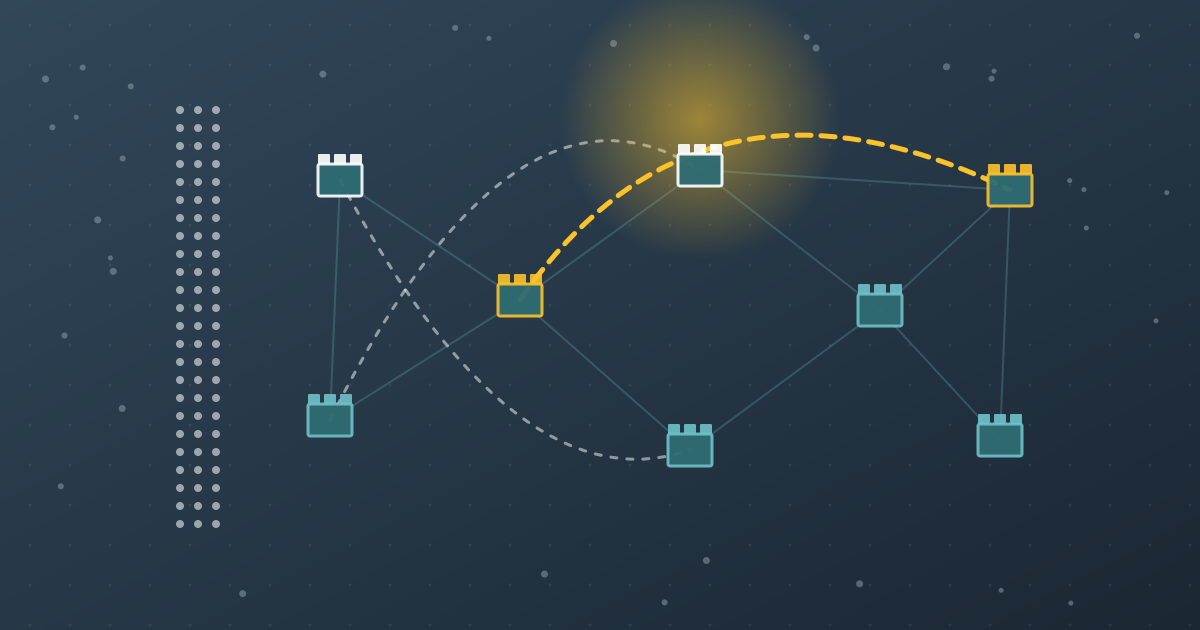
- A golden dot in the middle, around which rings of small circles grow, alternating between teal for rivals and mist-blue for potential partners
- A golden line runs from the center around a circle in the inner ring to a circle in the second ring
- Together they enclose the circle between them, and at the end the partner circle grows, moves inward and turns teal
How the principle shows up in practice
Francis I and Suleiman I
Hemmed in by the Habsburgs, the Catholic king of France allies himself starting in 1536 with the Ottoman Empire, the Habsburgs’ rival in the east, and in doing so shocks Christendom.
Richard Nixon in China
In 1972, the United States moves closer to the People’s Republic of China, the Soviet Union’s estranged neighbor, and so strengthens its hand against Moscow.
Microsoft and Facebook
In 2007, Microsoft invests in Facebook and becomes its exclusive advertising partner. In this way, it strengthens the rising rival of its own rival, Google.
Who lies beyond your rival?
Get your profile across all 12 groups in about 10 to 15 minutes.
Start the Strategy CheckGroup 8: Interaction, Alliances and Negotiation
Guiding question: How do you act when others are in the game too?
Stage 4 of 5: Act with others
- TraditionEastern Strategy
Sun Tzu, Kautilya, the Thirty-Six Stratagems, the Tao Te Ching, Miyamoto Musashi, François Jullien
- Related principles
Where the 92 principles come from: eight traditions of strategy, from classical war theory to dealing with uncertainty.
More about the originBackground: WEGVISOR’s own selection from the strategy literature · More about the origin